

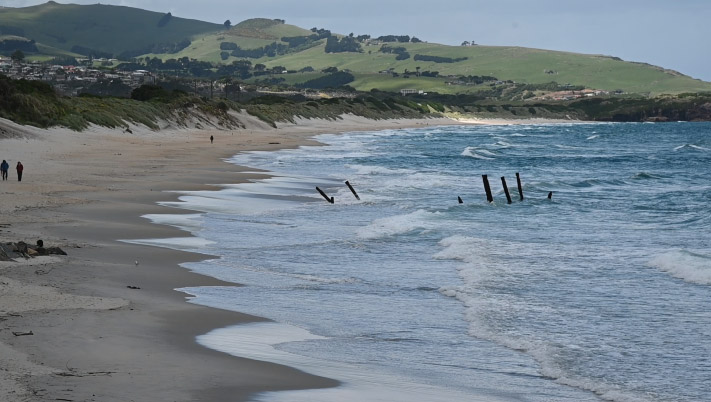
A bid to reinstate a groyne at St Clair Beach in Dunedin without obtaining a resource consent was worth a try, Dunedin Mayor Jules Radich says.
He also remained determined to have the structure rebuilt, despite the project striking a setback at an environmental planning meeting.
"It remains the only thing that has ever worked at St Clair Beach to build up sand," Mr Radich said yesterday.

Dunedin city councillors had hoped consent might not be needed and reinstatement of a groyne might be allowed as a permitted activity under coastal plan rules.
This would have been a less onerous and less expensive path than getting a resource consent, but the Otago Regional Council has not budged from its view consent is required for the proposal.
A pre-application meeting was held last month and the advice issued to the Dunedin City Council was reinstatement of a groyne could not be regarded as a permitted activity at St Clair Beach under coastal management rules.
"This is because the rule does not permit the reconstruction or replacement of those parts of a structure that have been absent for many years," regional council consents manager Joanna Gilroy said.
The last pole in a line that had been part of a groyne disappeared from view in July last year, although stumps could still be seen in December.
Mr Radich had argued the groyne was an existing structure and the city council should be allowed to repair it.
In December last year, the council voted 9-5 to direct staff to "proceed with an application for a certificate of compliance for reinstatement of the St Clair groyne from the Otago Regional Council and if granted proceed with reconstruction in the most cost-effective manner".
Mr Radich said it made sense to first establish if this could be done.
"You’ve got to give it a try, to see if you can do it the easy way first."
Options, likely including pursuing a resource consent, could be presented to city councillors this month.
They had previously been told the consenting process could cost up to $250,000 and take up to a year to complete.
Reconstruction of a single line of poles, planked together, might cost up to $320,000.
Asked if he was disheartened by the result of the pre-application meeting and if it put the project in jeopardy, Mr Radich said "absolutely not".
He remained convinced in his argument and said his interpretation of the coastal plan, that an existing structure could be repaired, was feasible.
However, the document was written and interpreted by the regional council.
"They can see a structure is existing, but the interpretation is the structure is insufficient."


