
PHOTO
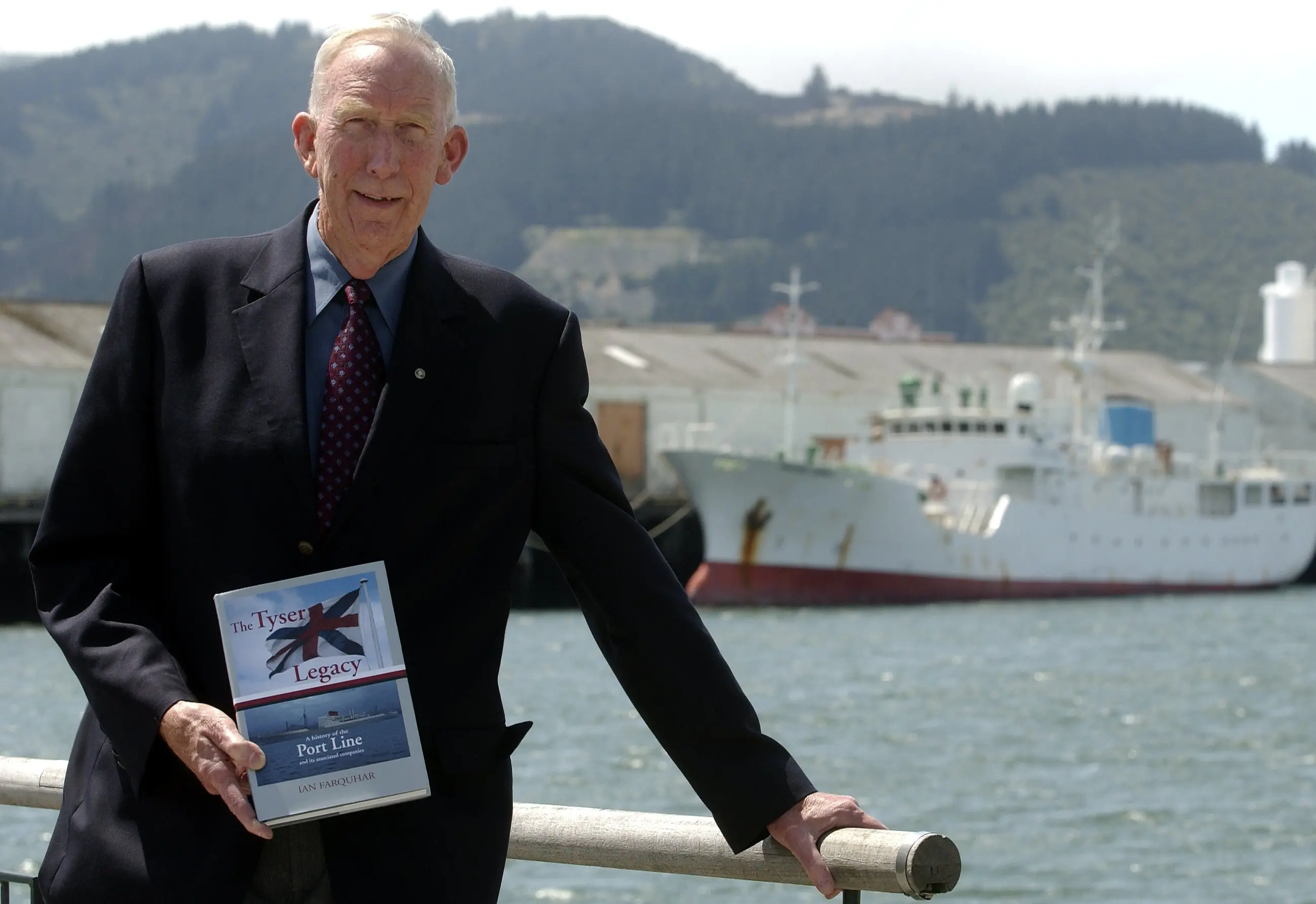
In his early teens, as World War 2 ended, Ian Farquhar became fascinated with the parade of grey-painted ships moving up and down Otago Harbour.
From the family farm at Highcliff he could see the ships in the harbour, and also out to sea passing up and down the coast. He started recording details and studying their histories, and from 1947 he started cycling to the wharves to photograph them.
When he left King’s High School in 1949 he joined Tapley Swift Shipping Agencies as office boy, and remained with the company all his working life, retiring as managing director in 1995.
Following his school days he used a camera which took postcard-size prints and in the 1950s-60s he corresponded extensively with other shipping enthusiasts around the world and endeavoured to establish complete fleet lists of the principal Australian and New Zealand shipping companies and the overseas lines that traded to Australasian ports.
In 1955 he bought a valuable photograph collection of steamships built up by Captain Walter Lee of Adelaide, and throughout his lifetime he continued to add new images. He actively used the collection to promote the preservation of maritime history by donating images to many authors.
Since 1951 over 2660 photographs from the collection have been used to illustrate many books published in New Zealand, Australia, Canada, United Kingdom and Germany.
He was also an active researcher and writer of shipping history and had over 300 articles published in maritime journals in Australia, Germany, New Zealand and the United Kingdom. He was the most prolific contributor of articles to New Zealand Marine News, being an Honorary Vice-president of the NZ Ship & Marine Society since 1958 and was accorded Honorary Life Membership in 2001.
Mr Farquhar was also a significant contributor to the Australian quarterly magazine The Log since it its establishment in 1954 and served as the New Zealand representative of the Nautical Association of Australia from 1968-2013; he was president of the Australian body from 2001-03.
He was also a member of several other maritime organisations around the world and he had an international reputation for his maritime knowledge, not only of the history of merchant ships, but also in the business of shipping and world trade.
He was a member of the World Ship Society of the United Kingdom from 1949 and the Steamship Historical Society of America from 1951, the New Zealand representative for the World Ship Society from 1950-59 and a member of the United Kingdom committee from 1954-59.
Apart from his writing, he also conducted three University of the Third Age courses on shipping history in 1999, 2004 and 2008.
Mr Farquhar wrote a number of books, the more significant publications being three editions of Union Fleet, a concise history of the Union Steam Ship Company of NZ Ltd and its ships; Jack of All Trades, Master of None, the history of the Shipping Corporation of New Zealand; Howard Smith Shipping-Enterprise & Diversity, a history of the Australia’s oldest shipping company, Howard Smith Ltd, and The Tyser Legacy — a history of Port Line and its associated companies.
He was a co-author of Crossed Flags, a history of NZ Shipping Company and the Federal Steam Navigation Company, and also Huddart Parker — A Famous Australasian Shipping Company 1876-1961.
Mr Farquhar was a meticulous researcher, and as a shipping historian he had the advantage over most other maritime writers in fully understanding the business of shipping, and whether companies or ships were profitable for their owners.
This aspect enhanced his reputation as a maritime historian and was reflected in The Shipping Interests of John Jones published in 2014. In addition the authors of over 110 books have acknowledged his contribution to their own research.
His writing was totally charitable and for all his shipping books published he donated the text and illustrations to either the NZ Ship and Marine Society in New Zealand, or the Nautical Association of Australia in Melbourne, so that any surplus on the sale of books would accrue to the benefit of each organisation’s aims and objects.
Over 65 years he voluntarily helped hundreds of people seeking information on their family, and the ships that they travelled to New Zealand on. Although his main interest was shipping from the age of steam, he jokingly used to say that he was forced into sail by the genealogists.
Mr Farquhar was the first New Zealander to sit the examinations of the Institute of Chartered Shipbrokers, London and in the final examination in 1958 he was seventh in order of merit and the top overseas candidate. He was elected a Fellow of the Institute in 1992 and was eventually appointed a Life Fellow.
He became a Fellow of the Chartered Institute of Logistics and Transport in New Zealand in 1985 and was honoured with Life Membership of the Institute in 2007. In 1984 he was invited to join the New Zealand Association of Waterfront Employers as the representative of the New Zealand stevedoring industry and remained on this council throughout the period of port reform from 1984-89.
He was active with a number of other industry bodies including terms on the management committee of the New Zealand Port Employers Association from 1988-92, and was President of the New Zealand Stevedoring Employers Association in 1988-89. He was on the council of the Otago Chamber of Commerce from 1972-90.
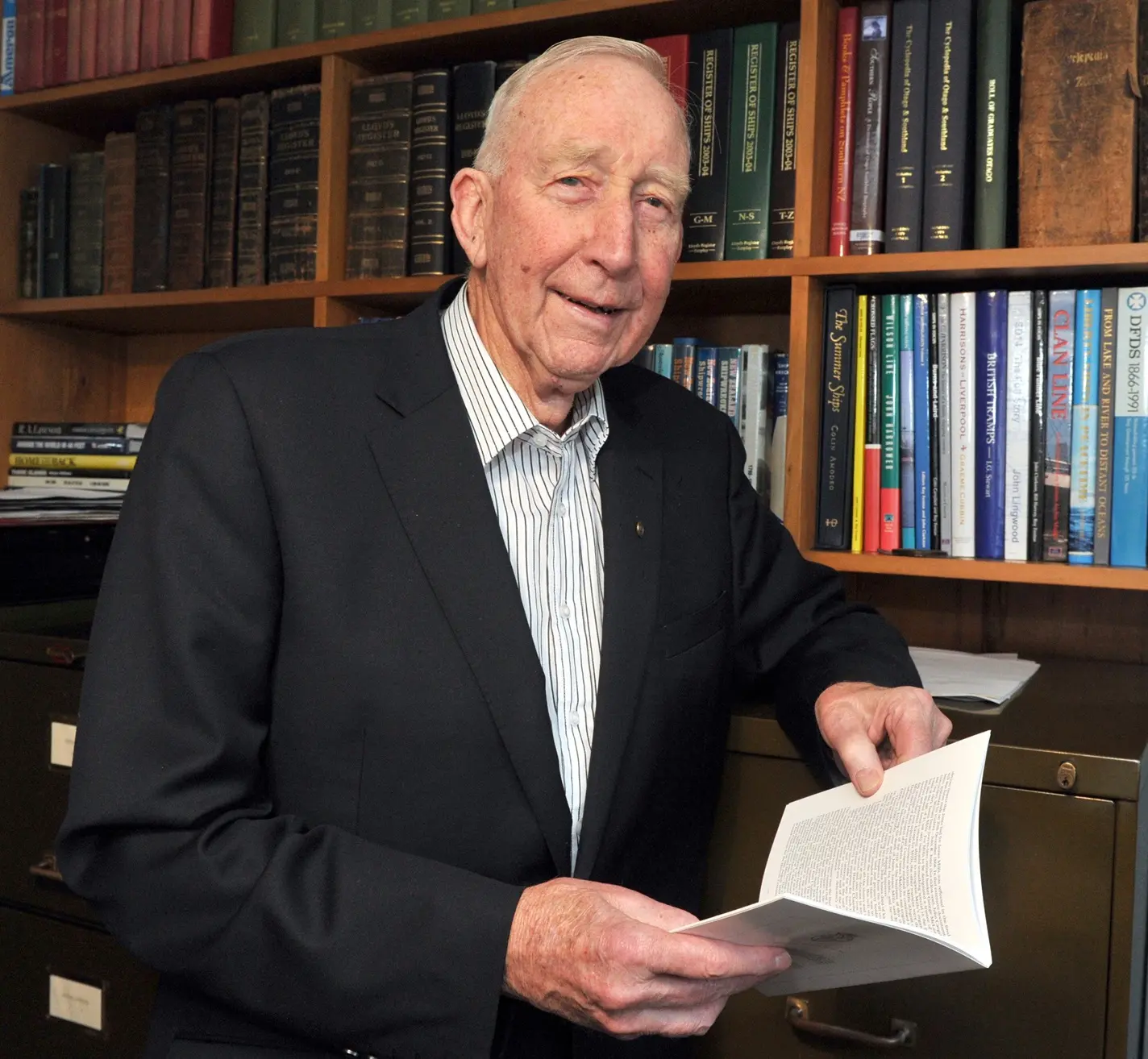
In 1971 Mr Farquhar was elected a member of the Otago Harbour Board and subsequently was successful in five more elections, serving a total of 18 years on the board. He topped the poll in three of the elections and was chairman of the Board from 1981-83.
When publicly elected harbour boards were converted to public companies, he was the first director appointed to the board of Port Otago Ltd in 1988, and he remained a director of the company for 12 years, serving as chairman from 1998-2001. His 30-year tenure on the board of the Port Authority has not been exceeded by any other member in the history of the port.
He was also a director of several other companies including the Otago Farmers Co-op Association from 1971-74, Reid Farmers from 1974-2000 (serving as deputy chairman from 1992-2000), and on its associated companies, as well as Tapley Swift Shipping Agencies from 1988-2014.
He was elected a Fellow of the New Zealand Institute of Directors in 2002 and was honoured with a Distinguished Fellowship in 2007.
Mr Farquhar was Honorary Consul for Sweden from 1989 to 1997 and for his services he was awarded the Royal Order of the Polar Star by the Swedish Government for his services in 1997.
In 2012, The New Zealand Company of Master Mariners made him an Honorary Member in recognition of his outstanding services to the company and the maritime industry in New Zealand.
He had a host of other involvements including serving on the management committee of the Otago Seafarers Society (later the Otago Seafarers Charitable Trust) from 1953, and was active at the national level as the resident director in New Zealand of the British and International Sailors Society, Southampton from 1985-2006, as the Otago director of the International Sailors’ Society, New Zealand from 1979-2004 and being elected Patron in 2006.
Through his shipping connections he had an active role with the Dunedin-Otaru Sister City Society from its inception in 1980 and in 2000 he received a commendation from the Mayor of Otaru for his contribution to the Sister City link.
In 1954 he joined the Committee of the Shipwreck Relief Society of New Zealand (now the NZ Shipwreck Welfare Trust) and subsequently served as national secretary from 1957-98, then as managing trustee of the trust from 1998-2004. He remained a trustee until 2016 and thus had a 62-year involvement with the organisation, with over 50 years as the administrator.
He was a co-founder with Doug Wright of the Otago Maritime Society in 1963. The society was established so local people interested in ships and shipping could meet on a regular basis. The society, jointly with the Otago Museum, created the Maritime Hall, which was opened in 1973 — the most comprehensive set of ship models in any one venue in Australasia.
Mr Farquhar supplied much of the historical material for the captions for each model and in recent years he has worked with museum staff in upgrading and enhancing the displays.
In acknowledgement of their individual contributions to community and welfare organisations, Mr Farquhar and his wife Shirley (nee Clark) were both awarded Queen’s Service Medals in 1989.
The couple married in 1960 and they had one son and two daughters.
Mr Farquhar began an association with the Hocken Library in 1963 and subsequently became a significant donor of maritime and company records. He was the first president of the Friends of the Hocken Collections when it was established in 1991 and remained in this role until 2002 when he took over as secretary, finally retiring from the committee in 2010.
In 2007, the University of Otago admitted him as an Honorary Fellow of the Hocken Collections.
His maritime collection of shipping photographs is the most complete collection of Australian and New Zealand shipping within Australasia. It was bequeathed to the Hocken Collections.
In 2013, Mr Farquhar lodged 252 books with the Hocken Collections as well as extensive shipping archives occupying some 30 shelf metres. Because of his shipping knowledge he was constantly asked to help people seeking shipping information.
He joined the Rotary Club of Dunedin South in 1967, becoming President in 1978 and serving as District Chairman of the Rotary Foundation from 1980-82. He played an active role in the affairs of the club, being honoured with a Paul Harris Fellowship in 1987, and this was augmented with a Sapphire pin in December 2000 and after his retirement, a two-Sapphire pin in June 2013.
All Mr Farquhar’s life he lived on the same site at Highcliff that his grandfather had bought in 1867. He built the third house on the property in 1973.
He died on September 22, aged 94. — Supplied