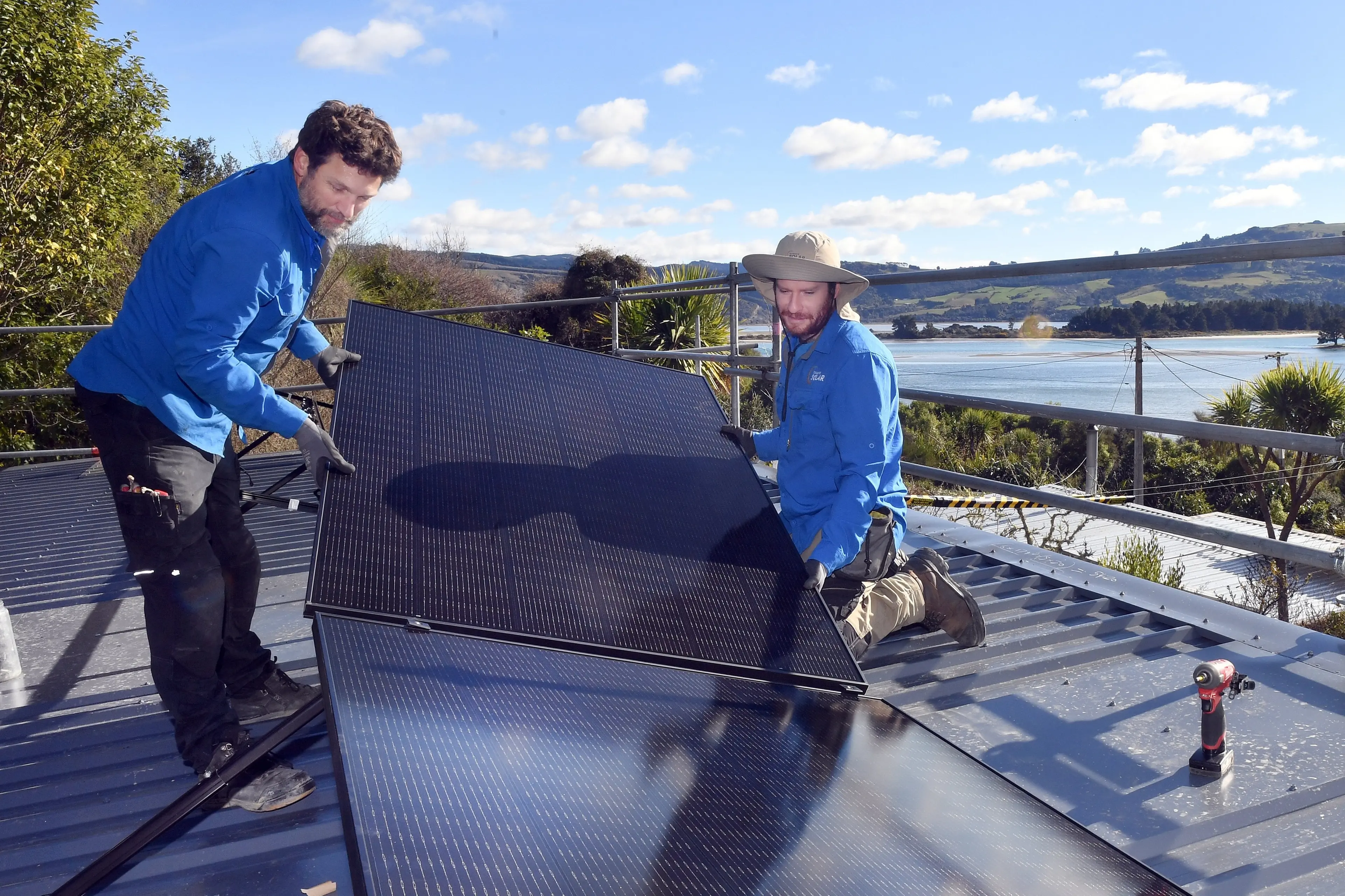
Demand is going through the roof for solar power in Dunedin, and higher electricity prices are driving the uptake. The government announced this week it had agreed to make residential and small-to-medium scale solar panel installation in New Zealand the simplest in the developed world. Think Solar Dunedin director James Kettle said there had been a significant increase in demand over the past 12 months. “Inquiries have increased by approximately 300% compared with the previous year, while our completed installations have increased by around 400%. We have also had a broader range of customers now considering solar with more interest from landlords, commercial businesses and people building new homes, alongside the traditional residential market,” he said. Rising electricity prices had been a major driver. “Over the past six months, in particular, we have seen more homeowners looking for ways to take greater control of their energy costs. “Rather than simply trying to reduce their electricity consumption, people are looking at how they can generate and use their own electricity to reduce their reliance on the grid.” An average installation costs within the range of $18,000-$25,000 for solar only, or $30,000-$40,000 for solar and battery storage. “While upfront cost is an important consideration, we are increasingly seeing customers look at solar as a long-term investment in their energy costs and energy independence.” Mr Kettle said Dunedin and the wider Otago region had areas more favourable for solar than others, with good access to sunlight and limited shading. “The idea that you need to live in a particularly sunny part of the country for solar to be worthwhile is a misconception. For the majority of homes and businesses across Dunedin and Otago, there is an opportunity to make solar work effectively.” Prices have increased slightly since the beginning of the year due to changes across the supply chain. “What we have seen is a growing number of initiatives designed to make the transition to renewable energy more accessible.” There has been a significant increase in demand for battery storage. “Customers are recognising that generating solar power during the day is only part of the equation. A battery allows them to store that energy and use it when they actually need it, particularly in the evening when household electricity consumption is often at its highest. “Ultimately, we are seeing a shift in how people think about solar. It is no longer simply about putting panels on the roof to reduce a power bill. Aurora Energy customer and commercial services general manager Mark Pratt said most households in Dunedin could install rooftop solar to power their homes as well as export surplus energy back into the electricity network, which would reduce their energy costs. The company said it had 1278 solar connections on the Dunedin network — increase of 26% in the past 12 months.