
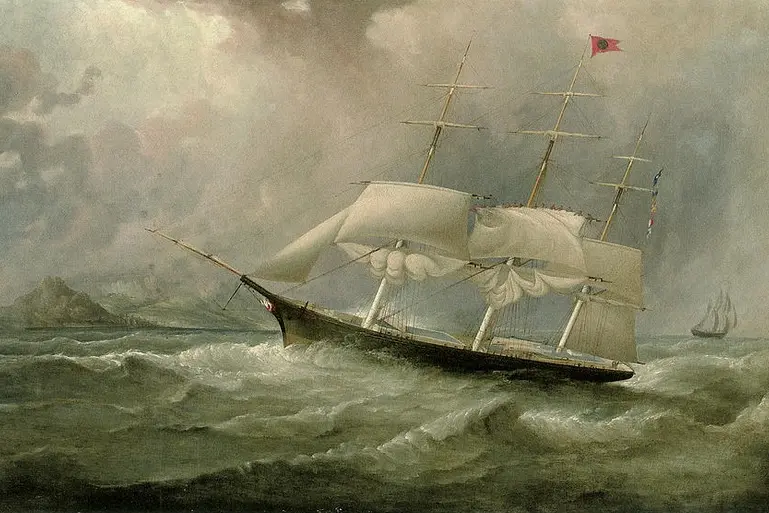

PHOTO
The Star reporter Sam Henderson delves into the archives to unearth tales of crime, corruption and scandal in the settler south.
It is 12.30am on January 23, 1862.
Third officer J. Moseley smells smoke aboard the clipper Ocean Chief, lying in Bluff Harbour.
He goes forward and finds it issuing from the fore hatchway.
As Mr Moseley gives the alarm, second officer Charles Marsh goes below.
The fire is in the lower hold, in the sheep pens on the starboard side.
Hoses from the fire engine pumps on board are run out and put below, but they do not work.
These pumps are designed to suck seawater up so it can then be directed towards the flames.
Crew members pass water down in buckets but the hay ignites in every pen and the hold has to be abandoned.
The ship becomes a mass of flames rushing up the hatchways, half as high as the tops.
The master of Ocean Chief, Captain William Brown, orders sails to be spread over the hatches and ventilators.
By 2am, some express confidence the ship can be saved.
But a boy hauling a bucket over the bows hears air escaping from a suction pipe used to pull seawater from the ocean up into the fire pumps.
Chief officer Wright goes over the side and sees three holes have been deliberately bored into the pipe, preventing the equipment from creating suction and causing it to pull air instead of water.
The intake line of the aft fire engine is found to have intentionally drilled holes as well.
About 3am the fire is roaring tremendously in the hold and Capt Brown orders her scuttled, her cables buoyed and slipped.
The vessel is put ashore clear of the narrow harbour entrance.
At 7.30am, the main and mizzen masts go over the side with a fearful crash, the mizzen ripping up the poop.
A solid Oregon foremast of enormous size stands upright to the last, the yards burning off it bit by bit, until the flood-tide extinguishes the smouldering embers and leaves the noble vessel burnt down to her copper.
Ocean Chief was a wooden clipper of 1026 tons, built at Thomaston, Maine, in 1853.
It was owned by James Baines and Co of Liverpool, sailing under the Black Ball Line house flag.
She left Melbourne on January 2 with 4000 sheep for the firm of Thompson and Crispe, arriving on the evening of January 13.
Entering port under a pilot against an adverse wind and ebb tide, with a hard westerly blowing, she was driven ashore close to Tiwai Point.
She was refloated at about 11am the next day, considerably damaged, and berthed at the wharf.
Nine days later she was alight.
As smoke continued to hang over the harbour all day, Capt Brown composed a letter to Capt Andrew Elles, collector of customs at Invercargill.
“I have to inform you that my ship, the Ocean Chief, was set fire to by some of crew (proof still existing) about midnight last night.
“None of the crew have yet left the Bluff and it is possible, in my opinion, that by using most strenuous exertions, the perpetrator of this wicked act may be caught and punished.”
Invercargill police magistrate Matthew Price arrived with a large force of troopers to try to prevent the escape of the delinquents.
The Southern News reported it was supposed the cause of the sabotage was a desire on the part of some of the crew to desert.
Gold had been found at Gabriel’s Gully the previous year and the Otago rush was at its height.
While this was not specifically speculated at the time, the call of potential riches could have tempted some of the crew.
Later accounts directly speculated the men set fire to the ship to free themselves for the diggings and the fortune waiting there.
There could be another reason why some of the crew decided on such drastic action.
Ocean Chief had come off Tiwai Point considerably damaged and was tied up at a wharf at the bottom of the world going nowhere.
Her crew faced weeks of hard work putting her right, for the same wages and the same bunks.
A burnt ship needs no repairs. A crew without a ship is a crew released.
Another possibility was speculated by the Southern News at the time.
The destruction of Ocean Chief came soon after similar disasters to three other large liners in the harbours of Port Jackson and Hobson’s Bay.
Perhaps there was an arsonist that had a connection to all these events.
Capt Brown offered £200 for information to anyone who could give information about how the fire originated, “upon conviction of the party or parties concerned”.
Invercargill police magistrate Matthew Price held a court of inquisition, speaking to 10 witnesses.
A jury including masters of other ships lying in the harbour found Ocean Chief had been wilfully set on fire but that there was not sufficient evidence to prove the guilty person.
On January 27, the Superintendent’s Office posted a further £100 reward for any information that might lead to a conviction, but there was no success finding a culprit.
The mystery remains to this day just what led to the sabotage and burning of the clipper.