
PHOTO
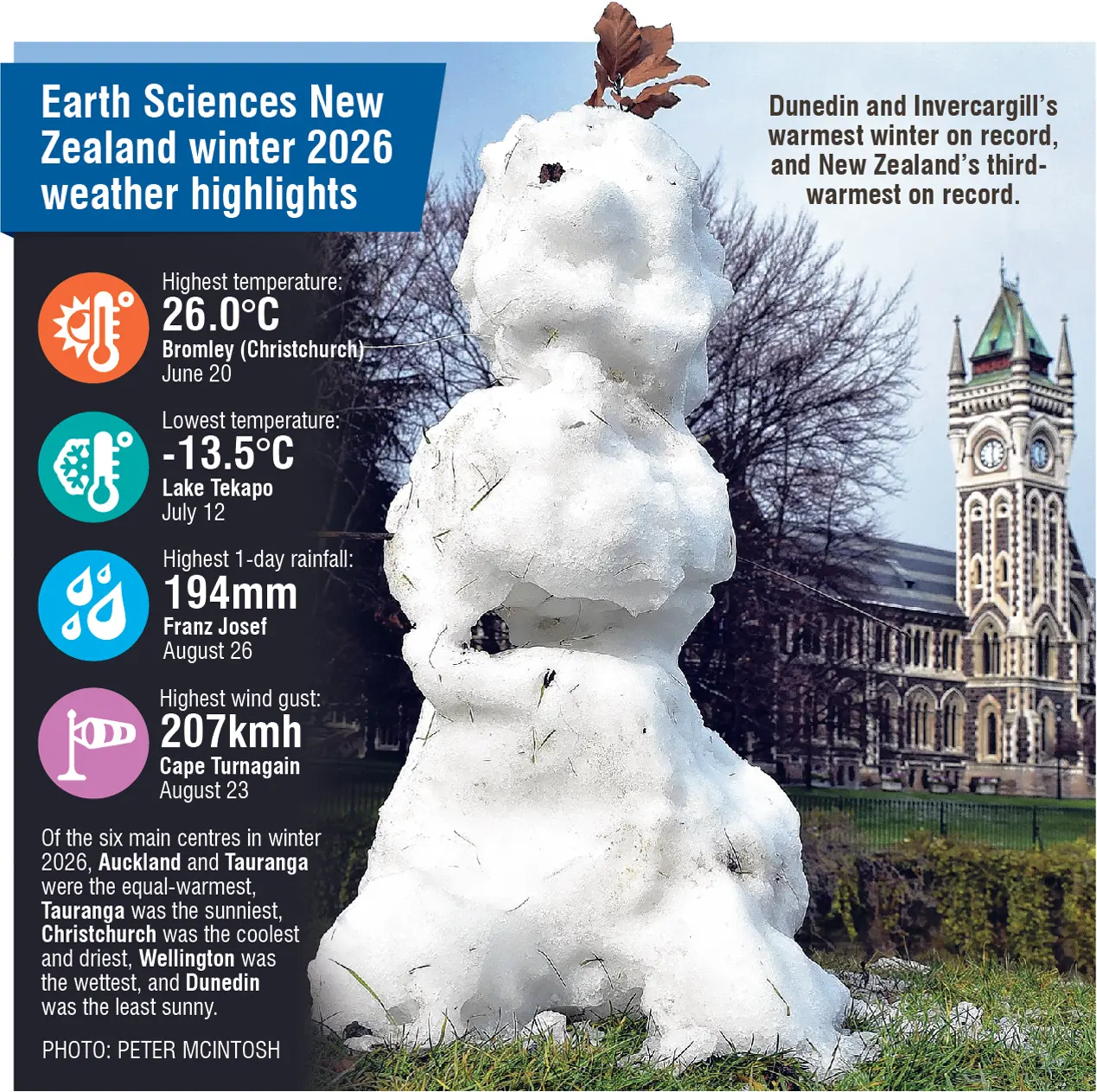
Many across the South may be surprised to learn Dunedin and Invercargill have just had their warmest winters on record, despite the usual polar blasts with heavy rain, snow and severe gales.
Earth Sciences New Zealand climate scientist Gregor Macara said they were among many long-standing records which toppled in Otago and Southland over the past three months.
Winter temperatures in Dunedin (Musselburgh) averaged 8.9˚C (1.6˚C warmer than usual), while Invercargill’s mean was 7.5˚C (1.5˚C warmer than usual).
Mr Macara said 25 other weather stations across the country also observed their warmest winter on record, including Haast (9.7˚C), Milford Sound (8.1˚C), Puysegur Point (10.0˚C), Ranfurly (5.1˚C), Lauder (5.4˚C), Tapanui (6.8˚C), Tautuku (8.3˚C), and South West Cape (9.4˚C).
Oamaru, Middlemarch, Manapouri (West Arm Jetty), Lumsden, Cromwell, Gore, Tiwai Point, Balclutha and Nugget Point also recorded their second warmest winters on record, he said.
Record daily maximum air temperatures for winter were also recorded at Manapouri (Airport) (18.4˚C) and Lumsden (18.9˚C) on June 19, and Clyde had its second-equal highest maximum daily temperature when the mercury hit 20.7˚C on August 25.
Nationwide, it was New Zealand’s third-warmest winter on record, with a nationwide average of 9.7°C, he said.
“This may surprise a large portion of the population, especially in northern areas where winter temperatures were close to average.
“However, the exceptional warmth of June nationwide, and the relatively warm winter throughout the South Island, were the dominant features of the country’s overall seasonal temperature.
“Temperatures were above average or well above average throughout the South Island.”
Rainfall totals were also above normal, or well above normal, for Southland and Otago.
New Zealand’s wettest location relative to normal was Oamaru, where 218% of normal winter rainfall was recorded.
The town observed 285mm of rainfall, making it the town’s third-wettest winter since records began in 1941.
It also had its third-highest winter extreme 1-day rainfall total when 110mm fell on July 5.
On the same day, Dunedin Airport had its highest extreme 1-day rainfall total with 116mm, he said.
“It was a relatively wet winter in Dunedin, with the city receiving 134% of its normal winter rainfall.”
Many other areas around the southern regions also observed near-record levels of rainfall.
Mr Macara said the “impactful heavy rainfall” which occurred in eastern parts of the South Island from July 5-9 prompted three local states of emergency to be declared.
Winds were also particularly strong during June and July, when Manapouri recorded its highest winter extreme wind gust of 81kmh.
Oamaru and Gore recorded their second-highest wind gusts of 93kmh and 126kmh, respectively.
Given the continued strengthening of El Nino conditions, more long-term weather records are expected to tumble in the coming months.
john.lewis@odt.co.nz