
PHOTO
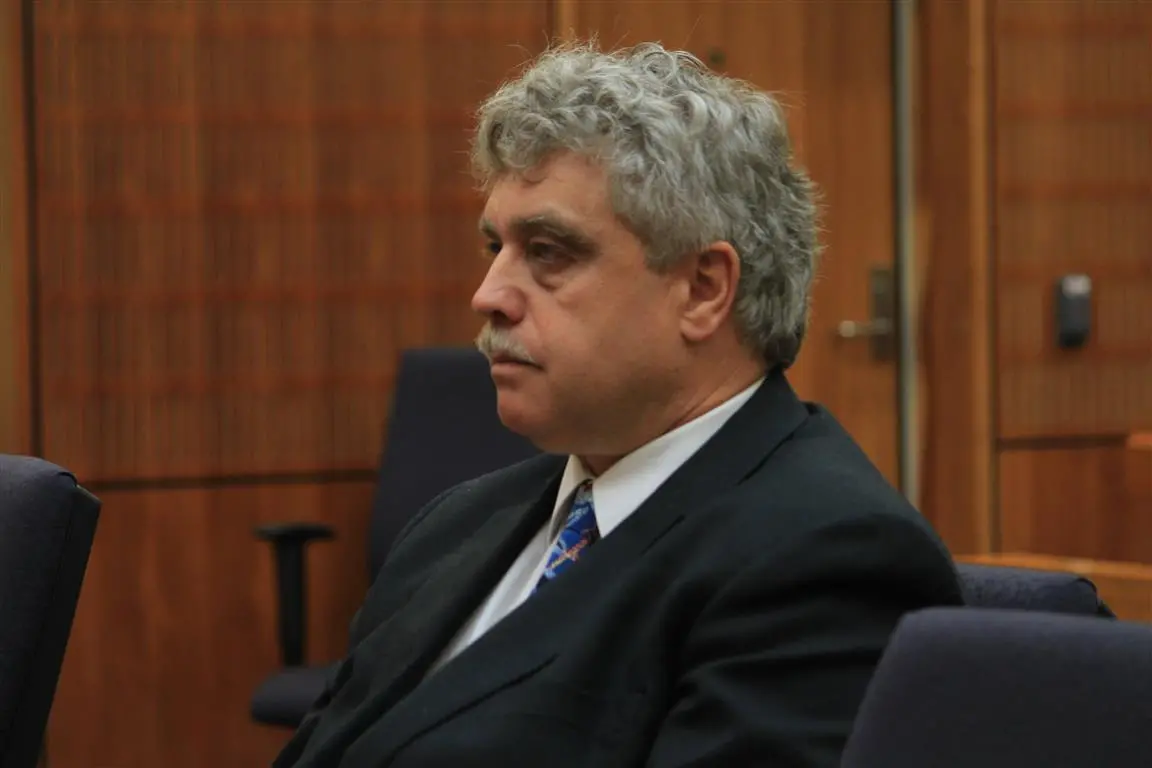
Frank Russell Walmsley stood motionless in court yesterday as he was found guilty of 52 charges against him - including 12 of rape.
His wife and daughter sobbed in the public gallery as the head juror read out the verdicts. As Walmsley was escorted from the High Court at Timaru, his son called out: ‘‘The truth will come out, Dad. Innocent.''
Walmsley (57) turned to look at his family and supporters in the court after Justice David Gendall remanded him for sentencing on June 24, but he said nothing.
During the trial, Walmsley denied all the charges against him. He did not give evidence.
The former Oamaru caregiver was found guilty on 23 charges involving four victims during his time at the Oamaru Child, Youth and Family home from 1995 to 2000.
He was found guilty on 29 charges against four additional victims when he practised alternative medicine as a life coach from 2005 to 2012.
The three-week trial began on April 5. After 13 days of submissions and evidence, the six men and six women of the jury returned with their verdict about 4pm yesterday, following 16 hours of deliberations.
Walmsley's offending began when he was 36 years old.
Walmsley raped two teenage girls and attempted to rape another while at the Child, Youth and Family home, which he ran with his wife, the jury found.
While acting as a life coach, Walmsley repeatedly attacked one victim for several years, starting from when she was under 12 years old. The 13 offences he committed against the girl included representative rape charges from 2005 to 2011.
In total, three of the 52 offences were not sexual in nature: Walmsley was found guilty of assault with a weapon, a dog lead, and two charges of assault.
Aside from the 12 rape charges, Walmsley was convicted of 37 additional sexual offences. They included nine charges of sexual conduct with minors, 13 charges of unlawful sexual connection, and 11 charges of indecency.
Crown prosecutor Andrew McRae said Walmsley held a position of power over vulnerable young people and demonstrated an ‘‘abnormal sexual interest'' in young teenage girls.
His offending followed a pattern. He gave gifts to young girls and typically progressed towards more serious offending with each victim.
Walmsley made girls dress up and he took an interest in uniforms. And he approached girls while they were in the shower.
He was first investigated in 2000, but escaped charges.
Mr McRae argued during the trial that a man investigated for sexual misconduct against a young teenage girl would not put himself in the position of being alone with vulnerable young girls again, unless he meant to reoffend.
All four victims from his period as a life coach told the court Walmsley took naked photographs of them, and while a laptop recovered from his home in a 2014 police search did not contain naked photographs, software was found which could be used to securely delete files.
Another program used for peer-to-peer sharing showed searches for the terms ‘‘vidio (sic)'', ‘‘child'', ‘‘underage'', ‘‘sex'', ‘‘children of the night'', ‘‘videos'', ‘‘pre-teen'', and ‘‘pre-adolescent''.
Victims were also able to describe a black vibrator Walmsley used on them, which belonged to his wife.
Evidence Mr McRae called ‘‘explosive'' was given by Anne Marise Martin, the Child, Youth and Family supervisor responsible for the Oamaru home at the time Walmsley was a caregiver.
Moments before a meeting at the home to address complaints against him, Walmsley pulled her aside to tell her in private he had bought gifts for the victim and devised a story to sneak them into the house without his wife knowing: the police search the night before had made him think.
After a victim came forward while he was acting as a life coach, police renewed their investigation into his time as a caregiver. The original complaints were reinvestigated and three more victims came forward.
Mr McRae said the Crown's case, eight separate victims describing the same or very similar types of things, relied on the ‘‘graphic'', ‘‘unusual'' and ‘‘compelling'' evidence of the victims regardless of whether they could recall ‘‘peripheral details'' under cross-examination.
Defence counsel Craig Ruane questioned the credibility of the Crown's complainants during the trial, calling them troubled children. He said there was a possibility of collusion among the witnesses.
Walmsley faced 82 charges in total, but with 22 alternative charges included on the Crown's charge list, he faced a possibility of 60 convictions. Of the 52 guilty verdicts, 28 were reached by a majority decision.