
PHOTO
The government is moving ahead with its plans to cap the amount councils can increase rates by to a maximum of 4 percent, but won't be able to pass the legislation until next term.
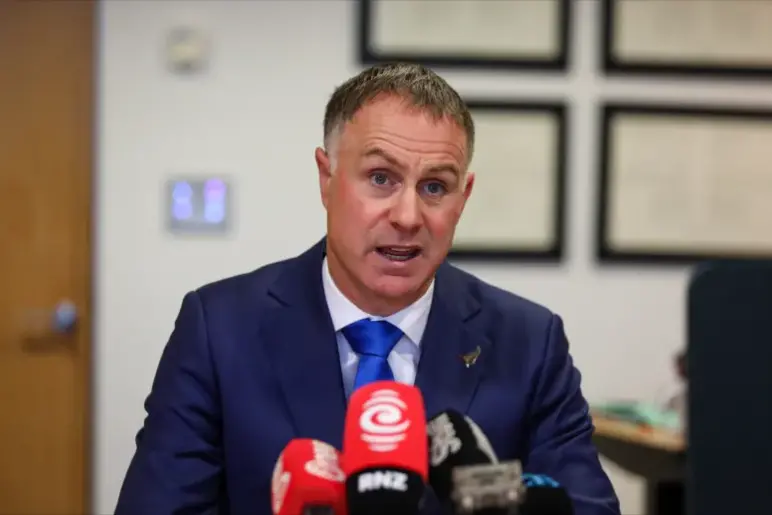
Local Government Minister Simon Watts says the legislation would put "a brake on excessive increases and [give] ratepayers greater certainty", but confirmed the average amount households would save is only $34 a year.
"For too long, ratepayers have been hit with steep and unexpected rates increases, adding pressure to household budgets at a time many New Zealanders are already feeling the squeeze," Watts said.
The changes would also "sharpen the focus on delivering the services communities expect councils to get right, like fixing the potholes, collecting rubbish and running our pools and parks".
Asked if councils had said the policy was achievable and whether the services that communities need can be paid for with this policy, Watts only said that having a "core set of areas of focus" versus was going to be easier for councils.
"As a result of that, then we would expect that that would provide benefits also in terms of the ability for them to reduce spending in particular areas."
Watts said the legislation would be passed "in effect next term", given the limited amount of time before the House rises ahead of the election. If passed, it would come into effect on the 1st July 2029.
He maintained it was "government policy" and had support from National's coalition partners. It comes after those coalition partners have specified they won't support a ban on social media, despite that legislation being announced as government policy.
"With respect, the policy that I'm announcing today is government policy and the coalition partners have been supportive alongside all members of that cabinet," Watts emphasised.
"It has the support of government."
Asked why he wasn't able to get the legislation across the line earlier, in order to pass it before the election, Watts said he'd been working through a comprehensive process and taken time to consider the complex legislation.
On user charges, Watts said they weren't part of the rates cap model. For people going to a public pool or library, it was up to local councils to determine those costs.
"I don't, as Minister of Local Government, get involved in setting charges for how much you pay to go to your local pool."
But he didn't say whether those charges might increase as a result of councils receiving less revenue from rates.
But on Monday, Prime Minister Christopher Luxon had said rates caps were "very important, so you don't have increases in fees and charges".
Watts had to correct that on Tuesday, saying Luxon was referring to the context in which Treasury refers different costs. He said Luxon was referring to what Treasury refers to as "administrative costs", that includes rates.
"The rates cap will not apply to fees and charges on councils; they are explicitly excluded," Watts repeated, saying Luxon had subsequently clarified the comments.
Local Government New Zealand (LGNZ) said in response to the announcement that councils couldn't be expected to deliver "more infrastructure, support growth and meet communities' expectations with fewer levers".
"The maths just doesn't add up and something will have to give," President Rehette Stoltz said.
Stoltz also referenced local government only getting 10 percent of the country's tax take, but being responsible for about a third of all public infrastructure investment in New Zealand.
An Infometrics report for LGNZ in 2025 found the average New Zealand household pays 10 times more towards government taxes than in council rates.
"Introducing a 4 percent cap when councils' costs are increasing at a much higher rate will hamstring already-constrained councils' ability to maintain investment in the services and infrastructure that people rely on them to provide."
Watts disagreed with that, saying everyone had their view.
LGNZ also referenced estimates by officials the rates cap would only save households $34 a year.
Watts confirmed the figure, but said it would depend on the different councils, on average though the number was correct.
"$34 is a savings for households, which is not immaterial. But the important thing here is around certainty," Watts said, and households knowing what was coming in future rates increases.
Stoltz also said the announcement came "hot on the heels" of the National Party ruling out an accommodation levy, which she called a "key tool" that could have helped take the burden off ratepayers.
She said the government was not addressing the drivers of costs, and rather "making things worse by passing on the costs of government reforms to councils and ratepayers."
As part of the announcement, Watts confirmed councils would be able to apply for exemptions from the 2-4 percent band if they were responding to "events such as natural disasters that go beyond what a council can reasonably be expected to plan for", and "where a council can demonstrate prudent financial management and a justified need to operate above or below the target range".
To qualify for the latter, councils would need to carry out community consultation before applying.
"We recognise there will be limited circumstances where councils need greater flexibility, such as recovering from a natural disaster or responding to events outside their control," Watts said.
"Exemptions will not be granted lightly and will only be available in exceptional circumstances where there is strong justification."
The caps will take full effect from 1 July 2029, but long-term plans prepared before then will need to consider the target range of 2-4 percent.
The target range will be reviewed every six years.
Water services, such as those provided by Watercare in Auckland and Tiaki Wai in Wellington, will be exempt.
An independent regulator will be established to monitor compliance, assess exemption applications, and support councils through the transition and provide guidance.
