

PHOTO
The leader of the Opportunity Party says people are starting to see the nascent movement as a stable and safe coalition partner, as the new RNZ-Reid Research poll puts the party in the driver's seat.
Meanwhile Labour has been unable to capitalise on National's recent woes, and has actually been the one to suffer.
But Chris Hipkins believes National's attack line on tax will only weaken as the campaign ramps up.
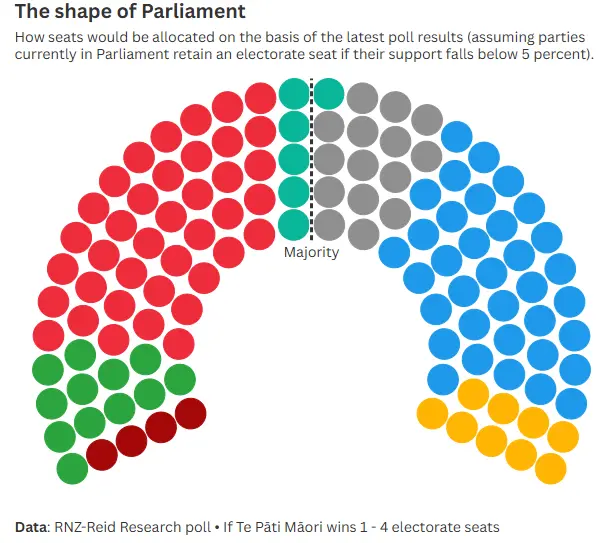
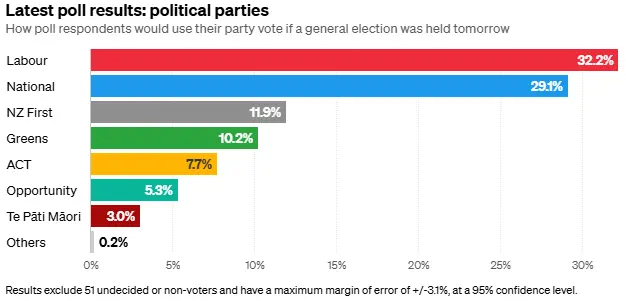
Opportunity is on 5.3 percent in the latest poll, the party cracking the threshold needed to enter Parliament for the first time in this poll.
If the results were replicated on polling day, the right bloc would have 59 seats and the left 55 - neither having the numbers to govern without Opportunity's 6.
Leader Qiulae Wong said there was a growing discontent amongst New Zealanders that the major parties were not setting out a vision for the future.
"We're providing an alternative narrative around what that could be, and I think New Zealanders are really, really ready for that. So I think that's where we're seeing interest grow in Opportunity," she told RNZ.
National has ruled out working with Opportunity, and is starting to lump its policies in with Labour, the Greens, and Te Pāti Māori.
But Opportunity is leaving the door open to National.
Labour, meanwhile, is keeping Opportunity as an option, but Hipkins is not going to give Wong a ring before the election.
"We don't do any deals pre-election," he said.
"My view is that voters get the chance to have their say first, and then we sit down and we talk to other parties after the election, depending on what the voters dish up."
Wong, too, did not see the point in doing any deals now.
"I don't think it's helpful for us to try and play into the left-right blocs. That's what we're trying to move away from. We've said that we'll set out clear bottom lines, so that will give those major parties an indication of how we'll approach negotiations. Then it's really up to them. Once we see how the votes fall, how they want to respond to that."
Labour's 1.8 point drop to 32.2 percent comes as National ramps up the attacks, hitting Labour where it is most vulnerable: tax.
National's campaign chair Simeon Brown was less willing to talk about National's 29.1 percent result than he was going after Labour on tax, saying tax would be the key issue at this year's election.
"What this poll shows is that as New Zealanders realise that Labour and their mates are intent on increasing taxes, they are becoming more and more concerned about that agenda."
Hipkins said a "scare campaign" was all National had, and it would quickly be found out.
"They can't campaign on their track record because their track record is so abysmal. So if their strategy for getting re-elected is just to make up lies about the opposition, I think that people will soon see through that."
Brown was adamant National would not work with Opportunity, rolling out the tax attack again.
"We're not going to be doing a deal with Opportunity. They want to put a land tax on every single New Zealander."
Wong did not believe National's decision to rule Opportunity out had necessarily driven its polling increase, with support coming from the traditional left and right.
"I suppose for many of those people that are supporting us, they see us as the most stable and safe coalition partner, regardless of whether it's a Labour or National-led government."
ACT leader David Seymour remained sceptical, believing Opportunity would run out of steam as more sunlight was shone on the party and its policies.
"They finally come under some scrutiny and basically abandon three of their key policies, under scrutiny, in a couple of weeks. I think that people are starting to look harder at them and seeing less and less as they look harder."
Wong said it was right for Opportunity to come under more scrutiny as it became a viable party for entering Parliament.
"We definitely welcome that. I think for us, we maintain our integrity, we answer questions honestly. We are a party that follows evidence and data, and so we will always engage in conversations in that way," she said.
ACT has attracted some star power in the shape of Paul Henry, but that big name and big personality has not shifted the dial, the party riding steady on 7.7 percent.
But Seymour said it varied from poll to poll.
"It depends which poll you look at. In others, we've gone up 50 percent, from 6 points to 9 in a month. So I guess you can't really accept the premise that that's true," Seymour said.
"We're very grateful for the people giving their party vote to ACT, and we're going to keep campaigning to lock Labour out and unlock New Zealand's potential right til the final whistle."
The Green Party is also steady on 10.2, eager to put the tumultuous times of the beginning of the term in the past.
MP Ricardo Menéndez March said the party was aiming for its best ever result, and it was building a campaign bigger than ever before.
"This is a really good place for us to build on, in the hope that we can actually secure a record election result come the election."
Menéndez March said the Greens were not relying on Opportunity to change the government.
"The Opportunity Party is relying on being able to potentially keep Luxon in power, which is something we're actively fighting against. And this is why we'll just make sure that we have the biggest vote available to us, so that we actually can secure a change of government and a change of direction."
Te Pāti Māori, meanwhile, is on 3 percent, but that number does not matter to the party anyway as it tells its supporters it wants their candidate votes.
Co-leader Debbie Ngarewa-Packer said there would always be supporters who two-ticked Te Pāti Māori, but its focus was on winning the seven Māori seats.
"It's great to have that growing support, but our success is going to be measured by the Māori seats and the influence we can have on on being able to change this government."
And despite comments towards the Greens' Lawrence Xu-Nan that earned him a rebuke from the prime minister, Winston Peters and New Zealand First have not been punished in the polls.
The party is up to 11.9 percent, another consecutive rise.
Peters' response to RNZ was the same as always, that he would turn the polls into confetti.
No rethink on Opportunity - Luxon
Speaking to Morning Report on Monday, Luxon said he did not need to rethink ruling out working with Opportunity.
"No, absolutely not. I mean they want to institute a land tax at 1.75 percent and just be a disaster for every young person who's saved up and put their equity together and gone and secured a home and it gets wiped out immediately.
"They're a party of more tax just like Labour, just like Te Pāti Māori, just like the Greens."
He said the 7 November election was "the poll that matters", and maintained his position laid out last month of not working with Opportunity even under a confidence and supply arrangement.
"When you seriously want to level a 1.75 percent annual land tax on the value of your land that's a big problem."
He said "Labour and their mates" wanted to bring in nine new taxes, despite Labour ruling out bringing in new taxes other than the narrow capital gains tax the party is campaigning on.
National over the weekend ruled out any new taxes - including ideas the government had previously been considering like on banks and a "bed tax" which the government had agreed to investigate as part of the signed regional deal with Auckland and the unsigned on with Queenstown Lakes.
Luxon promised National would announce alternative means of revenue gathering for tourism in coming weeks.
This poll of 1000 people was conducted by Reid Research, using quota sampling and weighting to ensure representative cross section by age, gender and geography. The poll was conducted through online interviews between 14-21 August 2026 and has a maximum margin of error of +/- 3.1 percent at a 95 percent confidence level.
