
PHOTO
A string of earthquakes rumbling the Southern Alps north of Milford Sound are not due to the Alpine Fault, a seismologist says.
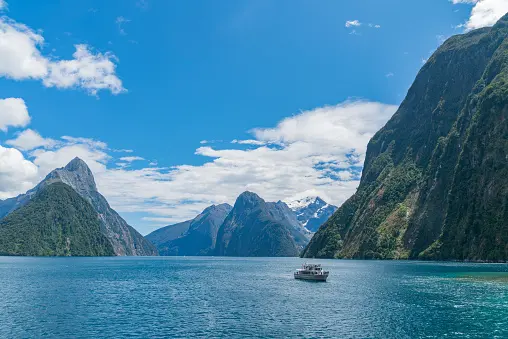
Dozens of aftershocks have been recorded in the lower South Island after a string of earthquakes that struck near Piopiotahi (Milford Sound) on Wednesday night.
A 5.5 magnitude earthquake struck about 6.15pm followed by a larger 5.6 shake shortly before 7pm. Three more smaller quakes soon followed over the next hour, all about 40km northeast of Milford Sound.
The tremors have prompted calls for local authorities and central government to get around the table to nut out an emergency response plan.
Southland's mayor Rob Scott was at his Lumsden home when an earthquake one-two punch struck the region.

According to GeoNet, almost 7000 people felt the quakes.
"Every earthquake seems to be different. The stronger one I felt was like a short sharp jolt," Scott said.
Both quakes were shallow, recorded at a depth of 5km.
Scott said the quakes served as a wake-up call around the area's emergency preparedness and how it will be funded.
"We've got a very small council and we're basically hosting a million people a year where there is a predominant risk lies.
"For Milford, for something like that happening during the day, around 1pm during that peak time, when you've got 3500 people in the area. We need to be looking after them."
Earlier this week Scott suggested a possible limit on visitors to Milford Sound to lower the scale of a disaster - such as a tsunami or earthquake - following the devastating tragedy in Nepal.
Given Milford Sound's profile as the country's most renowned tourist attraction, central government should be involved, Scott said.
"It's a national crown jewel, it's a national treasure, it's something that we promote for people to come and see in New Zealand and it's in the national interest.
"I think the drive and the funding for this work needs to come from a national level because it will be a national disaster if something did go wrong there. It's ensuring the right people in the right places because we can't just bury our heads in the sand and ignore it."
Aftershocks were expected to last for days, with Earth Sciences NZ recording at least 81 known shakes since Wednesday night.
Earth Sciences NZ on-duty seismologist Sam Taylor-Offord said the quakes were not on the Alpine Fault, a 600km geological fault runs almost the entire length of the South Island.
"We're seeing a number of earthquakes that are about 15 to 20 kilometres southeast of the Alpine Fault — and that is close. But there are many faults in this area."
The quakes were aligning with the Hollyford fault system, Taylor-Offord said.
Experts say the Alpine Fault had a strong chance of rupturing in the next 50 years.
Taylor-Offord said determining what the future quake outlook looked like remained difficult.
"[There are] too many variables, but I can say this earthquake is close to the Alpine Fault which we know can host magnitude 7-8 earthquakes. We're expecting one in the next 50 years, most likely.
"There will be a little bit of stress moved onto the Alpine Fault and other faults in the vicinity, but it's very little and doesn't change the picture from beforehand."
