
PHOTO
Only one in $9 of government roading funds gets spent in the South Island, a new report obtained by RNZ reveals.
The south accounts for almost a quarter of the country's population, 22 percent of GDP, a third of export goods and 40 percent of international visitor spending, but receives only 11 percent of transport spending.
Local political and business leaders say the lack of investment is disappointing.
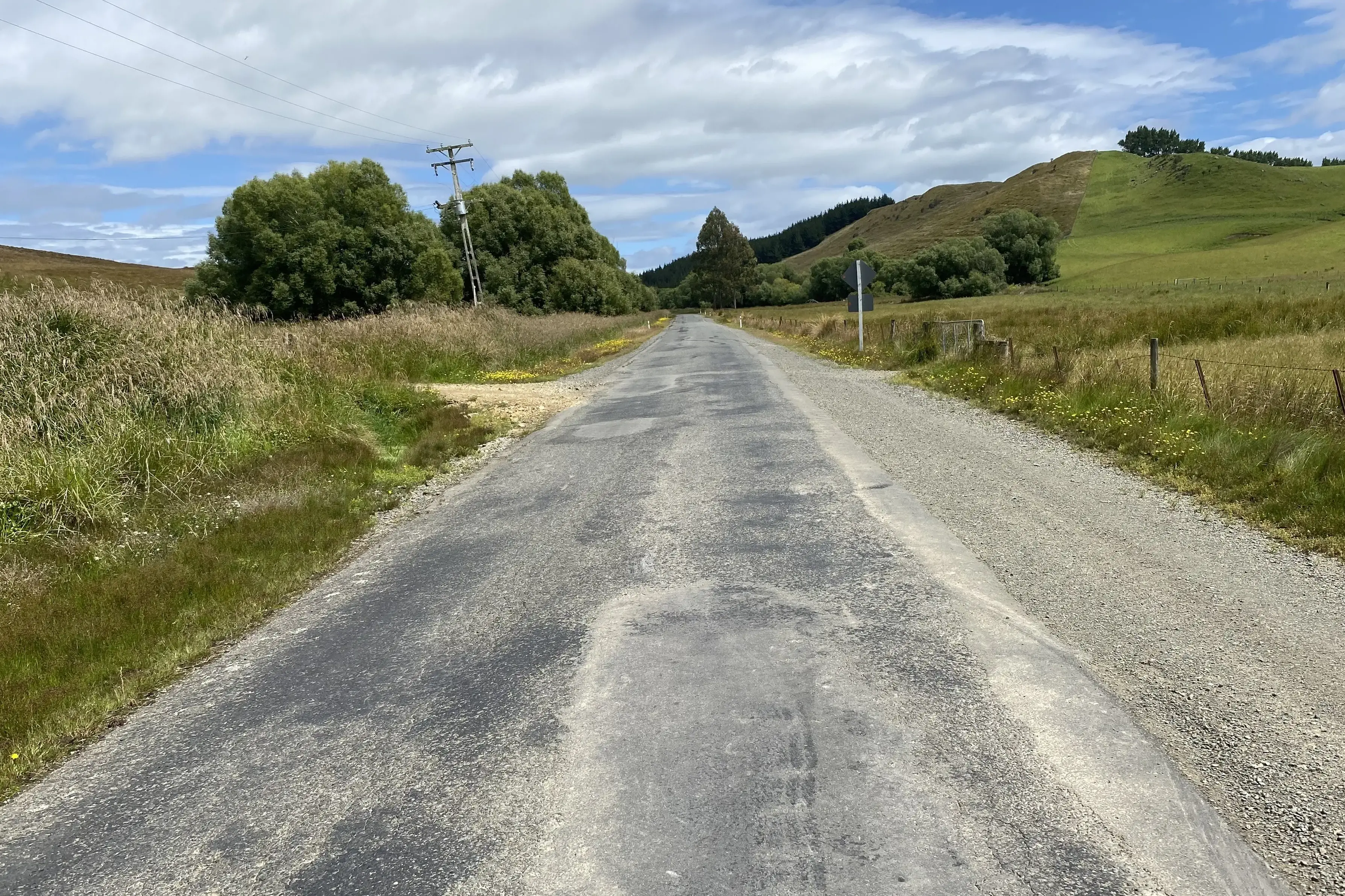
Southland mayor Rob Scott has told RNZ that trucks are unnecessarily driving an extra 3.5 million kilometres in his district every year because bridges are not up to scratch and the council will soon have to weigh up reverting sealed roads to gravel.
But South Island Minister James Meager says the government has made a huge investment in the South Island's roads and other infrastructure, as well as simplifying and speeding up consent processes and cutting red tape.
It was "simplistic" to suggest the government was not listening to the South Island's leaders and delivering on their priorities, Meager said.
The report, released on Thursday and commissioned by the South Island Regional Transport Committee Chairs Group, highlighted the disparity between the south's contribution to the economy and what was being delivered by the National Land Transport Fund.
If National Land Transport Fund expenditure matched the population in the South Island it would have resulted in an extra $1.2 billion in spending in the past year alone -about the cost of the currently unfunded Woodend Bypass or the Hope Bypass.
"That's a fair point," Meager said.
"I guess my response would be is that it's a little more complex than just looking at the population makeup. It's actually part of my job, and part of my colleagues' jobs, to make sure that we raise these issues with decision makers, with cabinet, and making sure that we've got the investment in the right place.
"The key thing is we need to not necessarily look at writing checks based on what the population is here or there. What we need to do ... is to identify the infrastructure constraints that we have in the South Island that actually are holding back growth.
"And we have got a lot of stuff underway. We can't underestimate all the work that actually is happening. You've got Ashburton Bridge. The Woodend Bypass is proceeding - just got consenting, just got fast-track consent. In the budget there was $400 million for roading infrastructure resilience and $140 million of that went to the South Island. So there is a lot happening."
'It's keeping us awake at night'
Canterbury Regional Transport Committee chair Deon Swiggs said the report highlighted what many in the South Island had been feeling for some time.
"When I look at the numbers it's disappointing ... and resilience is the big piece that we are fighting for in the South Island," Swiggs said.
"We've got storm events that are happening, we've got ageing infrastructure. So, yes, the South Island is definitely punching above its weight from an economic activity point of view and the money generated here is going towards New Zealand at large, but the South Island needs this investment.
"We've been saying this for quite some time that the numbers do not stack up ... and investment in the South Island needs to improve. We do not want to see the degradation of our existing corridors. We all know that when you don't maintain what you've got, it costs a lot more to then fix it."
Rob Scott said Southland was at a tipping point.
"I've seen the great work that our staff have been doing and I'm seeing the stress coming through now and it's keeping us awake at night as a council, knowing that once we get over that tipping point we're not going to be able to recover as a Southland region and also as a country. It's going to be a lot more expensive to fix the roads up later on ... rather than just actually keeping on top and maintaining our network properly," he said.
"If you look at the length of road per capita that people are looking after, in Auckland a resident is looking after four metres worth of road. Wellington, 1.6 metres. And if we come to the South Island and we've got our fastest growing district in the country at the moment, Selwyn, someone's looking after 30 metres. What do you reckon Southland's number is? It's 151 metres.
"We are subsidising Auckland, which I don't mind, but it's actually coming at the expense of our roads. All of the road user charges that we generate on our roads, only half of that is coming back for that road maintenance."
It led him to write a letter to Transport Agency chair Simon Bridges calling for a new way of allocating road funding as Southland was tens of millions of dollars short of just maintaining the status quo.
Meanwhile central government was pushing ahead with further expressways and highways that would put even more pressure on maintenance spending, Scott said.
"If the heartbeat of New Zealand's export market loses the routes to get that produce to market, we're going to be in trouble as a country," he said.
"We're not actually asking for much. I scratch my head when I see all of this money - that $55 million going onto that Harbour Bridge Extension paperwork, the $250 million going on a [Queenstown] roundabout, the new 26 kilometres worth of expressway in the North Island - we just need a drop in the bucket from all of those projects just to be able to maintain our roads."
'We have two Cabinet ministers in the whole of the South Island'
Swiggs said politics was at play.
"What we're seeing here is that there is a weighting of North Island politicians and less South Island politicians and especially in Cabinet. I think we have two politicians in Cabinet from the South Island," Swiggs said.
"We need to have a better mix of proportionality around the politicians that are decision makers at Cabinet. But we also need a more transparent process about how the money has been apportioned and where these big projects are."
Local councils had to be far more transparent in how they decided to spend money compared to central government, Swiggs said.
Business Canterbury chief executive Leeann Watson agreed South Island representation was lacking among senior politicians.
"We are underrepresented, absolutely. We have two cabinet ministers in the whole of the South Island and I believe Auckland has 16. So that in itself speaks some volume," she said.
Despite that Business Canterbury had regular contact with Prime Minister Christopher Luxon, Deputy Prime Minister David Seymour and Finance Minister Nicola Willis, Watson said.
Willis claimed after this year's budget she had not "had a request for a major headline project in Canterbury".
Luxon offered a similar view last year and called for Canterbury's leaders to get their priorities straight.
Watson said the remarks were frustrating.
"There is no doubt that we have asked for some investment," she said.
Swiggs said there was "no shortage of projects that we could do tomorrow to make the South Island a better place".
"I'm going to pick on one, which is the long-touted mass rapid transit for Christchurch. Mass rapid transit is an end goal," he said.
"To get to the mass rapid transit system we need to do the investment in our existing public transport. We've put through business cases to NZTA. This council appropriated the money through our long-term plan. We went through consultation. We had it on our budgets and then the [Government Policy Statement] comes out and cut the funding.
"That has a flow-on effect to us not being able to deliver the improvements to our public transport that we wanted and then that has an impact on the mass rapid transit down the line. When the government puts a cap on what the region wants or the city wants it has flow-on effects.
"That was there and that could be delivered relatively quickly if there was a will from the government and ... they have that information. So that's just one example. They could invest in that with us, with the region, with the city, but they've chosen not to."
Meager said the government was committed to delivering the Woodend Bypass.
"We're not short on ambition. What we are short on is, quite frankly, the revenue needed to get these projects across the line," he said.
"Now part of that is to do with the growth we need to generate revenue, whether that's through fuel excise and road users which help fund the land transport fund or general growth.
"So we need more revenue coming in. We also need to make these projects a lot more affordable and a lot cheaper and so that's why we've done things like Fast-track and reforming the RMA system so that when these large scale projects are actually underway, we can make them more affordable."
There was a significant amount taking place in and around Canterbury, including the recently opened Te Kaha Stadium in Christchurch, flood protection improvement and spending in health, education and transport, Meager said.
'The South Island is outperforming the North Island'
The report laid bare what has been described as New Zealand's "two-speed" economy.
"The South Island is outperforming the North Island with GDP growing by 1.2 percent in the March 2026 year compared with 0.2 percent in the North Island," the report said.
"This outperformance has persisted, with South Island GDP growth averaging 0.6 percentage points above the North Island over the five years to 2025.
"South Island employment rose by 0.4 percent, while North Island employment fell by 1.2 percent. Southland, the West Coast, Canterbury and Otago recorded growth. The South Island's unemployment rate is 4.1 percent, below the North Island's 5.7 percent."
The South Island was making an outsized contribution to the country's economy but further investment was important to maintain it, the report said.
The roading network was vital to connect people and businesses with supply chains and markets and for tourism.
The South Island accounted for 43 percent of the country's roading network and 45 percent of the State Highway network.
"The South Island's share of roading expenditure appears disproportionately low relative to its contribution and level of road use. In 2025 the South Island received 11 percent of NLTF roading expenditure despite generating 27 percent of national vehicle kilometres travelled, 22 percent of GDP, one third of goods exports, and 40 percent of international visitor spending," the report said.
"This imbalance is evident across South Island regions, where shares of population, GDP, exports, visitor spending and road use generally exceed each region's share of NLTF roading investment. Ensuring that South Island transport infrastructure is adequately maintained and invested in is therefore important not only for the South Island but for New Zealand's overall economic performance."
The report also underscored the importance of the Cook Strait ferries to the South Island's economy.
"The Cook Strait ferries provide a 'sea bridge' connection between the South Island and the North Island. The transportation infrastructure provided by the ferries is a critically important economic enabler for the South Island economy and its broader contribution to New Zealand.
"An estimated 3.5 million tonnes of annual freight are carried on ferries."
More than $10 billion crossed the strait last year with 71 percent southbound and 29 percent northbound.
About $1.8 billion of South Island international spending came from visitors who took the ferry.
"This is equivalent to about 23 percent of the total international visitor spending that occurred in the South Island over the past year, which highlights the critical importance of the ferries as an enabler of international tourism earnings. Transport connectivity is fundamental to sustaining this contribution."
Back the South Island for stronger productivity and higher incomes - business leaders
Watson said the government needed to be investing more in the South Island's infrastructure for the good of the country's economy.
"We can have the best innovation, we can have the best quality products, but if we haven't got the infrastructure to support the imported components coming in to make those manufactured goods or the right roads to get our exports to Lyttelton Port or to Christchurch Airport or not sufficient freight capacity then ... we can't actually realise the full potential of those exports to this country," she said.
"Infrastructure is vital, just like energy is. It underpins everything that we do from moving our people, moving our freight and just having connectivity across the South Island.
"Our message to political parties is really simple - if New Zealand wants stronger productivity and higher incomes and greater resilience then backing the South Island right now is exactly what they should be doing because we can provide all that with the right settings."
The government could not afford to not invest in the south, Watson said.
"We often talk about what the costs are of delivering projects but we don't talk about the cost of delaying and deferring," she said.
"First of all, I think we've got to do a better job of actually costing up the project. Secondly, I think we need to look at those alternative procurement and funding and financing models because we know if we continue to use the same funding and financing and the same procurement models that we've always used, we'll get what we've always got.
"Right now we've got a country that has definitely got some resilience issues in terms of some of its core infrastructure. We've got a whole lot of maintenance that we need to do and so we've got to make sure that we also look at those alternative ways of doing things."
Watson and Swiggs emphasised that funding infrastructure in the South Island was an investment.
Swiggs said money spent in the South Island benefited the whole country.
"This is definitely not a handout. We have shown where the money has been generated, we've shown the economic activity is happening here," Swiggs said.
Watson said Business Canterbury was working on a project called Canterbury Ambition that set out the region's vision for improving growth, innovation and quality of life.
She said that, alongside government investment, could unlock the private sector.
"In some cases it's actually about getting the government out of the way," she said.
"The piece of work around Canterbury Ambition is actually about not waiting for government to tell us what we should be as a region or what we should do. It's about us shaping our own future. So the private sector is in the driving seat of that and actually pushing ahead and what we've heard from this government is that they actually want to partner with business.
"Our businesses don't want to hand out. Our businesses want to shape their own future."
