
PHOTO
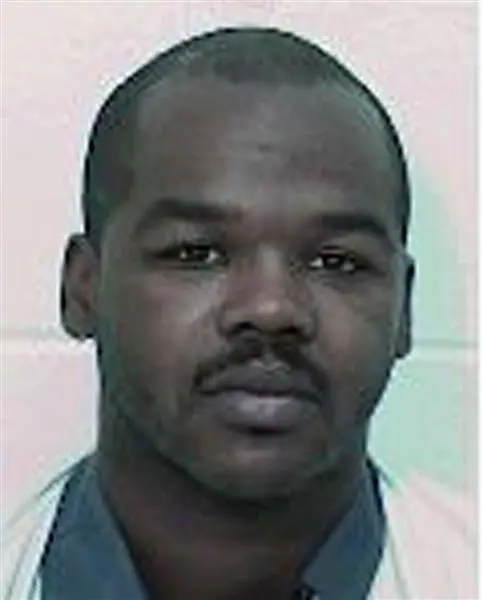
Curtis Osborne, a bald and burly 37-year-old with a hint of a mustache, sat strapped to a gurney behind a glass window for all to see.
His eyes shot over to a group of four reporters as we walked into the viewing chamber, locking briefly with mine. There was no way to gauge how he felt, but to me he looked horrified.
I've never met Osborne, had hardly heard his name until the last few months. But we shared a powerful and unsettling bond that night, one I'll never forget. His eyes fixed on mine minutes before he took his last breath.
I've worked at The Associated Press for three years now, and covered more than my share of gloom. But I had never witnessed an execution.
When the chance came up to cover Osborne's June 4 execution, I saw it more as a duty than anything else. But there was also something a bit more primal about it that appealed to me.
Very few subjects we cover as legal reporters ever seem complete. Verdicts are appealed. Sentences can be shortened. Even laws get overturned. There is something unique, though, about a story that has an absolute end.
Friends and relatives questioned my sanity. Veteran colleagues warned me of the emotional toll it could take. One told me he couldn't sleep after covering his first execution. Another offered to be a sounding board on the long ride home if I needed it, though when that time came the execution was the last thing I wanted to talk about.
For seven months, there was an unofficial moratorium on executions while the US Supreme Court considered a challenge to Kentucky's lethal injection procedures. After the justices said those procedures are not unconstitutionally cruel, Georgia became the first state in the nation to resume executions in April. Since then, there have been two executions in Georgia and 10 across the nation.
Like most capital punishment cases, Osborne's was far from routine. He was convicted of shooting Arthur Jones and Linda Lisa Seaborne in 1990. Prosecutors say Osborne killed Jones because Osborne didn't want to pay him a $400 tab. They say he killed Seaborne because she happened to be in the car with him.
After his conviction, his lawyers appealed. They argued his previous defense attorney was a known racist who never told him a life sentence deal was on the table, and told another client that Osborne deserved the chair.
Former President Jimmy Carter and ex-Attorney General Griffin Bell rallied to Osborne's side during the appeals process, and the ex-chief justice of the Georgia Supreme Court made a similar appeal for clemency in person. But it was denied and the case moved forward, vindicating prosecutors who called the claims of racism "outlandish."
The date was set and I was told to arrive at the state prison in Jackson at 4 p.m., three hours before the scheduled execution.
Two hours later, the four reporters were told to shed all our belongings - wallets, computers, jewellery, even pen and paper - and hop on a rickety van that would take us to the prison complex.
We emerged from the van, walked through a security checkpoint, a metal detector and then to a whitewashed underground tunnel lined with the kinds of motivational posters you'd see in an elementary school - pictures of animals and scenery with captions such as "FOCUS" and "MAKE IT HAPPEN."
Up a flight of stairs and to another checkpoint, we were each given a pad of paper and two freshly sharpened pencils and guided to a waiting room. There, amid fading softball trophies and the whirring of soda machines, we waited almost two more hours.
We spent most of the time silent - not quite an awkward silence, but one I would describe as "shared." As we sat there, Osborne's lawyers were furiously working at last-ditch appeals. Georgia's top court had already denied an earlier appeal before we left for the prison, but the US Supreme Court had not yet made its decision.
Sitting in the lonely break room, without cell phones or computer access, we were kept guessing until a guard came in and announced: "Five minutes." It turned out the Supreme Court had indeed denied another appeal as well, doing so at around 8 p.m.
Soon, we were on our way to the death house, a low level bunker outside a prison basketball court. We waited in the van for another 30 minutes, and no one - not even the guards accompanying us - knew why.
Suddenly, the driver's walkie-talkie crackled and the van lurched forward. The doctors, it seemed, had finally found a vein where they could shoot their lethal injection.
We were among the last to arrive at the viewing chamber, which was already filled with about a dozen witnesses - family members of the two victims, scattered among several rows of wooden pews. None of them uttered a word, though many seemed unsettled by the experience; the benches creaked and groaned as they shifted in their seats.
All eyes were on Osborne, who was strapped to the gurney behind a broad glass window, the viewing chamber that separated witnesses from the spectacle they were about to see.
It was an awkward experience, one that was more uncomfortable than painful. I was sharing a deeply personal moment with Osborne, the final moments of his life, and I didn't even know the man.
But there was little time to reflect.
The prison warden is asking Osborne if he wants to make any last remarks. No, he shakes his head. He's already rejected a sedative to relax him before the lethal injection and has refused to eat his last meal, a cheeseburger plate. Once again, he is defiant to the end.
The warden hardly pauses.
A last prayer? Yes, Osborne nods.
The chaplain then starts speaking softly, asks God to "favour" Osborne, who is squeezing his eyes shut. As the prayer nears its end, Osborne mouths a few silent words, perhaps his own goodbye. The chaplain squeezes his arm one last time.
At 8:51 p.m., the lethal injection begins to course through his veins, a concoction of three drugs that's used in succession as an anesthetic, a muscle paralyzer and then a substance to stop his heart.
Osborne's eyes appear to be welling up with tears. He looks firmly at the ceiling, blinks occasionally. After a few minutes, his eyes begin to close. His breathing slows. His body is looking more relaxed, or as relaxed as it could be strapped to a gurney. Once more, he opens his eyes, staring ahead. He suddenly takes a deep gasp, as if he is yawning.
For a few minutes, there is nothing. The witnesses are perfectly still. Then, his eyes seem to inch open and his lips seem to purse ever so slightly. He goes quietly.
Two doctors arrive to inspect Osborne, taking turns checking his pulse. They nod at each other.
The time of death was 9:05 p.m. The curtain was pulled closed, the viewing chamber emptied.
And the story was over.