

President Donald Trump falsely claimed victory over Democratic rival Joe Biden on Wednesday with millions of votes still uncounted in a White House race that will not be decided until a handful of states complete vote-counting over the next hours or days.

- KEY POINTS
- TRUMP has won Texas, Ohio, Montana, Idaho, Iowa, Florida, Kansas, Missouri, Utah, North Dakota, South Dakota, Nebraska, Wyoming, Louisiana, Indiana, Arkansas, West Virginia, South Carolina, Oklahoma, Mississippi, Alabama, Tennessee and Kentucky
- BIDEN has won Arizona, California, Washington, Oregon, Minnesota, Hawaii, New York, New Hampshire, New Mexico, Illinois, Maryland, Delaware, New Jersey, Connecticut, Maine, Rhode Island, Massachusetts, Vermont, Virginia, Colorado, District of Colombia
- Interactive map: Winner state by state
- How the Electoral College works
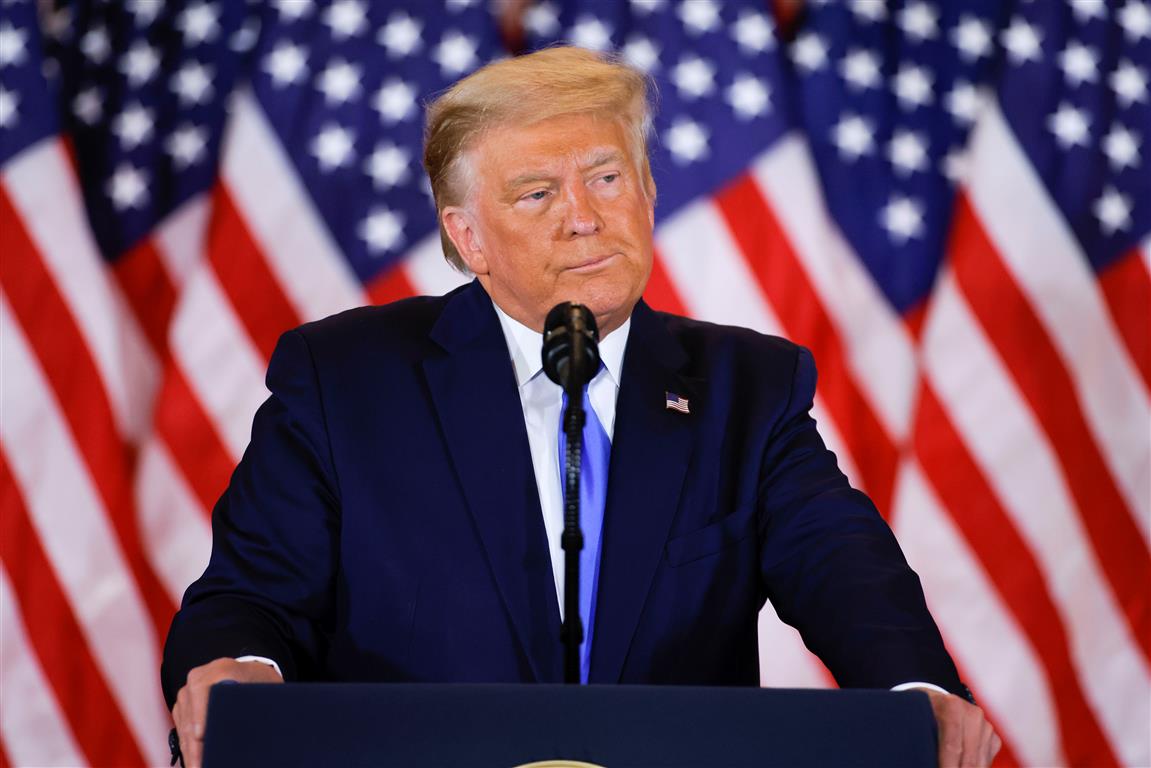
Shortly after Biden said he was confident of winning the contest once the votes are counted, Trump appeared at the White House to declare victory and said his lawyers would be taking his case to the US Supreme Court, without specifying what they would claim.
"We were getting ready to win this election. Frankly, we did win this election," Trump said. "This is a major fraud on our nation. We want the law to be used in a proper manner. So we'll be going to the US Supreme Court. We want all voting to stop."
Polls have closed and voting has stopped across the country, but election laws in US states require all votes to be counted, and many states routinely take days to finish counting legal ballots. More votes stood to be counted this year than in the past as people voted early by mail and in person because of the coronavirus pandemic.
Earlier in the evening, Trump won the battlegrounds of Florida, Ohio and Texas, dashing Biden's hopes for a decisive early victory, but Biden said he was confident he was on track to winning the White House by taking three key Rust Belt states.
Biden, 77, was eyeing the so-called "blue wall" states of Michigan, Wisconsin and Pennsylvania that sent Trump, 74, to the White House in 2016 for possible breakthroughs once those states finish counting votes in hours or days to come.
Winning those three states would be enough to give Biden an Electoral College victory.
"We feel good about where we are," Biden said in his home state of Delaware, shouting over a din of supporters in cars honking their horns in approval. "We believe we're on track to win this election."
Trump has repeatedly and without evidence suggested that an increase in mail-in voting will lead to an increase in fraud, although election experts say that fraud is rare and mail-in ballots are a long-standing feature of American elections.
The race is so tight Americans likely won't know the winner of the election today — or maybe even tomorrow.
Biden told his supporters "we're on track" to win the election but "we will have to be patient" until all votes are counted. He said a result might be known tomorrow morning (US time) but "it may take a little longer".
Trump tweeted "we are up big but they are trying to steal the election. We will never let them do it ..." He said votes cannot be cast after the polls have closed. AP reports that in multiple states, ballots can in fact be counted if they arrive after Election Day.
Trump later deleted the tweet - seemingly to correct a spelling error in which he wrote "poles" instead of "polls" - and said he would make a statement tonight: "A big win!"
Twitter flagged Trump's tweet about the Democrats "trying to steal the election", saying "some of the content is disputed". And Facebook put a label on the post, saying votes were being counted and no winner was yet projected.

In Pennsylvania, of the 4.5 million votes counted so far, only 750,000 are absentee votes, or just 17%. According to Edison Research, more than 2.4 million early ballots were cast in the state, of which nearly 1.6 million were by Democrats and about 555,000 by Republicans.
Even without Pennsylvania, Biden victories in Arizona, Michigan and Wisconsin, as well as a congressional district in either Maine or Nebraska, which apportion their electoral votes by district, would put him in the White House, as long as he also holds the states that Trump lost in 2016.
Path to victory
In the US, a candidate becomes president not by winning a majority of the national popular vote but through a system called the Electoral College, which allots electoral votes to the states and the District of Columbia largely based on their population. There are a total of 538 electoral votes, or “electors,” meaning a candidate needs to secure 270 to win.
The two contenders split the early US states to be projected in the White House race as expected, with conservative states like Alabama, Indiana, Kentucky and Tennessee going to Trump and Democratic-leaning Massachusetts, Vermont, New York and Connecticut going to Biden, according to projections by television networks and Edison Research.

FLORIDA
Part of Trump's strength in Florida came from an improved performance relative to 2016 in the state's counties with large Latino populations. Trump's share of the vote in those counties was larger than it was in the 2016 election. In the weeks leading up to the election, opinion polls in key states showed Biden under-performing with Latinos.
Biden (77) still has multiple paths to the 270 electoral votes he needs without Florida, despite having spent lots of time and money trying to flip the state that backed 74-year-old Trump in 2016.
NORTH CAROLINA
Trump was shading Biden in the battleground state of North Carolina, at 50.1% to 48.9% with 94% of expected votes counted.
RECORD VOTING
Voters, many wearing masks and maintaining social-distancing to guard against the spread of the coronavirus, experienced long lines in a few locales and short waits in many other places. There were no signs of disruptions or violence at polling sites, as some officials had feared.
The winner - who may not be determined for days - will lead a nation strained by a pandemic that has killed more than 231,000 people and left millions more jobless, racial tensions and political polarisation that has only worsened during a vitriolic campaign.
Ahead of Election Day, just over 100 million voters cast early ballots either by mail or in person, according to the US Elections Project at the University of Florida, driven by concerns about crowded polling places during the pandemic as well as extraordinary enthusiasm.
The total has broken records and prompted some experts to predict the highest voting rates since 1908 and that the vote total could reach 160 million, topping the 138 million cast in 2016.

Supporters of both candidates called the election a referendum on Trump and his tumultuous first term. No US president has lost a re-election bid since Republican George H. W. Bush in 1992.
Voters on Tuesday will also decide which political party controls the US Congress for the next two years, with Democrats narrowly favoured to recapture a Senate majority and retain their control of the House of Representatives.
Trump is seeking another term in office after a chaotic four years marked by the coronavirus crisis, an economy battered by pandemic shutdowns, an impeachment drama, inquiries into Russian election interference, US racial tensions and contentious immigration policies.
Biden is looking to win the presidency on his third attempt after a five-decade political career including eight years as vice president under Trump's predecessor, Barack Obama.
Biden has promised a renewed effort to fight the public health crisis, fix the economy and bridge America's political divide. The country this year was also shaken by months of protests against racism and police brutality.
- additional reporting NZ Herald
Related Stories


Comments
The Democrats are obviously seriously out of touch with a large section of the American public.
Perhaps what we are seeing is simple a revolt against the current wave or professional career politicians that campaign on personality and PR/Marketing prowess instead of effective policy for the social good. Perhaps anything is better than the status quo which has allowed the planet to be destroyed, the stability of the world stage to be undermined, and the divid between rich and poor to grow faster than it has previously (in our lifetimes).