

PHOTO
“If you say nothing, nothing happens.”
That sentiment motivated Residents Association of Omarama chairman Stephen Grundy to pen a letter to the Ahuriri Community Board asking for support in advocating for the town.
Mr Grundy wrote the letter on behalf of the association to “express concerns about any proposal to reduce ratepayer-funded services in Omarama”.
“Last month, the [Waitaki District ] Council determined rates would rise by 16.9% for the new financial year,” it read.
“In addition, councillors instructed staff to find further savings with chief executive Alex Parmley saying this would impact the level of service the council could provide.
“As an association we have spent months lobbying for the council to spend the rates it has collected from Omarama ratepayers on the amenities it has committed to providing.”
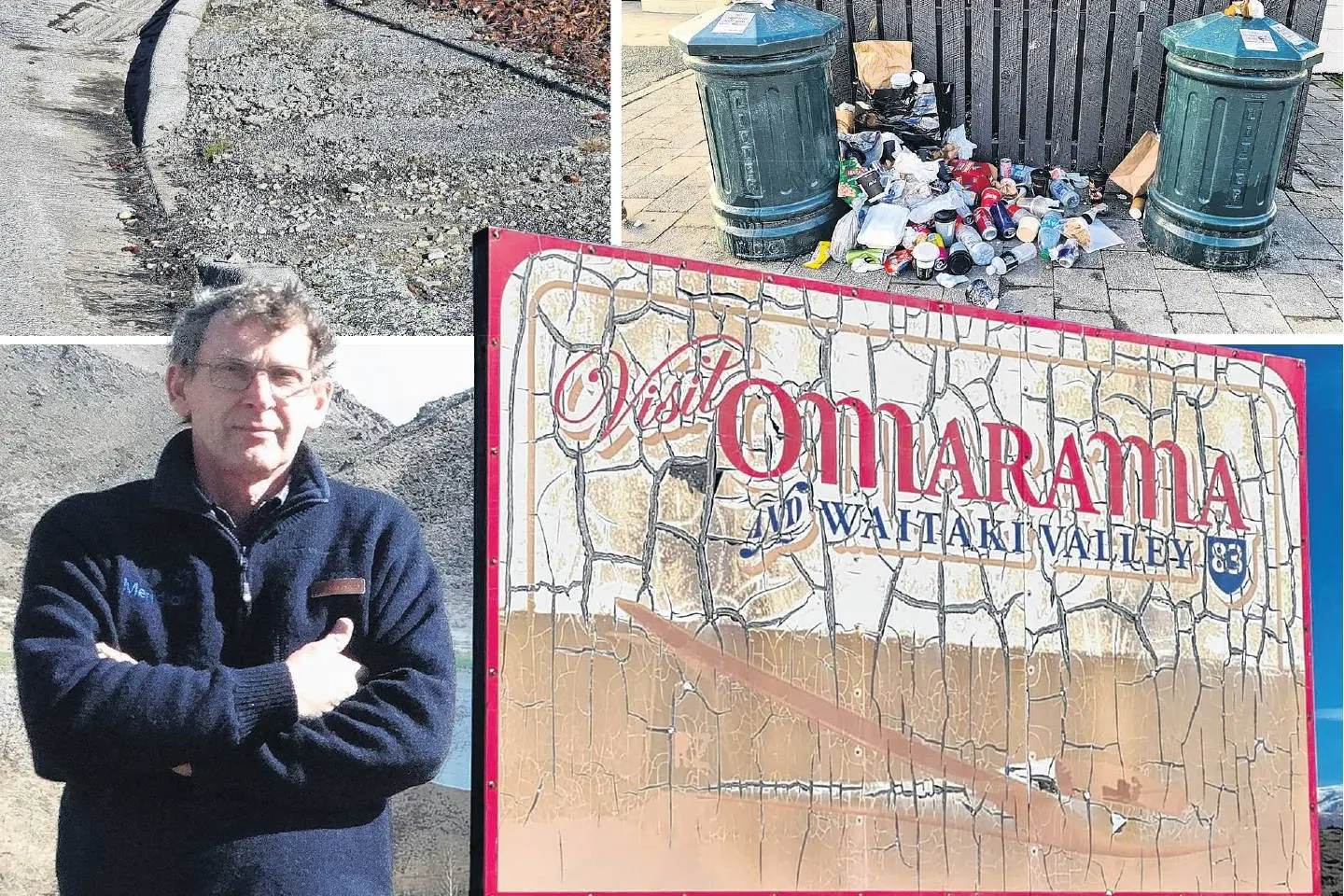
He highlighted overflowing rubbish bins, run-down signs at the entrances of the town and the poor state of footpaths as key concerns.
“In each of these instances the present state of affairs reflects badly on the image of our town to residents and visitors alike, and it also reflects badly on the Waitaki district as a whole.”
Mr Grundy told the Oamaru Mail the association’s message to council was “do something now, please”.
“We made it known that we didn’t want there to be a reduction in services because we’re feeling that things haven’t been maintained.”
He signed off his letter to the community board as being from “the forgotten town at the edge of the universe”.
“We know we’re a long way from Oamaru and I personally think it’s a factor, but it shouldn’t be, really.”
Omarama sits about halfway between Queenstown and Christchurch.
“You get traffic going both ways.
“This is the point where the tourist buses stop and people get out and you think, ‘This is the welcome to Omarama … broken footpaths, flooded gutters and overflowing rubbish bins.’ It’s not a good look.”
While he acknowledged there were a number of issues facing the council, the association had to look after its residents.
“Even though all those things are going on, we need to say something because if we don’t say something, they won’t know that we’re not happy.”
The association had been campaigning for “quite a few years” about the signs, which had slowly deteriorated in the intense sun.
“They’re all cracking and barely readable and the colours have all gone.”
The association would “rather see them gone” if replacements were going to take a while.
Mr Grundy said while rubbish was “a complex thing”, the town’s small bins were not working.
“Bins are getting full. People are putting their rubbish on the ground; it’s blowing around.”
It had been nearly a decade since the council had completed any major fixes on the footpaths, Mr Grundy said.
“We did go to the council and ask when they spent some significant money on footpaths and their response was 2017, 2018 — we’re coming up to 10 years.
“When you look in our statement for where our rates go, there’s a beautiful chart that says your money goes to all these different areas and in three different places, footpaths are mentioned.
“How can we go for 10 years with none of the money being spent on footpaths, or very little?”
The association did its own survey of the footpaths.
“We got on our bicycles and surveyed 7km of footpaths.’’
They took 130 photographs of defects.
And the poor upkeep of the footpaths was affecting residents in Omarama.
“Some of the things you can do in a town like Oamaru you can’t do here.
“Kids here don’t have scooters because where do you ride them?”
Age Concern in Omarama had also shared concerns about the elderly population using the footpaths, Mr Grundy said.
“How safe is it to walk down the footpath without tripping over a pothole or a raised part of the footpath?
“These are just basic requirements of having a good footpath.”
A council report from May disagreed with the findings of the association.
“In terms of overall condition in Omarama, all footpaths are considered to be in good condition,” a council spokesman said.
“In terms of the faults identified within those footpaths, most are considered to be in fair condition, with those being in poor and very poor condition identified.”
The timing for any work on the footpaths in Omarama was yet to be confirmed, the spokesman said.
The council was also manufacturing new signage for the district, with installation slated for “later this year”.
“We will have more information then but can confirm they are the detailed corten steel option, and quotes came in within budget.”
After Mr Grundy’s letter was presented to the community board, it formally requested a report from council staff on waste management in Omarama as well as proposing footpath remediation.
Waitaki District Mayor Mel Tavendale said it was important to “make sure we’re not going backwards” in terms of council services.
“The service level discussion when you’re trying to find savings within the budgets is a really problematic one because there’s no easy fix.
“We certainly do our best to share services around and I think there is certainly some work to be done in Omarama.
“We understand that and we need to be continuing to work towards that.”
The long-term plan discussions were a key part of addressing these issues.
“When we’re working through some of our long-term plan budgeting conversations, we need to be trying to find the balance between what our community is asking for and what we can afford.
“We do need to look at how we can find sustainable funding sources moving forward so we can still actually get the level of service our community wants.
“That’s where we’ve got to put a process around it because this is a conversation that is going to play out in every one of our communities.”
Mr Grundy said he was hopeful short-term measures would be taken.
However, a long-term solution would depend on how other local government reforms would turn out.