PHOTO
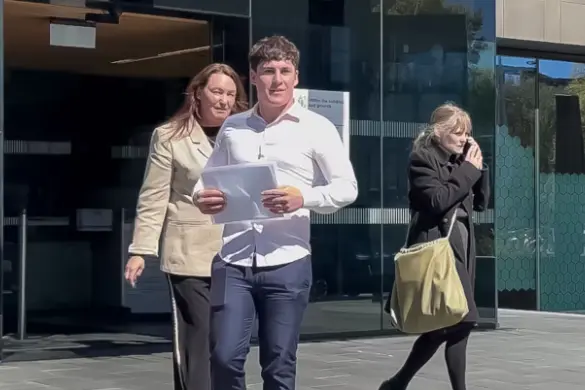
New Zealand Army intelligence specialist Arthur Finegan denied a “nasty” assault – until he was confronted with CCTV footage showing an attack that left a taxi driver unconscious.
He then blamed the driver for interrupting him and two associates after they failed to pay a $20 fare on New Year’s Day and fled on foot.
The group had been out drinking late in Queenstown on January 1.
Soon after fleeing without paying, the driver caught up to them and asked for the money.
But instead of paying, Finegan, an 18-year-old private with high-security clearance privileges in the Army, grabbed the driver by the scruff of the neck and turned him around.
One associate then kicked him in the back of the leg while Finegan threw a barrage of left-arm punches at the driver’s face.
Another associate struck the driver in the back of the head, causing him to fall to the concrete ground.
Finegan then started kicking the driver, striking him three times in the torso as he lay in a foetal position.
He then walked to the driver’s head and continued the assault as two bystanders tried to pull him backwards.
Using a powerful right kick, he struck the driver three more times in the face and head.
He was pulled away by an associate and fled the scene.
The driver was knocked out and received cuts to his lip, abrasions and bruising to his face. He was unable to move his jaw for days after the assault.
Today, Finegan appeared for sentencing on a charge of injuring with intent to injure in the Christchurch District Court.
‘It was a nasty assault’
His lawyer DeAnne Nicoloso called for a discharge without conviction, which the police opposed because of the serious nature of the assault.
“It was a nasty assault,” she said.
Nicoloso said Finegan was supported in court by a Sergeant Major who told her he had been permanently removed from the Army’s intelligence section and lost high-security clearance privileges.
She said Finegan had completed basic training and didn’t quite have a “foothold” in his career.
The Army was all he dreamed of and he didn’t have a plan B, she said.
“Because of his offending, he has been taken out of a team and been doing admin-type work pending the outcome.”
She submitted a conviction could limit future travel with the Army.
Restorative justice hadn’t worked out but he had offered $1000 to the victim.
“He is a man with great potential,” Nicoloso said.
The police prosecutor said Finegan used full force when he kicked the victim in the head.
It was a serious assault and the gravity of the offending was high, the prosecutor said.
‘Almost a pack mentality’
Judge Noel Walsh said it was a sustained act of violence on a hardworking and vulnerable taxi driver, “almost a pack mentality”.
Judge Walsh said he had read the victim impact statement.
“This sort of offending is viewed seriously; there was physical harm and psychological harm suffered.”
The driver worked two jobs in Queenstown and had lived in New Zealand for 11 years.
“He is a very hard-working person; I accept he lost income as a result.
“He was highly vulnerable working by himself; he faced up to you and your drunken mates.”
Judge Walsh said a co-offender had been dealt with in Youth Court.
The judge said Finegan had no previous convictions, was employed fulltime with the Army, demonstrated remorse, was prepared to attend restorative justice and had engaged in counselling.
“I accept that you are a young man with potential and you have been proactive.”
Judge Walsh said Finegan was in his first year as a private working as an intelligence officer.
“You had long-term vision to be a soldier.”
The judge accepted a conviction would affect his ability to enter certain countries.
“Drawing all threads by police and your lawyer, I find the consequences would be out of proportion.”
Judge Walsh discharged Finegan without conviction and ordered him to pay $1500 for emotional harm.
“It is something he [the victim] will never forget,” the judge said.