

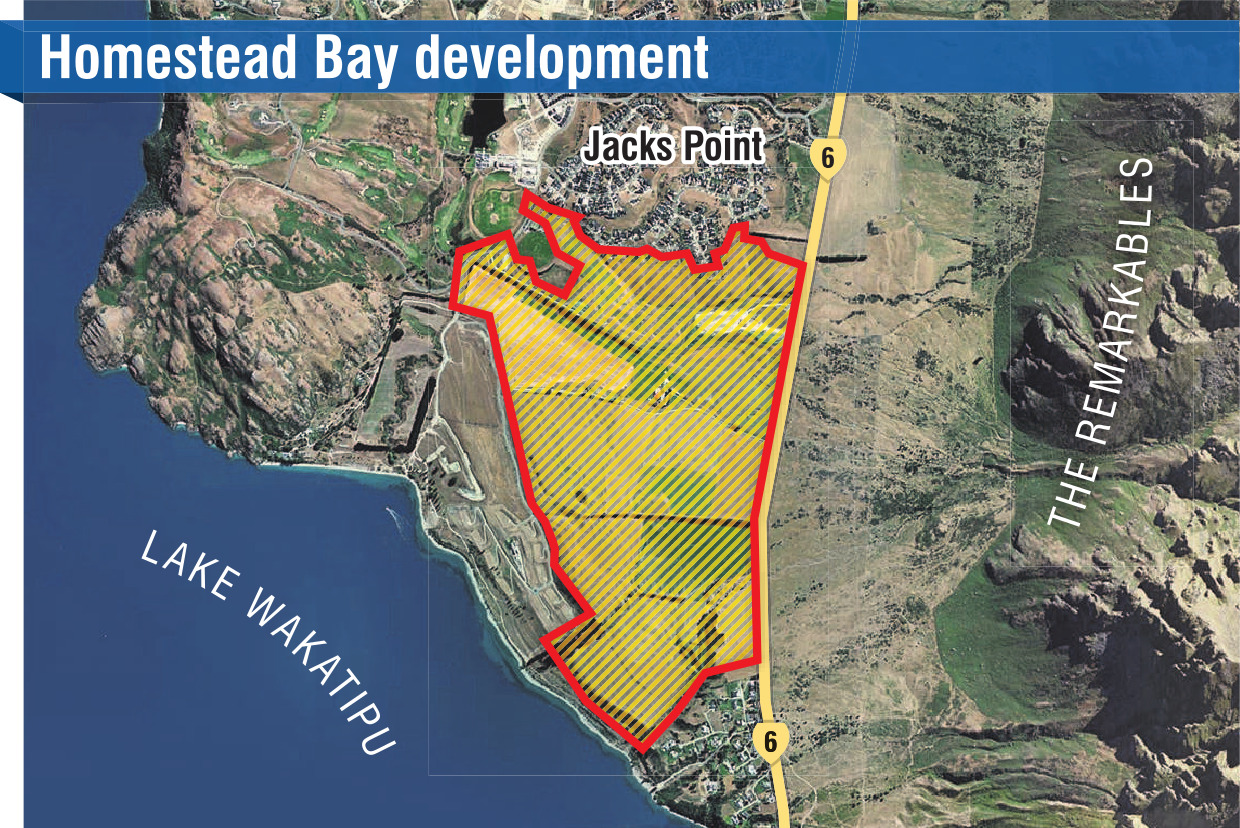
RCL Homestead Bay Ltd had applied through the fast-track legislation to develop land on State Highway6, between The Remarkables and Lake Wakatipu, known as the southern corridor.
The proposal is related to another company which has developed the nearby Hanleys Farm community, under the same parent company as RCL Homestead Bay Ltd.
The application was for 1438 standard residential lots, 22 medium-density superlots allowing for 203 future residential units and 14 high-density superlots allowing for 890 future residential units. Combined, the proposal will provide 2531 residential units in 205ha.
But the fast-track application was changed to the initial 1438 lots.
The application was heard by a panel made up of Queenstown lawyer Jayne MacDonald (chairwoman), environmental scientist Dr Jane Kitson, engineer Alan Pattle and resource consent hearing commissioner Rosaline Day-Cleavin.
It has released a draft decision approving the development with conditions and is seeking comments from invited stakeholders and the applicant.
Some stakeholders were against the proposal, citing concerns over traffic, wastewater and the layout of the subdivision. They were asked to comment in October.
The Queenstown Lakes District Council (QLDC) had questions about the two options for wastewater: connecting with the council scheme or putting in a stand- alone system.
Connecting with a council scheme at Hanleys Farm was not possible as any spare capacity was taken up with houses not yet built in already zoned areas.
A standalone system would alter stream ecology and possibly affect Lake Wakatipu.
It was also relying on a private entity to manage discharge consents and there was a risk to groundwater quality and drinking water supplies.
The Jacks Point Residents and Owners Association said it had issues over development wanting to use land which was set to be used for wastewater for Jacks Point residents.
There would be adverse traffic effects on Jacks Point residents.
Landscape architect Joanna Dey said while the intent to address housing demand was understandable, the approach assumed Queenstown could absorb urban-style growth in the same way as larger, less constrained regions.
"It cannot. The district’s geography, infrastructure limitations and dependence on its natural landscape make it fundamentally different. QLDC cannot simply continue to say ‘yes’ to central government pressure for more housing without first asking whether this location is suitable or sustainable," she said.
"If growth continues without careful management, the very qualities that make this district desirable — its landscape, community character and liveability — will be permanently eroded.
"The signs of this are already visible. It is therefore essential that future development is executed with foresight and restraint. We have one opportunity to get this right," Ms Dey said.
Principles such as wide-open and easy-to-see reserves and the southern approach to Queenstown along SH6 needed adequate setbacks and layered planting buffers, she said.
"A development that disregards these principles risks permanently degrading one of New Zealand’s most iconic landscapes."
The panel found the evidence of the applicant’s planning expert Hugh Nicholson helpful. He said the development would bring a well-designed and compact urban form that would be a desirable, healthy place to live.
The panel said many submitters emphasised the location of the site between the two Outstanding Natural Landscapes of Lake Wakatipu and The Remarkables.
But landscape change from a rural to an urban environment was an anticipated outcome of the development and aligned with the strategic direction for the southern corridor, it said.
The Otago Regional Council said there were inconsistencies between the project and key public transport plans and policies.
NZ Transport Agency Waka Kotahi said the combination of developments, the application and those consented and plan-enabled, along the southern corridor would soon exceed the capacity of SH6.
However, the panel said no expert transportation evidence was provided by any commenter.
In a fast-track context, it was neither necessary nor equitable to require the applicant to fund corridor-wide, public-led works beyond the scale of its effects.
"The package of upgrades the applicant will deliver, including the new SH6 roundabout at Homestead Bay and staged intersection works, represents a substantial and proportionate contribution," the panel wrote.
Regarding water issues, an expert conference had resolved all technical points of difference, the panel said.
It decided the applicant could either connect with the council system or use an onsite system.
Stakeholders have until January 21 to respond while the applicant has a week after that to set out its response.


