
PHOTO
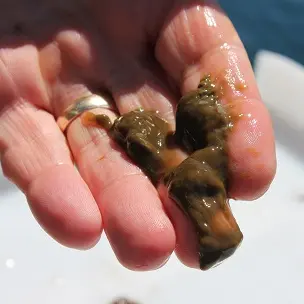
More research on more effective cleaning methods for boats and equipment, to stop the spread of lake snow, is being considered, the Ministry for Primary Industries (MPI) says.
Industries manager, recovery and pest management John Sanson said MPI recently commissioned Niwa to look at whether the check, clean, dry protocol promoted to stop the spread of the lake weed didymo would also work for lake snow.
The research found clean, check, dry was appropriate for use with lake snow, with a little bit of extra exposure time, as lake snow was a slime that tended to cling more than lake weed.
The Niwa research also identified an opportunity to further investigate other readily available products that could be more effective treatment methods for use with boats, for example.
"Alongside other agencies, we are considering any additional research that might be required on other cleaning methods and how we can get a better idea of where lake snow may be in New Zealand."
Last week, the Otago Regional Council said research it had commissioned into the origins of the algae responsible for creating lake snow showed it was highly likely to have come from outside New Zealand.
Genetic testing of lake snow samples by the report author, Landcare Research, found that specimens from Lake Youngs, in Washington State (US), and all New Zealand lakes were identical in more than one respect.
The mucus known as lake snow or lake snot was first discovered in Lake Wanaka in 2004.
It was formally identified by Otago University freshwater scientist Dr Marc Schallenberg in 2008.
Dr Schallenberg said he was not surprised Lindavia intermedia (the algae responsible for creating lake snow) came from overseas.
"Because people hadn’t reported it before the early 2000s, many of us [researching lake snow] thought it had either mistakenly been brought in or there was the possibility it had been here and some environmental changes had occurred to favour it blooming and dominating.
"This is a really good piece of evidence we can build on," he said.
Catchments Otago director Prof Gerry Gloss said the finding that lake snow was an introduced organism had major implications for management; it had changed the management focus from a local to national issue.
"The finding could have implications for how we use the lake, and raises the possibility of restrictions on movement of boats and equipment between lakes."
On Wednesday, the Ministry for Business, Innovation and Employment announced a million-dollar three-year Endeavour fund grant to Landcare Research to determine the causes of lake snow production.
Prof Gloss said Dr Schallenberg would be directly involved in aspects of The Lake Snow Toolbox research project.
Dr Schallenberg has spent the past week as part of an ORC-funded University of Otago research project taking sediment cores from alpine lakes to determine when lake snot arrived in New Zealand.‘‘We can’t assume necessarily that lake snow came here at the same time as didymo.
"It could have been here as far back as 150 years ago, when salmon and trout were introduced; we just don’t know."
Dr Schallenberg said although we could not eradicate lake snow from our lakes, we could learn from this to be more vigilant and prevent future invasive species from being introduced.
"All these incursions into the natural scheme of things teaches us how vigilant we need to be, particularly with more and more tourists coming here."
ORC environmental monitoring and operations director Scott MacLean said check, clean and dry was still extremely important for freshwater biosecurity in general.
He said this summer the ORC freshwater biosecurity advocates stationed on key boat ramps would "add lake snow to their dialogue with boaties".
kerrie waterworth@odt.co.nz