
PHOTO
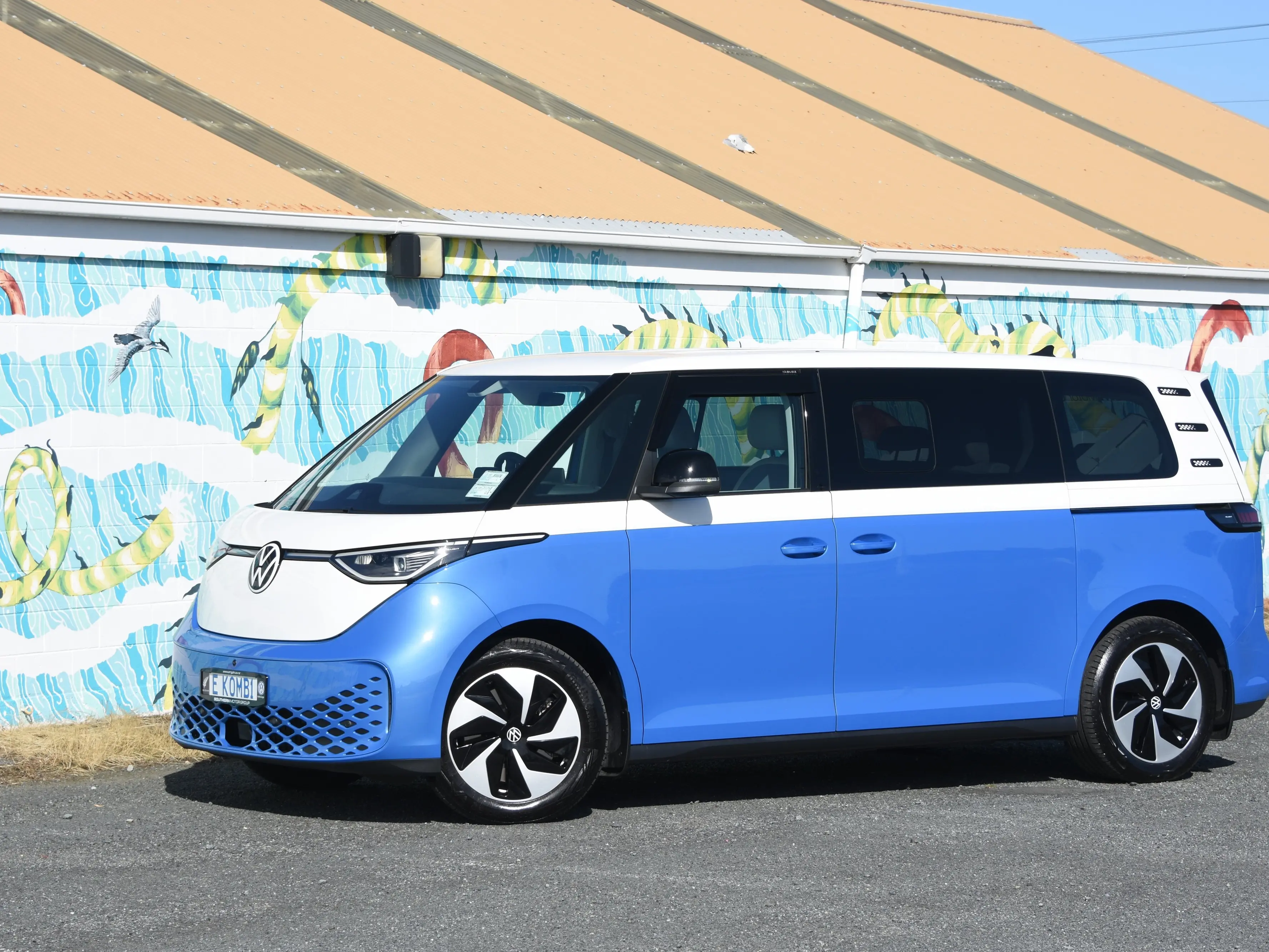
It may have taken three years for Volkswagen’s ID. Buzz to make it to our shores since it launched in Europe, but that hasn’t stopped it turning heads and drawing all manner of comments since landing here midway through 2025.
In many respects, the delay has been no bad thing, since the version we see takes what, for Europe, is an updated specification with a new drivetrain that delivers more power, longer range and faster charging. The update also provides greater flexibility in how the vehicle is configured.
While seeking to capture the iconic spirit of the original Kombi, the ID. Buzz is a thoroughly modern, fully electric machine. It’s designed around the MEB passenger vehicle platform, which underpins multiple all-electric models across the Volkswagen Group (Audi, Cupra, Skoda and VW), as well as being licensed to Ford.
For a model that was always expected to sell in relatively low volumes, the ID. Buzz is available in quite a few different forms, embracing normal and long-wheelbase versions, cargo van and passenger-carrying variants, different seating configurations and both single-motor rear-wheel drive and dual-motor all-wheel drive options.
While the normal-wheelbase ID. Buzz features a 79kWh (usable) battery, the long-wheelbase variants deploy an 86kWh (usable) battery.
Drivesouth’s appraisal is based on time behind the wheel of the long-wheelbase Pro.
What’s it look like?
This side of the original — and far, far smaller — hippie-era Kombi, there is simply nothing else on our roads that looks like the ID. Buzz. Its bluff nose, short overhangs, expansive glasshouse and upright tail provide more than a passing nod to the Kombi, but look beyond the cheerful stance and the execution of the design is thoroughly modern.
One thing you can be assured of is that the ID. Buzz will draw looks, waves and more than a few passing comments. Early in my time with the test car, someone told me it looked like a giant jelly bean. I’ve never seen a two-tone jelly bean, and I’m not sure whether the description was meant kindly or cruelly, but either way it’s been hard to shake.
What is standard?
All ID. Buzz passenger variants are equipped with matrix LED headlights, power-operated sliding doors on both sides for rear cabin access and a power-operated tailgate.
A 12.9-inch central touchscreen runs Volkswagen’s latest updated infotainment software. Smartphone mirroring and wireless charging are also standard across the range. Multiple USB-C ports are located across all seating rows, and tri-zone climate control is fitted. The GTX adds a head-up display, Harman Kardon premium sound system and power-adjustable heated front seats with memory function.
What can be optioned for the ID. Buzz is almost as important as what comes as standard. Indeed, Volkswagen holds very few standard-specification ID. Buzz vehicles in stock, on the basis that customisation will be the norm. You’ll likely want the two-tone paint for starters, perhaps some different wheels, maybe a colour-themed interior and potentially a whole lot more besides. Volkswagen claims over 2000 potential configurations when factoring in paint, interior and accessory options.
The ID. Buzz carries a maximum five-star safety rating, and its safety specification is comprehensive across the range. There’s a full suite of active safety systems and warnings, including adaptive radar cruise control and driver fatigue monitoring. Safe Exit Warning is a handy inclusion, using radar sensors to detect approaching traffic and alert passengers via LED lights in the side mirrors and an audible tone, with the ability to delay door opening, too. Pleasingly, none of the monitoring or warning systems felt overly intrusive on test.
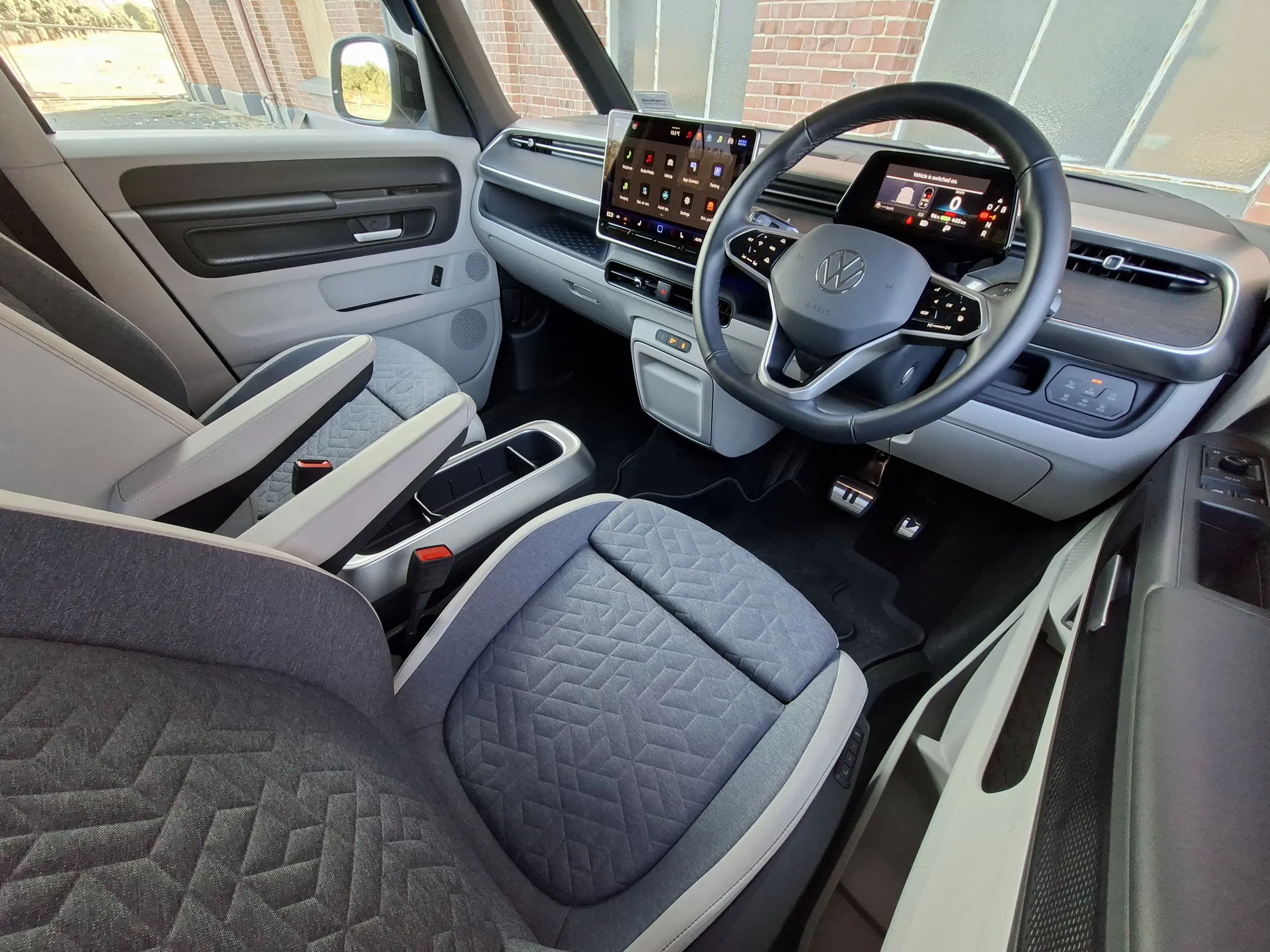
Amid a sea of relative sameness in the large SUV and people carrier world, the cabin of the ID. Buzz stands apart with a look and feel that is both distinctive and playful, yet undeniably practical.
Sliding-door access to the rear on both side of the vehicle is an absolute boon, and first impressions naturally focus on the sheer amount of interior room. Aided by the flat floor, high roof and vast glass area, the cabin feels airy as well as spacious — an impression that holds regardless of which of the three rows you’re seated in.
A six-seat configuration is available, with a pair of captain’s chairs in all three rows, but the norm for the LWB is seven seats, with three-person accommodation in the middle row. The good news is it’s genuinely possible to carry adults comfortably in all three rows.
Up front, the driving position is high and commanding. Front-seat comfort on the test car was enhanced by heating, cooling and even a massage function.
The central touchscreen is clear and responsive, and I found the smartphone integration seamless on test.
What’s it like to drive?
The test car proved engaging to drive, albeit in a somewhat unconventional way.
Even as someone accustomed to driving between 30 and 50 different models each year, I found the cab-forward driving position took a little adjusting to. With the long wheelbase, I was also very conscious around town of deliberately taking wider lines through 90-degree turns to avoid accidentally clipping the kerb with the rear wheels.
In urban environments, what’s happening more than 4m behind the driver can be something of a mystery, though this is largely mitigated in the ID. Buzz by its array of cameras and driver-assistance systems. The vehicle is also quite wide, so care is required both when choosing parking spaces and during manoeuvring. On the plus side, forward and side visibility is excellent, the steering is light and an 11.8m turning circle is respectable given the vehicle’s size.
As with most electric vehicles, the ID. Buzz accelerates briskly from rest with very little fuss. Beyond city limits, its acceleration is less dramatic, but it cruises quietly and comfortably and still offers ample overtaking performance at highway speeds when required. [Abridged]