
PHOTO
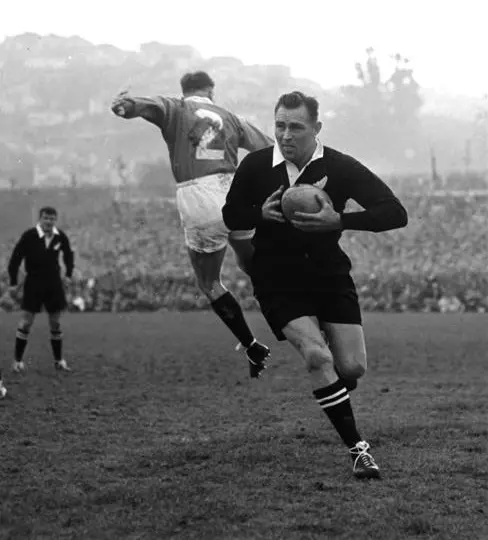
The victory was New Zealand's, or rather Don Clarke's, with a record six goals from penalties, three of them magnificent kicks.
But the day, for the 41,500 spectators at Carisbrook and for the 5000-odd who lined vantage points outside the ground, belonged to the Lions.
The record books will show that the All Blacks won 18-17 - by six goals from penalties, to four tries, a conversion and a goal from a penalty - but they will not show that the team which played the better attacking rugby was beaten on Saturday.
There is no doubt that the Lions made far more use of the opportunities which came their way from broken play than the All Blacks did.
There is also just as little doubt that in direct contrast to some of the All Blacks forwards, every man in the Lions team played to the utmost of his endeavours for the whole 80 minutes of the match.
It was cruel luck for them that they had to lose the match to a team which did not score a try and, what is more, rarely looked like scoring one.
But the team lost, and lost because it did not play to the rules of the game.
Most of the penalties from which Clarke kicked his goals were for flagrant breaches of the offside rule.
In a way, it was rather amazing to see the Lions paying so little heed to the danger of being penalised inside their own ball when Clarke was in such magnificent form with his boot.
They paid the penalty for their carelessness, but there is little joy in the whole of New Zealand, including the All Blacks camp, that the test should be won by penalty goals.
Nor should the All Blacks be happy.
Surely, no All Blacks pack of the past - even the one which was humbled by an inexperienced Australian pack in the second test at Christchurch last year - ever played so ineptly as the New Zealand eight did on Saturday.
Statistics
The Lions had the edge in the set scrums, where A. R. Dawson took the only two tight heads won during the day, were beaten in the lineouts by 32-12, and were outrucked.
To complete the statistics, the All Blacks were penalised 17 times, the Lions 20.
But possession statistics do not tell anything like a true story, particularly in the lineouts.
In this phase of play, it was remarkable the number of times the Lions poured through on the New Zealand halfback, R. J. Urbahn, either forcing him to kick hurriedly or to pass erratically.
There were other times when Urbahn was beaten to the ball as N. A. Murphy, J. Faull, W. R. Evans and G. K. Smith tore through the end of lineouts almost at will.
This was where New Zealand expected to make its drive through, with P. F. Jones, E. A. R. Pickering and B. E. L. Finlay teaming up to tear a strip off the opposition.
Finlay could not, because he injured a knee early in the match and was more or less a passenger from then on, and Jones and Pickering did not.
Instead, they allowed the Lions to take the initiative and retain it.
Jones did not play like the Jones of the last two tests against the Springboks.
He was the most spasmodic worker on the ground and his covering at No 8 was almost non-existent.
In his defence, it can be said that he injured a leg during the match. But this injury was received subsequent to A. J. F. O'Reilly's scoring a try from a superb movement initiated by A. W. B. Risman.
Jones was nowhere in sight when O'Reilly touched down, although at practice on Thursday afternoon he had shown amazing pace to cover a flashing back movement from the first five-eighth to wing.
Before ending comment on the lineout play of the All Blacks, I cannot understand why New Zealand persists in playing its best lineout jumper, I. N. MacEwan, at No 3.
MacEwan caught the ball more cleanly than any other forward on the ground, but to what effect? If New Zealand wants to attack from lineout play, then MacEwan would be far better placed at No 5 or No 6.
In the loose, the All Blacks were in second place for most of the match. They did not have the intense fire and drive which marked the play of the Lions pack.
Only one New Zealand forward was on the job for the whole 80 minutes - I. J. Clarke, one of the best forwards on the ground.
MacEwan was next to him in order of merit in the All Black pack, but all the others have played better.
What a different tale there might have been to tell had the All Blacks forwards gone about their work all the time as they did three or four during the match.
Whenever they sensed a scoring opportunity, they went into rucks with the will to win expected of men of their men of their calibre.
In the times in between, they lapsed back into mediocrity.
All honour to the Lions forwards for the part they played.
They went much better than the packs they have fielded in recent matches, and if they do not as yet rate as great forwards, they certainly matched New Zealand where New Zealand did not expect to be matched.
The All Blacks backs, especially the three-quarters, were given little opportunity to show their paces on attack.
There were three reasons: The close attention paid them by their opposite numbers and the Lions winging forwards; the indifferent service at halfback for which the All Blacks forwards were partly to blame; and faulty kicking by first five-eighth R. H. Brown, in particular, and by Urbahn.
Whenever the Lions backs sensed that New Zealand was going to win possession, they were up flat on the All Blacks backs in a flash.
Sometimes Brown was able to get the ball away when his outsides had enough room to spin it on, but often he was forced or elected to kick.
The kicks were not the kicks for the occasion.
Where all he needed to do was to drop the ball just behind the Lions backs, he persisted in either kicking high up field or for his forwards, who were not on the job.
Almost invariably, the Lions had these kicks covered before they landed, and often they relieved pressure by marking.
Some of them were fine marks, too.
T. R. Lineen had his moments at second five-eighth and seemed a man who would have gone places given the opportunities.
But the man who could well have put New Zealand fairly and squarely in the picture was centre R. F. McMullen. Every time he ran with the ball, he had the Lions nonplussed, and given good service he could well have been the best back on the field.
Neither wing had any real opportunity to show his places on attack. Neither showed any prowess on defence.
As a goal-kicker, it was Don Clarke's day at Carisbrook.
His general play was sound and he made one or two excursions into the backline, but as a fullback, he impressed no more than did K. J. F. Scotland, who played a grand game for the Lions.
The Lions backs entered the match in a defensive frame of mind, and in the first 20 minutes they were content to keep the game confined to the touch lines.
They did not get as many opportunities as the All Blacks did from broken play, but what chance they did get they turned to account.
Only one of the four tries scored came as the result of a movement engineered by the Lions initially.
This was O'Reilly's try.
The others were scored from mistakes made by the All Blacks when they were on the attack.
Match report reproduced from the ODT, Monday, July 20, 1959.