
PHOTO
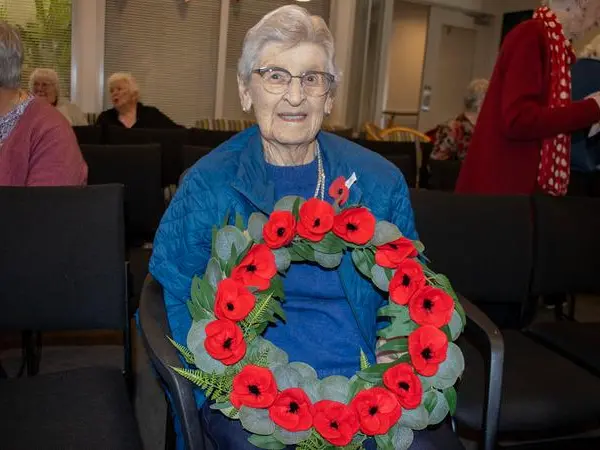
More than eight decades after losing her husband in World War 2, Gladys Harrington was overcome with emotion as she laid a wreath at her Christchurch retirement home.
Gladys attended the Bupa Cashmere View Care Home Anzac service on Friday.
Her husband, Flight Sergeant John “Jock” Gold was killed in 1944 when his four-engine bomber crashed during a training exercise.
Gladys, 102, said she thought of Jock during the entire service.
“It brought tears today.”
Originally from Dunedin, Gladys met Jock at a Joe Brown Town Hall Dance in the city.
“All the girls danced together, but he came over and asked me to dance with him.”
She said Jock was very interested in cars, but wanted to be a pilot when he got the call-up to enlist for WW2.
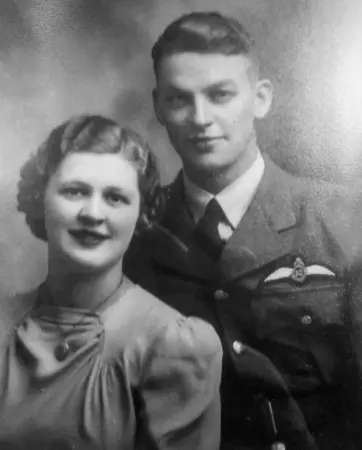
He was 21 at the time and was posted to the Royal NZ Air Force base at Wigram in Christchurch in March 1942.
After completing his elementary flying training, Jock was awarded his flying badge in May 1943 and was sent to Brighton in England.
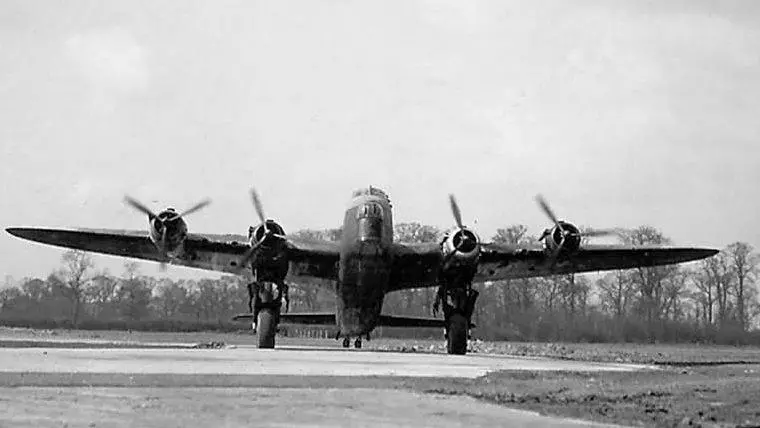
In July 1943, he started his advanced and night flying training. He flew Wellington bombers before converting to the four-engine Short Stirling.
On April 20, 1944, when he was 23 and held the rank of Flight Sergeant, Jock took off from the RAF Stradishall base in Suffolk. He was at the controls of his four-engined Stirling heavy bomber for a long cross-country night exercise.
The experienced seven-man crew had already completed 22 training flights and had one flight remaining before they were due to be posted to operational duty with No. 75 (New Zealand) Squadron RAF the following day.
But after a successful training flight, two engines cut out as Jock was landing about 11pm. The port wing dropped and the aircraft plunged head-on into the runway in front of the control tower. The plane burst into flames.
Jock and three other New Zealand crewmen, Flight Sergeant William Aitken, Flight Sergeant Godfrey Weston and Flight Sergeant Douglas de Laney, along with Englishman Sergeant John Cooper were all killed instantly.
The mid-upper gunner, Frank Hudson and rear gunner, Hector Frew, both survived. They managed to escape the plane before the bomber's high-octane fuel exploded.
Gladys said she was pregnant when Jock got the call-up to go to war.
“He never saw his son.”
She was at home with her mother and father when they received the bad news about her husband.
"The world dropped - it just was terrible."
Gladys went on to remarry and have another son.
“Jock told me before he left, please if I don't come back go on with your life.”
Gladys has been to his grave at the RAF Regional Cemetery in Cambridge, England.
“Even now I can still see him in my mind. I wonder where he is now," Gladys said.