

PHOTO
New data shows more than $41 million has been spent on making high-risk intersections safer in a Canterbury district over the past five years.
It comes at a time when the Selwyn District Council is beginning to formulate what will make up its next 10-year plan.
Of the $41.274m spent, $13.057m was funded by NZ Transport Agency Waka Kotahi (NZTA) subsidies, and $5.038m came from developer contributions, according to data released under the Local Government Official Information and Meetings Act.
Since 2024, it has also ramped up the amount it is spending on upgrading signage and road markings at intersections.
In 2024/25, $152,808 was spent, and $408,005 in 2025/26.
Between January 1, 2020, and December 31, 2025, 620 crashes were recorded, with 62% caused by someone failing to give way or stop.
The majority of the $41.274m has been spent on putting roundabouts in on Shands and Springs Rds designed to funnel motorists onto the Southern Motorway.
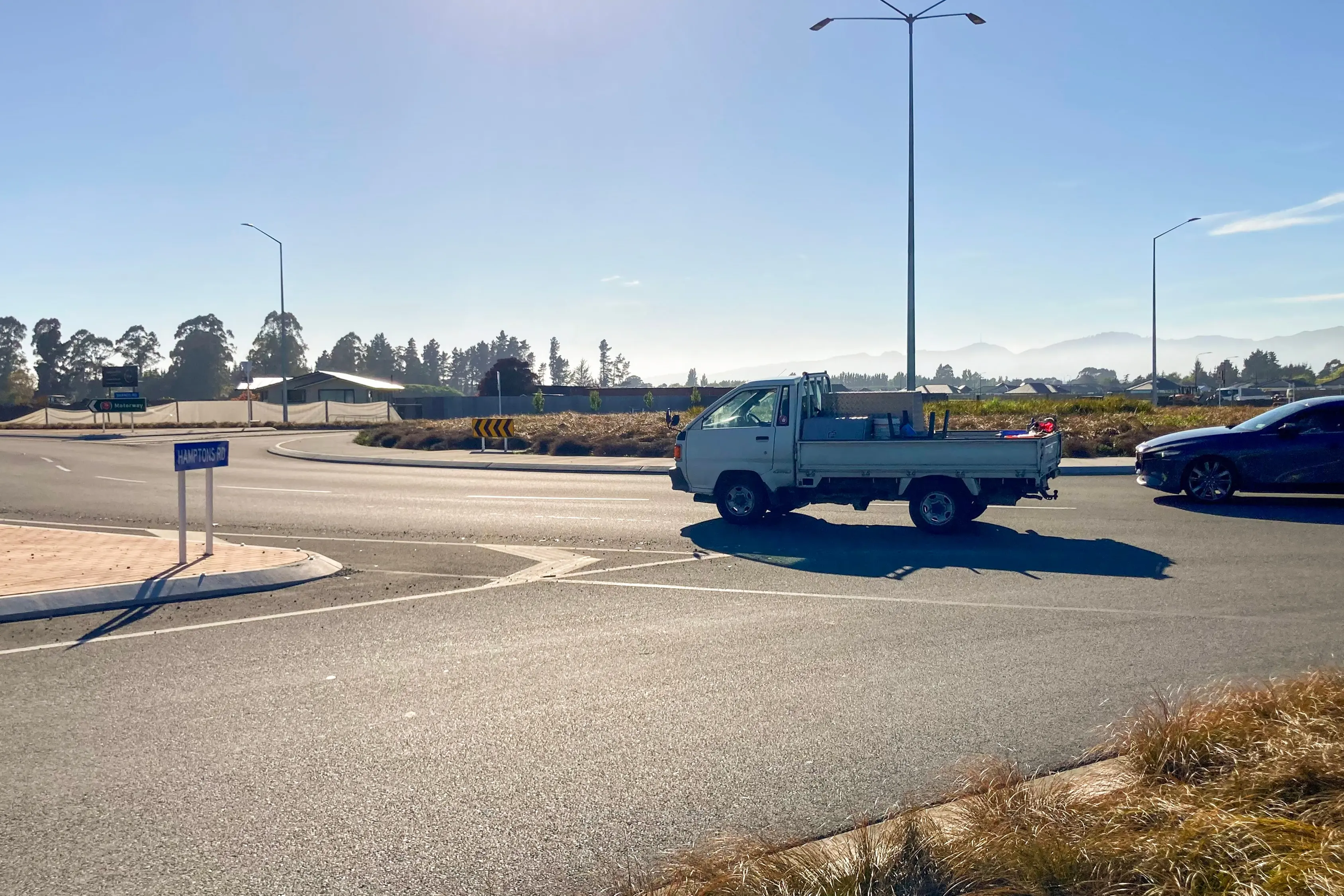
The biggest spend over the last five years was the Shands and Hamptons Rds roundabout, costing $10.513m, with 51% funded by NZTA and 7% by developers.
But the council is facing an uphill battle to fund the projects, particularly the larger roundabouts recommended for some of the district’s most dangerous intersections.
Next year, the council will have to comply with the Government’s planned 4% rates cap and faces a smaller funding pool for co-funded projects.

Councillor Denise Carrick said she was “worried” about the funding landscape heading into the 2027-37 Long Term Plan.
“I’m hoping they will be a priority, and if it means we have to cut something else, we will have to do that, which will be a difficult decision,” she said.
Carrick said it was too early to say what she would cut to get road safety upgrades approved.
“We haven’t got to that point yet.”
To receive co-funding from NZTA, the council has to make its case through the National Land Transport Programme (NLTP).
Council transport asset planning manager Yuwei Li told councillors at a briefing last month the signals from the current Government were that there was no money available.
“The signal from the Minister of Transport is that there is no improvement money in the next NLTP cycle, so if we decide on intersection improvements, it is going to fall mostly on council.”
Councillor Sophie McInnes said there was also a mismatch between the council’s long-term plan and the NLTP decision timeline, meaning the council may plan something but the funding may never arrive.
At the last NLTP in 2024, only two of the 35 projects for which the council had requested 51% funding were approved, leaving it with a $27m funding shortfall.
As a result, the council was forced to pull money from some projects, including rural intersection upgrades and two new roundabouts at high-risk intersections, to self-fund higher-priority projects.
McInnes said another issue Selwyn faces compared with the Waimakariri District was how people commute in and out of the district.
In Waimakariri, there was one main route into the city because motorists had to cross the river, she said. In Selwyn, people used a wider range of routes, spreading the council’s resources more thinly.
BIGGEST INTERSECTION SPEND
- Shands and Hamptons Rds roundabout: $10.513m, 51% NZTA, 7% developer funded.
- Shands and Trents Rds roundabout: $7.394m , 51% NZTA, 7% developer-funded.
- Lowes Rd, Levi Dr, and Masefield Dr traffic lights: $5.915m, no NZTA subsidy, 14% developer-funded.
- Springs and Marshs Rds roundabout: $3.395m, 51% NZTA, 17% developer-funded.
- Shands and Blakes Rds roundabout: $2.464m, 51% NZTA, 17% developer-funded.