


PHOTO
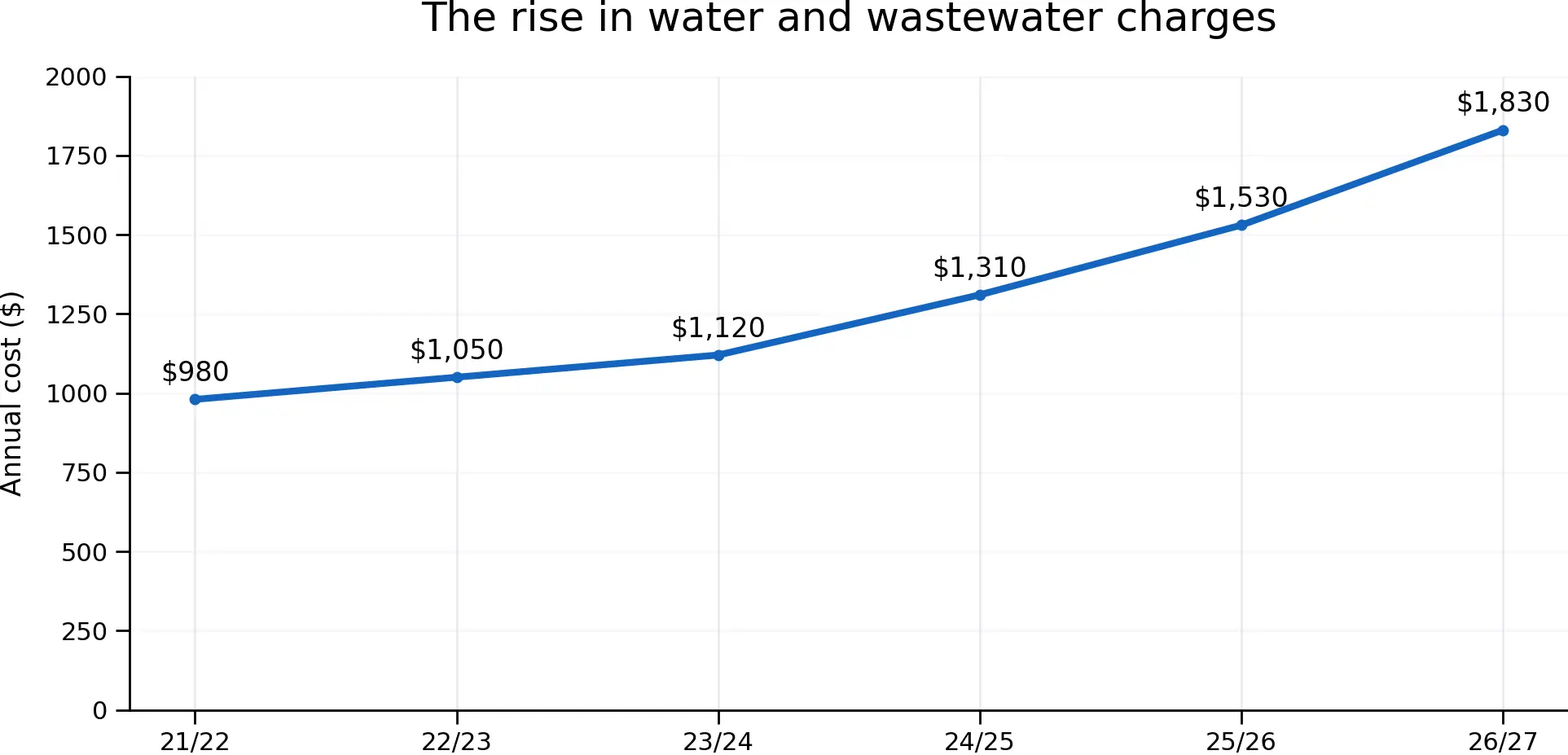
In the last five years, the cost of drinking and wastewater in a Canterbury district has jumped by 85%.
In 2021/22, a property that used the Selwyn district’s average of 257m3 of water over the year would have had a bill of $154.20. This year, that same household would be paying $380.
But the fixed charges that every property pays just to be connected to the network hit wallets the most.
The fixed charge was captured as part of a property’s general rates bill until July when Selwyn Water Ltd took over the network. The charges are now part of each household’s quarterly Selwyn Water bill.
Fixed charges help pay for the network maintenance, treatment facilities, and renewals.
Since 2021/22, the fixed charges for drinking water services has increased from an average of $267 a year to $498, while the wastewater fixed charge has risen from $564 to $952 a year.
Put it all together, and the average household bill for water and sewage has increased by 85%, from $985.20 a year in 2021/22 to $1830.36 in 2026/27.
Moving the fixed charges from the rates bill to the quarterly Selwyn Water bill has allowed residents to see a clearer breakdown of what they are paying for.
Many people have taken to social media to complain about the increasing cost.
One person wrote: “Another water bill and yet another big surprise. Usage 18m3 but the bill is in the hundreds.”
Another person wrote: “It's a ripoff. My rates (bill) dropped by $45 a month now water is costing $110 a month.”
Mayor Lydia Gliddon says people have raised the increasing cost with her.
“For a lot of households this is the first time they’ve seen their water costs on a separate bill rather than the line items that used to be on their rates bill, so some didn’t see them as a water cost.
“I understand why it’s a shock, and we need to explain the line items on the rates and Selwyn Water bills better.”
Gliddon is concerned price increases for households could become unaffordable.
“An 85% increase in five years is a lot for any household to absorb, and I know for some families it’s already tight.”
Gliddon said the cost increases have been driven by higher Government standards for drinking water and wastewater, the district’s ageing pipes and plants, and its fast growth.
“The work has to be done. Our job is to make sure every dollar is necessary, the work is well planned, and the cost is spread as fairly as possible.”
Selwyn Water chief executive Alex Cabrera said affordability was its key focus, alongside balancing public health and legislative requirements.
“Operating a water utility involves much more than the water that comes from a tap or the wastewater that leaves a property. Customer charges help fund the operation and maintenance of extensive networks, treatment and pumping facilities, regulatory compliance, asset renewals, resilience improvements and the infrastructure needed to support a growing district,” he said.
“Our task is to test those costs carefully, ensure growth contributes fairly to the infrastructure it requires, and balance necessary investment with affordability.”
Cabrera said residents are welcome to ask Selwyn Water questions about the fixed charges.
Local Government Minister Simon Watts said water services sector has had significant changes since four people died during a campylobacter outbreak in Havelock North in 2016,” Watts said
“While these changes have been balanced against keeping costs low for ratepayers, change was needed, and investment was in many cases long overdue.
“The reality for many communities was that their low water bills were due to not putting enough towards infrastructure and maintenance. That created a ticking time bomb which, at best, leaves ratepayers on the hook for even greater costs, and at worst poses a serious risk to life, as we saw in Havelock North.”
One of the main changes was requiring councils to chlorinate all water supplies.
In 2021, the council recognised it would increase volumetric charges more than rates were increasing. But the fixed charges had to be kept in line with the average rates increase.
Moving fixed charges out of the general rates also means the increases will not be included in the Government’s planned rates cap of 4%.
Initial forecasts based on the council’s 2024-34 Long Term Plan projected a 30% increase in bills in 2027/28, but Selwyn Water is planning to redo the council’s numbers.
As part of its initial strategy for 2026/27, Selwyn Water was able to reduce an estimated 24% increase to 18%.
Collectively, households were hit with an average 8.8% increase when bills from Selwyn Water were combined with a 4.5% average rates increase.
Cabrera said the company will be doing further engagement with residents as part of its 10-year Water Services Strategy.
“We agreed to an initial 12-month Water Services Strategy to allow time to reassess previous assumptions and develop a new, long-term strategy built on reliable data, community expectations and a forward-looking approach appropriate for a water utility,” Cabrera said
“As a new water utility, we are using this period to bring together financial, customer, operational and asset information to build a clearer picture of the cost of delivering water services both now and into the future.”
Gliddon and Cabrera said a target has been set on what next year’s increase should be reduced to.
Selwyn MP Nicola Grigg recognised any significant increase in household costs was concerning for many Selwyn families, retirees, and those on fixed incomes who are already managing tight budgets.
“I understand that some of the increases being experienced by councils reflect the substantial investment required to renew ageing water infrastructure and meet higher drinking water and wastewater standards,” she said.
Grigg said she would continue advocating for solutions that keep costs as affordable as possible for ratepayers.
“I will work constructively with Mayor Lydia Gliddon and Selwyn District Council to ensure local voices are heard as water service arrangements evolve.”
HAVE YOUR SAY: Do you think the cost of water and wastewater is becoming unaffordable? Send your views in 200 words or less to daniel.alvey@alliedmedia.co.nz
- Anyone concerned about their water bill can contact Selwyn Water on 0800 735 426 or email hello@selwynwater.co.nz