
PHOTO
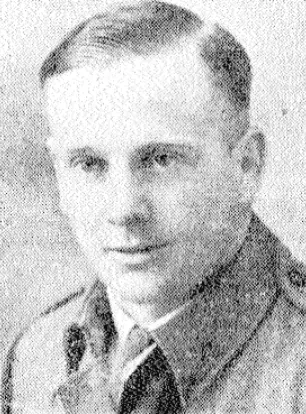
Private Karl William Hall was another casualty from the Italian campaign in World War 2.
An extensive obituary in a Timaru newspaper recorded that Karl had “died of wounds in Italy on October 18 1944”.
He was the fourth and youngest son of Charles Edward Timothy Hall and Annie Lucy Spring, who resided at 60 Harper St.
Born at Timaru on August 6, 1912, he received his education at the convent, Marist Brothers’ School and then Timaru Boys’ High School, which he attended from 1927-1932.
He took a prominent part in football and athletics and was a member of the First XV in 1930, 1931 and 1932, being captain in 1932.
He was also a prefect in 1931 and 1932.
He broke the then-record for the hop, step and jump, covering 39ft 10in.
After leaving school he continued his interest in athletics as a member of the South Canterbury Amateur Athletic Club, played tennis for St John’s Club and was a prominent member of the Old Boys’ Football Club, playing senior football from 1933-1940.
His obituary also recorded his employment with the Canterbury Frozen Meat Company as a member of the clerical staff in the fellmongery department at Pareora from the time he left school until he went overseas.
It was also reported that the manager of the freezing works, Mr W.S. Minehan, had spoke at his hearing with the Armed Forces Defence Board, saying it was in the public interest that Karl continue his employment at the freezing works.
The board disagreed and Karl entered camp in August 1942.
After training, he joined an overseas draft with the 23rd Infantry Battalion in August 1943 and sailed from New Zealand to the Middle East in January 1944.
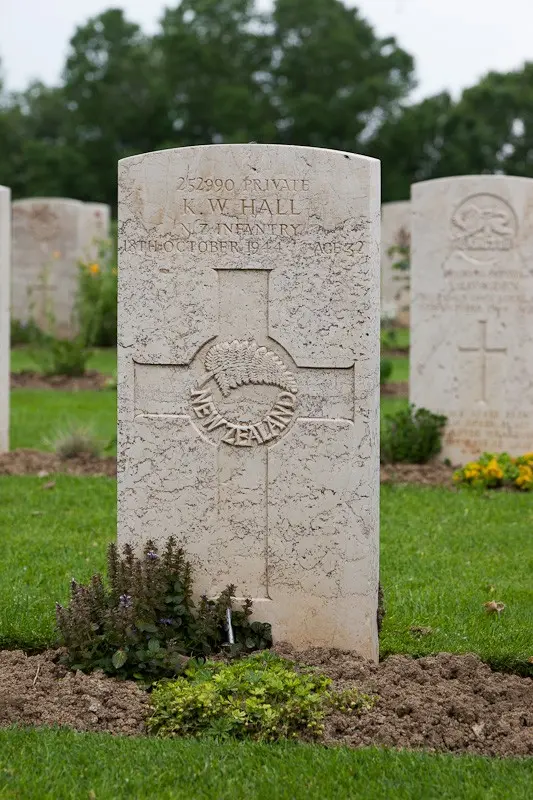
Karl lost his life during the Italian Campaign and was interred at Coriano Ridge War Cemetery, a resting place for many Commonwealth soldiers who fell during the fierce fighting in that region.
Coriano Ridge saw heavy action as Allied forces pushed north through the Gothic Line defences.
The battles around Coriano Ridge in October 1944 were part of the Allied campaign to break through the German Gothic Line in northern Italy.
This was a key phase of the Italian Campaign, and Coriano Ridge was one of the most fiercely contested positions.
There was heavy German resistance from the 1st Parachute Division and 76th Panzer Corps and along with the difficult terrain, they also had to contend with rain, mud and destroyed infrastructure making movement slow and supply lines vulnerable.
The New Zealand and Canadian units had a high casualty rate due to the exposed approach to the ridge and stiff German defences.
The war diaries record artillery duels and intense infantry combat lasted through much of September and into early October 1944.
By October 11 the weather cleared slightly, allowing the 2nd New Zealand Division to launch an assault toward the Pisciatello River and the town of Cesena.
On October 18, 1944 the 23rd Battalion was heavily engaged in clearing German strong points on the approaches to the Pisciatello.
The fighting was characterised by brutal infantry skirmishes around water-logged farmhouses, irrigation ditches and grape vines that hindered Allied tank movement.
The battalion faced relentless, highly concentrated German shellfire, which caused steady casualties among the advancing companies.
Karl died of wounds on October 18, 1944 probably from injuries incurred during this battle.
His last resting place is the Coriano Ridge War Cemetery along with many of his comrades.
He is also remembered on his parents grave In the Timaru Cemetery row 131 plot 77.
This grave has been cleaned by the Timaru Remembrance Army and a poppy attached to acknowledge Karl’s sacrifice.