
PHOTO
Laura Elliott takes in some new exhibitions.
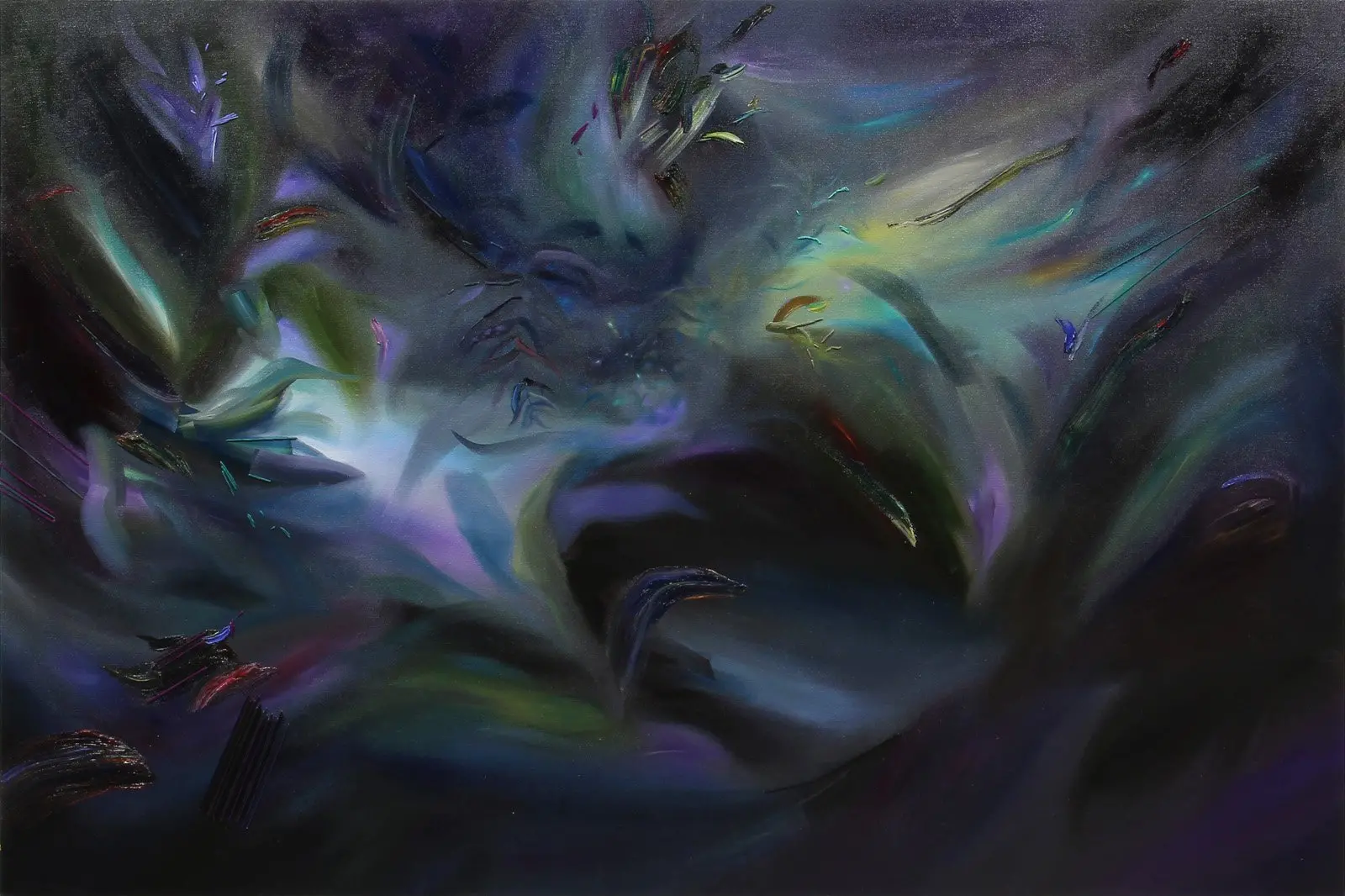
‘‘Flux”, Sarah Smuts-Kennedy, Molly Timmins
and Kate van der Drift
(Milford Galleries, Queenstown)
Exhibiting as part of “Flux” at Queenstown’s Milford Galleries (closed this week but reopening Saturday), Molly Timmins has a knack for turning the smallest ordinary details into something that feels special and almost mystical.
Striking and atmospheric, Timmins’s canvases echo from the Māori concept of te pō, the nurturing darkness before there was light and life, a space of infinite potential and imminent transformation.
Her Māori heritage and family history weave through abstracted gardens, the entwining roots of both endemic and introduced plants. In Bromeliad Garden Nightscape, the floral landscape becomes a scene of enormous depth and drama, order emerging from chaos, the darkness touched with infinite shades and degrees of colour and light, while Ripe Leafing is lit with autumnal fire, like the feathers of a phoenix.
Kate van der Drift’s gorgeous chromogenic photography is equally dramatic and other-worldly in appearance, turning small and fragile organisms into a sense of vastness and grandeur.
In several works, she submerged unexposed negatives into river water, letting sediment and aquatic life write their stories across the surface of the imagery, the setting itself becoming a means of creation.
Nearby, taking its title from a Mary Oliver poem, Sarah Smuts-Kennedy’s The Leaf Has a Song in It is a reminder to reconnect with nature, to remember the wonders we saw in the world as children are still there if we see them and listen for them. Her work perfectly captures that joy in imagination, the act of seeing beneath the surface.

“Encaustic Painting”, Jenny Hill
(Black Rabbit Cafe, Bannockburn)
In her latest collection, exhibiting at the Black Rabbit Cafe in Bannockburn, artist Jenny Hill delves further into encaustic painting, which involves mixing beeswax with pigments and damar resin, and fusing each layer with a heat gun.
The resulting works have almost the sheen of ceramic art, an incredible depth of colour and organic surface texture. The hills are threaded with veins of golden light in the jewel-toned Glow of the Land, while mist swirls over Lifting of the Fog, seeming to emerge from within the canvas, as if the imagery has merged with the elements and captured its own internal light source.
In groups of six, the smaller landscapes become intricate slices of life, windows onto different views and seasons, with stripped tree branches stark against a wintery sky, crystals glittering in a tumbling sea, and storms rolling across the plains.
Hill is known for her beautiful collage work, and the Evolving panels take the viewer from the infinite space of the sky above to the deep roots of the land below, grounding them on the shores of a turbulent sea.
In her Catch Up series, Hill celebrates her adult love of reading, after a childhood in which dyslexia made it difficult to always connect with stories - large jumbled letters tumble amidst images of native birds and plant life, tracing Hill’s travel and adventures through the New Zealand landscape, the ever-building stories of her own life and art.

“Nocturnes”, Tim Main; “Taonga is my USB Stick”, Michel Tuffery;
and “Villa Margaux”, Julia Holderness
(Gallery Thirty Three, Wānaka)
At Wānaka’s Gallery Thirty Three, Tim Main’s stoneware ceramic and oak ruru sculptures stand in silence to observe any curious visitors. It’s a mutual exchange of gazes, with the audience gazing at the owls and being studied in turn - suddenly we find that we’re the ones being examined, judged, seen in shades of both darkness and light. Main’s work is always invested with extraordinary sensitivity, breathing such life into his materials that you almost expect to hear the rustle of feathers.
Michel Tuffery’s "Taonga is my USB Stick” features work from his 2025 Lapita Studies, depicting shards of Lapita pottery and exploring the concept of artwork and treasures as carriers of knowledge, history and emotion. These objects pass through generations, from the hands and era that crafted them to the arms that hold, cherish and learn from them, connecting people and experiences over time. It feels especially pertinent in an age when the transmitting of knowledge feels increasingly impersonal, in some cases unreliable, and much of that important sharing of creativity and culture can be lost.
With the vivid and lively “Villa Margaux” series, artist Julia Holderness creates gorgeous, lush painted scenes and ceramics from an artists’ retreat in the 1930s south of France, through the lens of constructed artist Florence Weir. Via the character of Weir, Holderness explores art movements, travelogues, and the creation of art history, often subtly underlining the differences between the experiences of women artists and the narratives crafted about them.
- All three exhibitions open on Friday, July 3.