

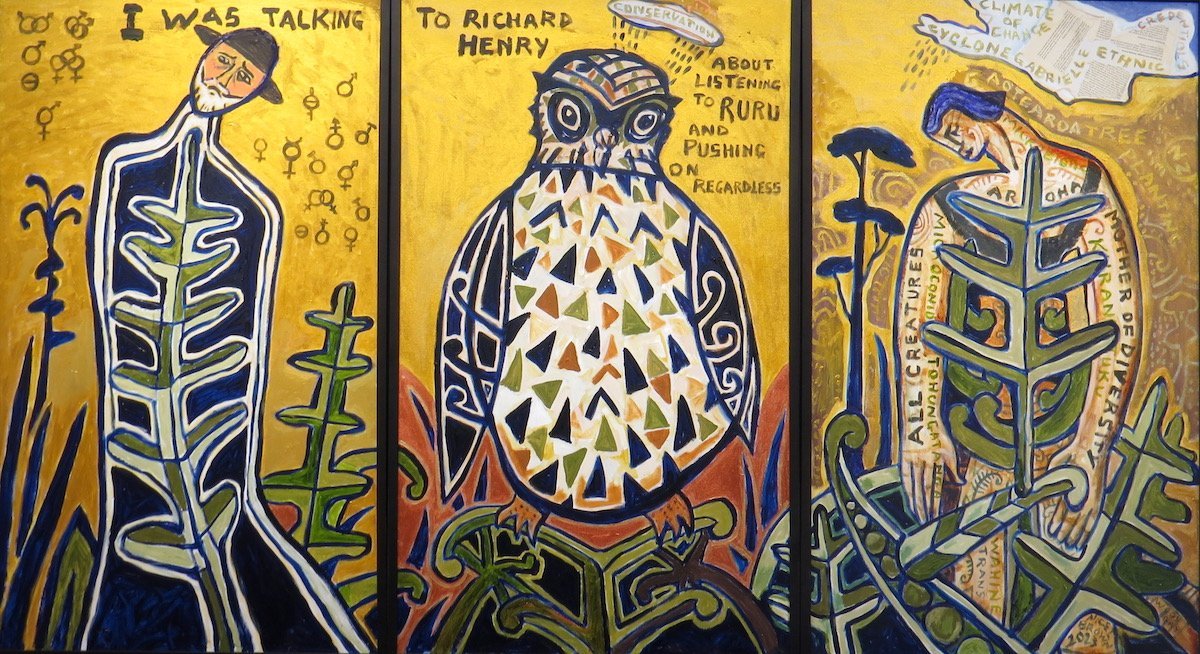
Nigel Brown is one of New Zealand’s most important living artists. His career is being celebrated by a major survey show at Milford Gallery.
The ability to see Brown’s works from the early 1980s to today allows us the opportunity to examine the artist’s development, themes and influences across more than four decades.
Early paintings, such as the Judith and Holofernes works, present a more realist style than Brown’s current works, but still display many traits found in his more recent pieces. The deliberate flattening of the scene, along with the use of painted internal frames, continue throughout the artists’ oeuvre.
Influences, from pointillism to cubism, are visible in many works and ‘‘Picasso’s guitarist’’ becomes a crooked-necked motif running through much of Brown’s career, reshaped into a black-singleted ‘‘Good Keen Man’’. The artist is also clearly inspired by his contemporaries and predecessors in New Zealand’s cultural scene, with Fomison and Baxter making frequent appearances and McCahon referred to in several of the works.
Brown’s trademark use of words framing adds to the poetry of his scenes, from the early landscapes to his strong narratives on New Zealand’s environment and our treatment of it. To get a thorough understanding of this major New Zealand artist, this exhibition is well worth a look.
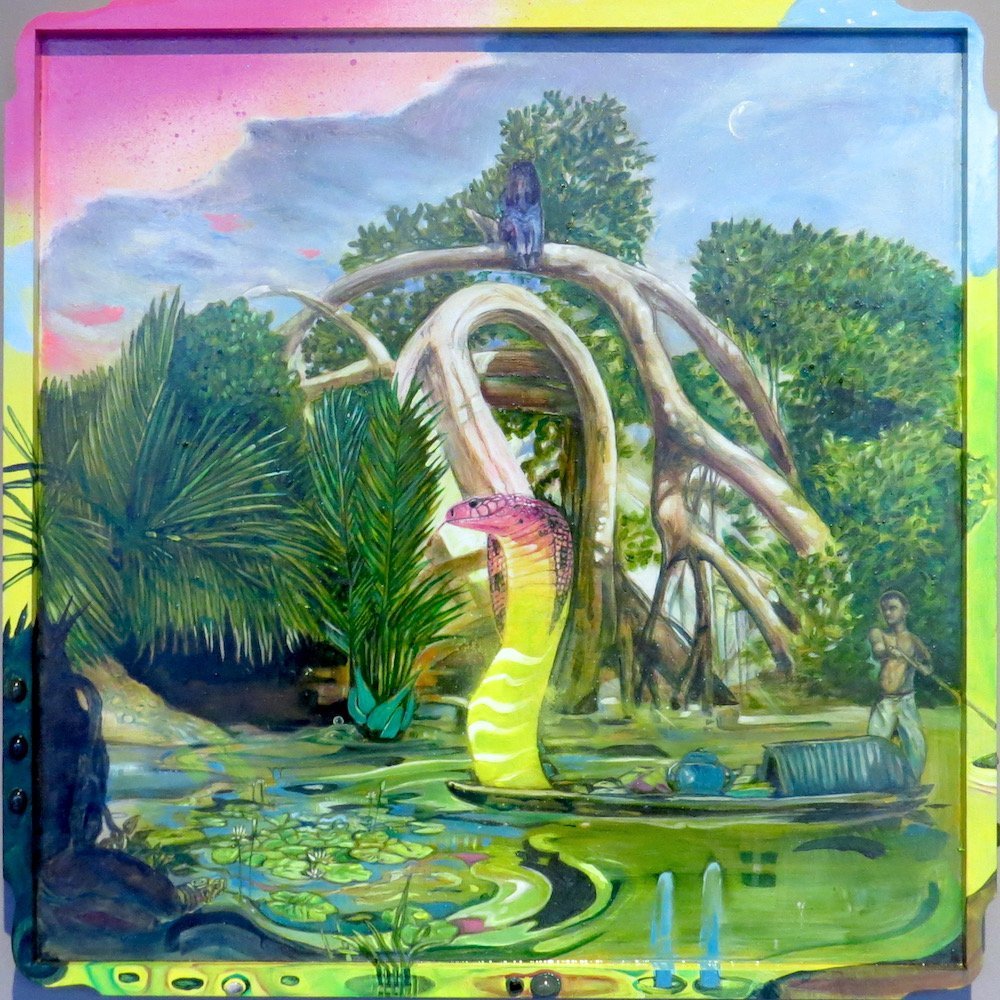
Guy Howard-Smith’s strongly surrealist works also speak of internal narratives, though the exact meaning of his symbolic language is far less clear-cut than those of Nigel Brown. The artist’s latest exhibition at Olga displays works relating to his search for his cultural roots amid the Anglo-Indian community in India.
Howard-Smith has created intensely busy paintings on individually created framed board, the artworks overflowing from the base across the enclosing timber. The busy juxtapositions within the works are reminiscent of Max Ernst collages, but here the images are painted, with the occasional addition of semi-precious stones.
These jewelled additions, when accompanied by the paintings’ repeating themes of ancient civilisation, supernatural forces and colonial rule, add to the mystery of the messages, though there is a pervasive suggestion of a search for identity among the shifting boundaries of being outside or inside two separate communities.
Overall, despite the bright colours of many of the works, it is perhaps the quieter pieces which have the most impact. The more muted The Piper and the Thieves and There are More Worlds than These have a soft intensity which may be less obviously present in those works where the brightness of the colours dominate.
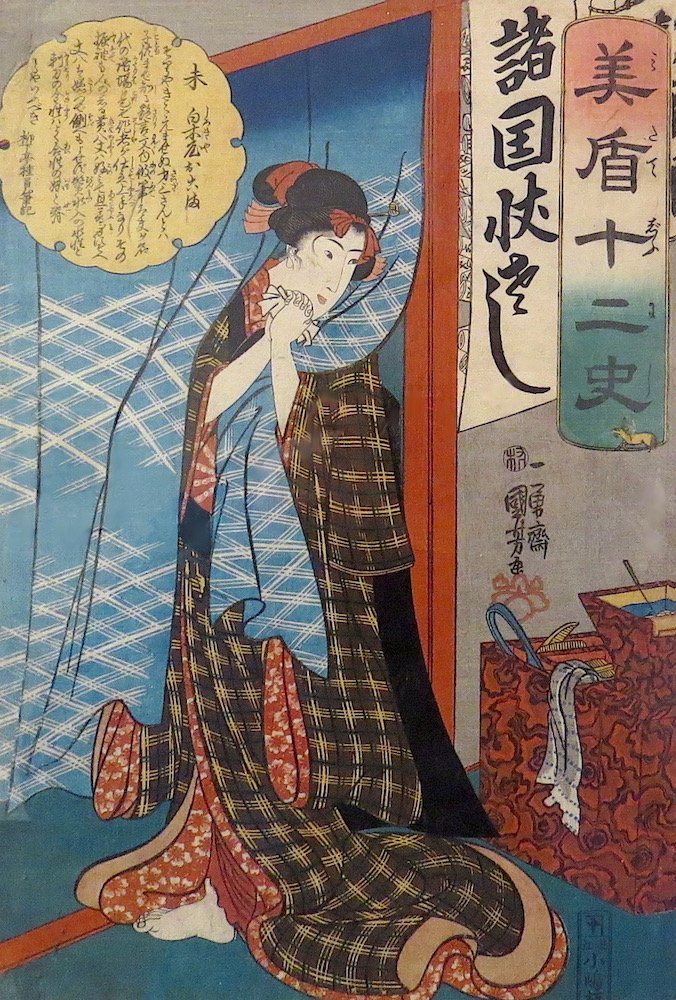
Brett McDowell is presenting his annual exhibition of antique Japanese prints at his gallery in Dowling St. The pieces date from the early to mid-19th century, many of them from the prominent Utagawa school of artists. The works, firmly within the ukiyo-e (‘‘floating world’’) genre, all depict society women of the time, whether they be actresses, wives of nobles, or prominent courtesans. These women are the ‘‘Bijin’’ (pretty women) of the exhibition’s title.
The works are charming and a wonderful window into an exotic culture of another era. They also display the incredible standards of the era’s printmakers. These woodblock prints not only required multiple pressings of different areas of the picture surface, but are notable for the astonishing intricacy of their design.
The skills required to produce the fine detail of Going to a Cherry Blossom Viewing Party or Goat (Hitsuji) — Shirokiya Okoma are extremely impressive and it is remarkable to think that works of this nature, now highly prized by collectors, were at one time mainly considered as cheap, low art.
An exception to this last comment is the fine Daikoku as a Kamuro, attributed to Gakutei Yashima. This work has the distinction of having been a specifically commissioned work.


![Anchor What? [maquette] (2002), by Morgan Jones. Plywood.](https://www.odt.co.nz/sites/default/files/styles/odt_landscape_small_related_stories/public/story/2026/04/maquette_for_anchor_what_2.jpg?itok=GIWsLOkh)

![‘‘The Ogee & Manaia’’ [installation view] from left to right: Manifold (2025); Up up up (2025...](https://www.odt.co.nz/sites/default/files/styles/odt_landscape_small_related_stories/public/story/2026/04/1_the_ogee_and_manaia_-_exh.jpg?itok=-BNex93K)

