
PHOTO
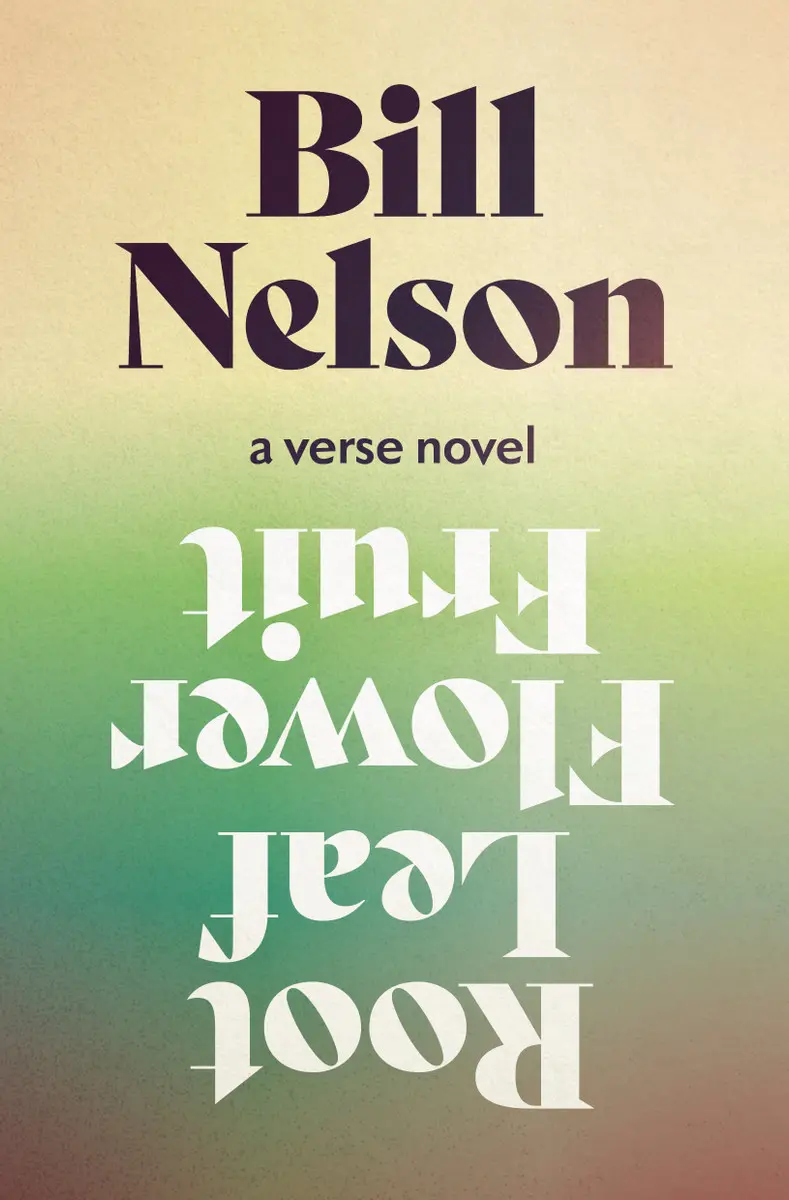
ROOT LEAF FLOWER FRUIT
Bill Nelson
Te Herenga Waka University Press
REVIEWED BY JESSIE NEILSON
From Wellington writer Bill Nelson comes a meditative work on the cyclical nature of birth and death, through the eyes of someone post-concussion. Like its title, Root Leaf Flower Fruit follows nature's growth through the seasons, through bounty and scarcity, as well as with transitions from rural to urbanised surrounds. The verse-novel format allows it its tranquillity. The narrator steps back from his visions and thoughts, letting the beauty of moments sweep by him.
The narrator, a father of young children, is walking carefully, looping through the neighbourhood of concrete culverts and roundabouts. It is a first venture out since his accident. The world feels different to him now, as if the furniture has been rearranged. He has been in hospital, the taste of mud in his mouth. Others are doubtful and imply he is too old to be riding. Yet, it is how he gets to know his world. He craves both the weightlessness and the deliberation. His children, too, can find their bearings as they navigate the urban geography.
His present state is one of disengagement, his memory returning, and concentration difficult. Though they tire him, he loves to read to his son and daughter, seeing how uncluttered they are. Their consciousness is an open question, a thing still flowering. His partner Latika, meanwhile, has a wind-up watch, the tiny pieces dismantled. Symbolically she is attending to repair, slotting it all together again into a workable state.
Like him, this man's grandmother is trying to thrive post-shock. She has had another stroke, and also time in hospital. While he is improving in physio, she is in slow decay. He mulls on this. Perhaps it is he in slow decay, and she has simply ‘‘left us behind, a side step/ to the left, maybe she was free’’. He is drawn to notions of floating free, a loss of responsibility. The narration tracks this as he enters a period of solitude.
This beautiful work glides between the present day and days of yore. The latter recreates the grandmother's story through a third person voice, where she was spellbound by the seasons and fertility, growing alongside the land.
Nelson's poetic inclinations are more than evident in this work. Prior to this, he published his debut poetry collection Memorandum of Understanding. This present work, too, consistently tends towards poetry. Nature is burgeoning and bright, while it is the human-made that is cumbersome. His body argues with itself, his back spasms. Even the farmhouse encroaches on the land. It was once transported, its ‘‘insides exposed... it planted its feet... But the scar remained’’.
Root Leaf Flower Fruit is startling in direction, as it roams far from the narrator's diminishing world, offering up all kinds of memories and regeneration.
Jessie Neilson is a University of Otago library assistant