

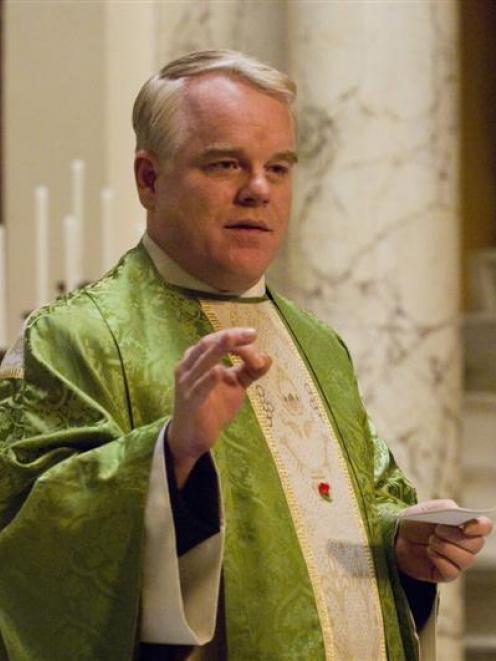
"My fingernails are always dirty," the Academy Award-winning actor concedes.
"Father Flynn wouldn't like me."
Father Flynn is Hoffman's latest incarnation, an affable, charismatic priest in the drama Doubt, based on the Tony Award and Pulitzer Prize-winning play by John Patrick Shanley.
Set in New York's The Bronx in 1964, Father Flynn is cornered into a fiery showdown with the stone-faced principal of the local Catholic school, Sister Aloysius, played by Meryl Streep.
Sister Aloysius accuses Father Flynn of molesting the school's only black student, setting off electric scenes between Hoffman and Streep.
Three years ago Hoffman claimed the best actor Oscar for his performance as literary celebrity Truman Capote in the biopic Capote, nudging out Heath Ledger's performance in Brokeback Mountain.
A year ago he was back in a tuxedo at Hollywood's Kodak Theatre, nominated for an Oscar for his supporting performance as a foul-mouthed, renegade CIA agent in Charlie Wilson's War.
Hoffman had better send the tux off to the dry cleaners again.
If pundits are correct, the tubby, scruffy 41-year-old will have his third Oscar nomination in four years for his portrayal of Father Flynn.
One of Father Flynn's habits is to fastidiously clean his nails, something the actor ashamedly admits he does not relate to.
"No, I should really clean mine," Hoffman, laughing slightly, says.
The interview is taking place in one of Beverly Hills' opulent hotels, but Hoffman is dressed in crumpled T-shirt, jeans and the Texas University Longhorns cap.
His grey beard is wild and unkempt and equally untamed hair pokes out from the cap.
The New York-born-and-based actor says this is who he is - a no-frills actor refusing to let fame or the Oscar change his persona.
"Movie star? I just can't relate to that," Hoffman offers.
Standing at 1.77m and with a roly-poly figure, Hoffman is not the typical Hollywood leading man, but his name is now sought after by studios to add prestige to a film.
It appeared to be an odd choice to cast him alongside Tom Cruise as the villainous Owen Davian in 2006's Mission: Impossible III, but Hoffman showed he could play a bad guy just as well as the pompous Freddie Miles in 1999's The Talented Mr Ripley or the jovial priest in Doubt.
He views the Oscar as largely a blessing, allowing the actor to pursue his own projects including his film directing debut, Jack Goes Boating, based on the play by Bob Glaudini, set to go ahead in 2011.
But, there are drawbacks to winning the golden statuette.
"You just lose your anonymity a little," Hoffman explains.
"There are times when you are having a conversation with your five-year-old son and someone comes up and interrupts that without saying 'excuse me'.
"Then you say you can't talk and they get mad at you.
"The majority of people are respectful, but people just lose their sense of privacy.
What had Hoffman enthralled was working with Streep again. They shared the stage in the 2001 production of The Seagull at the Delacorte Theatre in Central Park.
"I was younger then so was just getting to know her and I've spent time with her since outside of work."
"But, she's still Meryl Streep. She's the head of the ship so I would take her lead."
Shanley wrote Doubt in the aftermath of the US invasion of Iraq to explore the mood of the US when Americans who opposed the war were branded unpatriotic.
Shanley translated the doubts, finger pointing and suspicions to a setting he knew well - The Bronx in the 1960s.
Shanley grew up in the predominantly Irish Catholic New York borough and attended a Catholic school not dissimilar to St Nicholas.
Hoffman found the parallel between that time and the first few years after the 2003 Iraq invasion intriguing.
"If you had doubt about the Government, you were considered unpatriotic," Hoffman says of the post Iraq invasion period.
"People were intimidated to say, `Well, I'm not sure if it's right'.
"I think that changed about three years ago in my view.
"The president . . . became the most unpopular president that we ever had."


