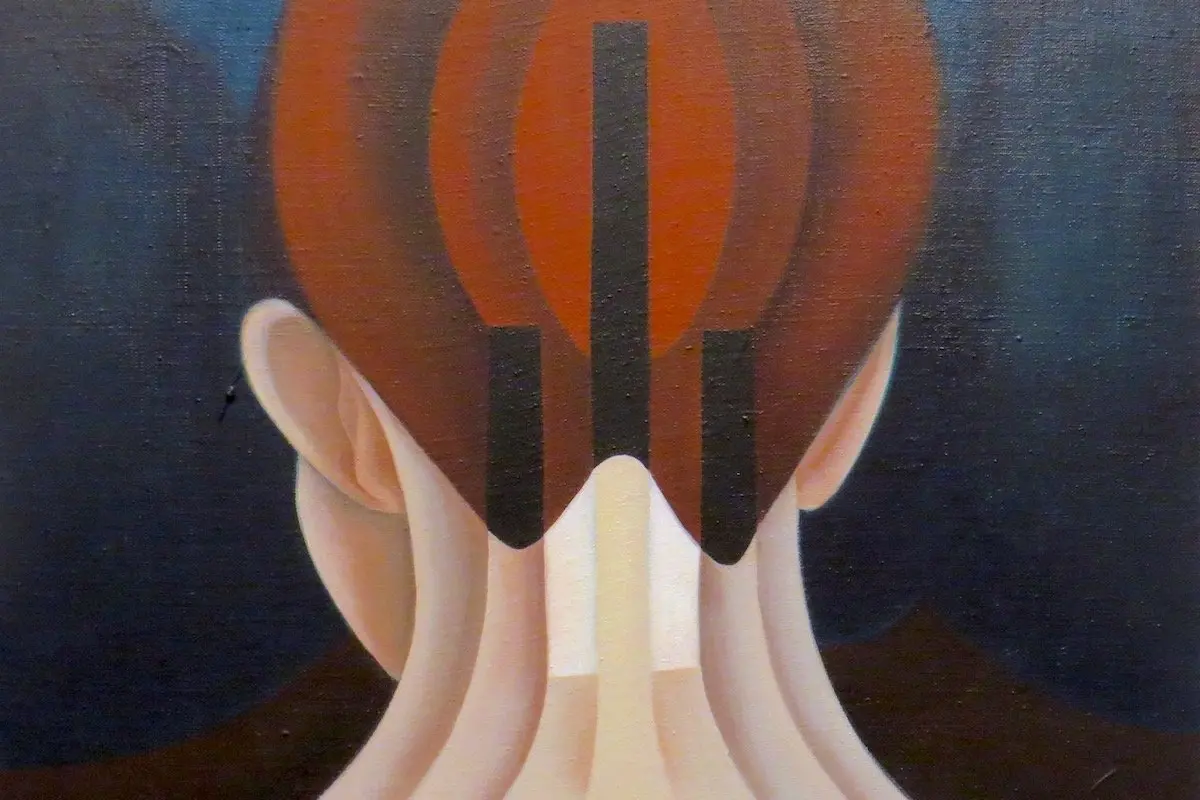
“From Behind”, Imogen Taylor (Dunedin Public Art Gallery) Imogen Taylor’s “From Behind” at the DPAG mixes many of the styles of the early to mid-20th century. The weight of this history is apparent. Leger’s cylindrical cubism and Lempicka’s stark Art Deco portraiture mix with the rich flowing lines of Marc and the later abstraction of colour-field art. Several of the paintings hang free of the walls, floating in the space above their assigned positions. We see the backs of the works, giving us a view “from behind” of the construction process, but — other than the titles and dates — we learn very little. What we do gain is a more intimate feeling, as if the paintings are doing what they can to break down the space between us. According to the exhibition’s notes, Taylor is commenting on issues ranging from power dynamics to queer desire. In this, her success is partial at best. Both of these subjects — and others mentioned in the notes — have been extensively and often far more blatantly dealt with elsewhere. The real surprise is the subtlety with which they are handled here. Again, this harks back to the early twentieth century, reminiscent of the work of artists like Marsden Hartley. But that gentility is the entire point: the works’ meaning creeps up gradually rather than hitting you over the head. james dignanRob Foote's "Bird Song". Photo: James Dignan “Vestigium”, Rob Foote (The Artist’s Room) There is remarkable subtlety of a different form in Rob Foote’s “Vestigium”. The exhibition’s title is well chosen. These works seem to float in air, leaving only a vestigial trace of the intense work that must have gone into their creation. Foote’s impressive magic realism is created from powdered charcoal, occasionally tempered with oil, applied in delicate layers using a cosmetics brush, a technique he refers to as “painting with smoke”. There is certainly a fumy phantasmal quality to the light in these works, especially in airy pieces such as “Bird Song”. In a suite of smaller pieces, the artist takes this to its logical conclusion by creating clouds from his clouds of dust, the heavy air settling over floating boats and Dunedin rooftops until it is difficult to decide which is the heavier and which is the lighter subject. Alongside these pieces are more matter-of-fact, but still beautiful and surreal works which double as animal studies, among them two works featuring tamed wild beasts handled by the innocence of children. “Echoes of the Innocent” with its tiny child and massive bison is a particular delight. The astonishing use of light in pieces such as “After the Show” and “Frozen Time” is also admirable. james dignanEvan Woodruffe's "19th April, 2026". Photo: James Dignan “To See Takes Time”, Evan Woodruffe (Fe29 Gallery) Fe29 Gallery is presenting a series of new works by Evan Woodruffe. Woodruffe’s abstract expressionist works are colourful and vibrant, perhaps brighter than the pieces in previous exhibitions he has had at Fe29. The pieces have a vibrant spring-like quality, a direct contrast to the more autumnal feel of previous exhibitions. There is also more dynamism in many of the pieces, a gestural approach which adds energy and life to the works, many of which are simply titled for the date on which they were created. The artist’s most recent acrylic pieces, especially those titled for days in April and May this year, have something of the wilful use of colour as objects found in the work of artists such as Miro and Kandinsky. The hard edges of blue and black delineate these boldly coloured regions. Alongside the acrylics are several gentler watercolour works, as well as two art journals featuring both art and text. Despite the changes to Woodruffe’s art, there is also a great deal of continuity. Tension continues to be generated by the artist’s trademark use of material draped across the canvas prior to the start of painting, creating an uneven, ridged surface. The scale- or petal-like mottling of the background is another welcome returning feature.