
PHOTO
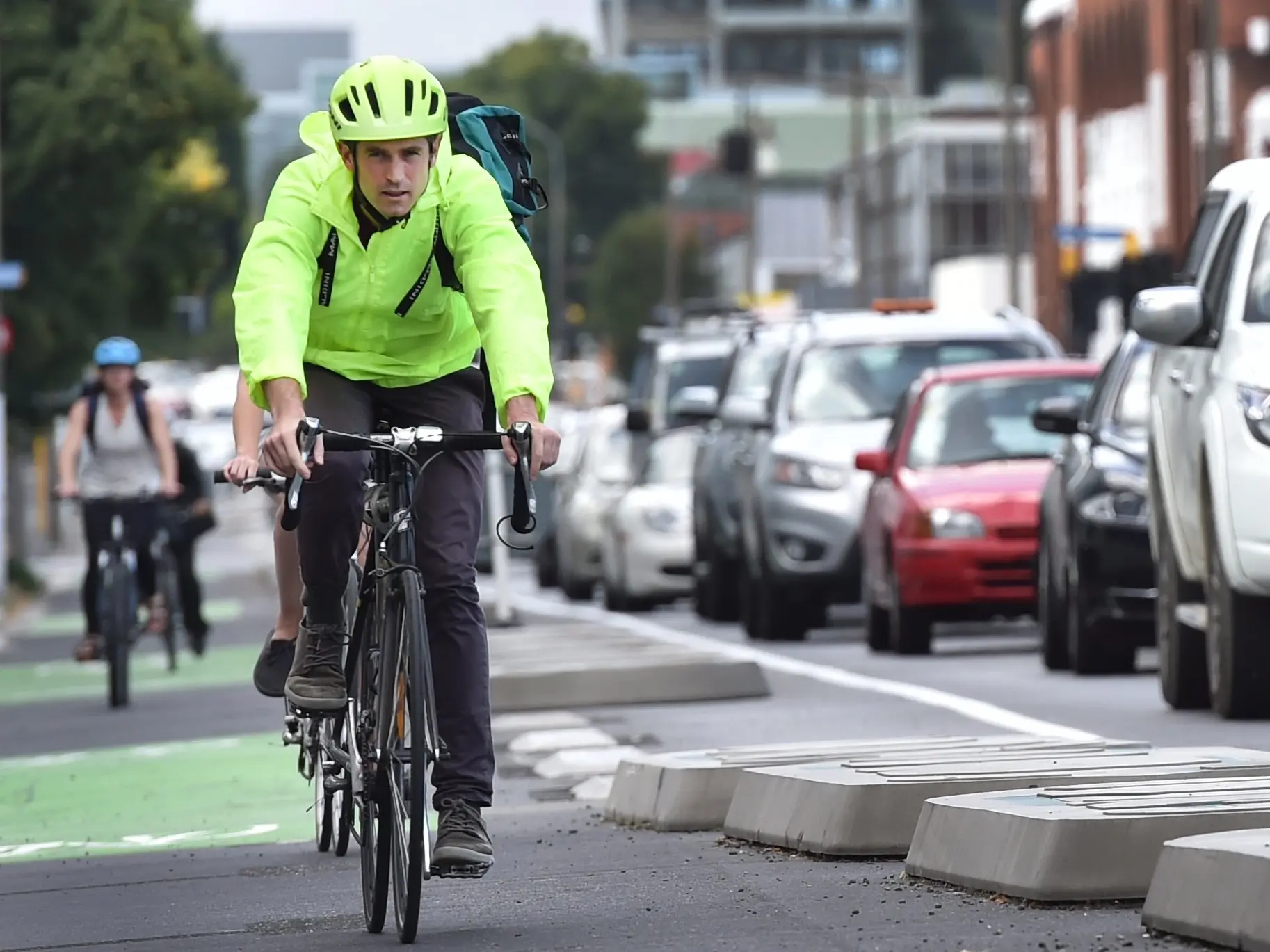
Neither Alexa Forbes nor Aaron Hawkins owns a car. Marian Hobbs does, but she plans to arrive more often at the Otago Regional Council offices, where she is chairwoman, on her electric bicycle. Progress has been slowed by a recent fall, Hobbs (72) says. But she’s determined and looking forward to the cycleway reaching Port Chalmers. She lives out that way.
Of course, Hawkins is famously Dunedin’s hitchhiking mayor, a servant of the people who relies on them to get to work.
Cr Alexa Forbes, the chairwoman of the Otago Regional Transport Committee, attends her Dunedin meetings of the Otago Regional Council (ORC) by catching a bus — reading papers en route.
These three are critical players in southern efforts to mitigate climate change. And mindful of what that needs to mean in their own lives.
Forbes says it’s vital. If the measures local government takes to cut emissions in this part of the world are to have an impact, everyone will need to play their part.
"Are you riding the bus, are you getting on your bike, have you given up your private car, have you changed your lifestyle?" she asks on the phone from Queenstown, where she is based. "Because that is the support we are going to need in a democracy like ours. It has to come bottom up and top down."
As far as the top-down portion goes, all three have track records of leading on climate change and ambitions to do more.
Cr Forbes, a leading figure in Queenstown’s search for low-emission solutions, says the work that’s gone on there to address the town’s transport footprint may be beginning to elicit the sort of groundswell of support it needs. Perhaps a tipping point.
She points to the recent hearings on subsidising a ferry between between Queenstown Bay and Frankton. The commercial ferry service was about to fold, so a variation to the Otago Regional Passenger Transport Plan was proposed in order that the service could be subsidised.
There was an outpouring of support — described as "overwhelming" by the hearing commissioner — including a petition with almost 2000 signatures.
"Nobody talked about what it was going to cost. Nobody even mentioned it," Forbes says.
And anyone considering raising it should first consider that everyone on that ferry will be doing their bit to ease Queenstown’s traffic congestion, she says.
"People are really willing to make change up here now. They are really willing to start looking at a public transport service. And we have had a lot of rates rises [in Queenstown] over the last few years, and you know what? Even as a councillor I never heard a peep from people complaining about them. They wanted to get a service."
Hobbs hopes Forbes can bring some of that thinking to bear on other parts of the province — Dunedin certainly, and its ring of commuter towns and suburbs, but also Cromwell, Alexandra, and Oamaru.
"I want fast runs on the board, so it would seem to me it will be buses."
She suggests one in two commuters using public transport as a goal.
"If we did that in two years, I would be a really happy grandmother. Then I want to take it up even further."
That will mean buses people want to get on — buses that take the bumps out of the peninsula road for those with bad backs, she says.
"I want to go to either better quality diesel, with less carbon, or ultimately in the end electric — or something — buses."
We need to look after those driving too, she adds. Expect to see movement on a living wage for bus drivers.
"Why do this? Because that is the low-hanging fruit for reduction of greenhouse gases, public transport, that’s why we really need to move on it."
Mayor Hawkins’ council has already stumped up $600,000 towards making fares more affordable. Not just because councillors thought it a good idea, but because annual plan feedback supported it.
"Ever since Queenstown Lakes District Council went in with the ORC to make their buses cheaper, flat fares across the district, there has been increasing demand from within our own community to do the same," he says.
It’s not just about buses though. Hawkins says safer walking and cycling access needs to be extended to all Dunedin’s neighbourhoods.
And with his council committed to zero carbon by 2030, work is under way to identify what can be done in all areas of the organisation’s work to contribute to that.
That work needs to inform the council’s next long term plan, he says, as it will run from 2021-2031, the critical years for bringing greenhouse gases down.
Forbes says the one meeting of the Otago Regional Transport Committee to date this term went well.
"The conversation seems to have shifted from the more operational ... to, ‘how are we going to cope with these major drivers of change’."
Coping with the climate crisis will involve a focus on transport networks, urban planning, rail and airports, she says.
Add coastal shipping to that, Hobbs says.
She was at a recent meeting in Wellington between regional council chairpersons and the head of the NZTA, Nicole Rosie.
"The question I asked her was: ‘I stood and on my platform was reducing carbon, and that’s really tied up with transport. Is that what’s important to you?’ And she said, ‘Yes, and it’s not only that but it is changing our modes of transport’. And that’s good news."
Former Dunedin Mayor Dave Cull, who is now president of Local Government New Zealand, says it’s the sort of work local authorities can’t do alone.
"The work has to be joined up between local and central government."
He is waiting to see what the Zero Carbon Act means for local government, and how it might refocus its priorities.
The Act might yet involve targets for local government around reducing carbon emissions, he suggests.
"Clearly that would strengthen the way forward for councils."
Councils then wouldn’t be choosing between their traditional approach to transport networks and climate change work — they would have to do both.