
PHOTO
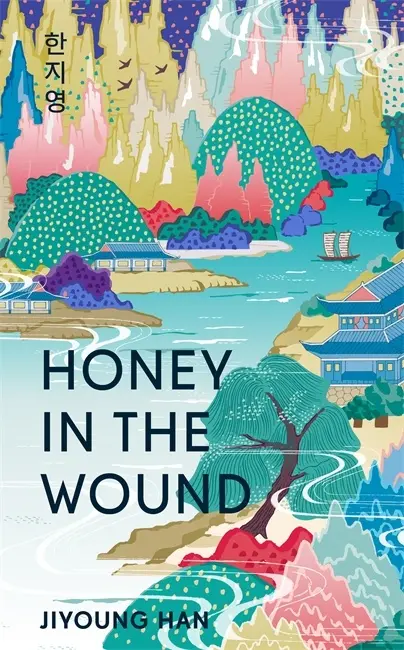
Honey in the Wound
Jiyoung Han
Bonnier
Reviewed by Jessie Neilson
In this sweeping Korean epic, we follow a mountainside-dwelling family as their lives are decimated by the arrival of the Japanese.
It is the turn of last century, 1902, and the family survive on hunting and growing.
However, 1910 signals the end of the 500-year Chosen Dynasty and the beginning of the Japanese occupation of Korea.
Their country now becomes part of the Empire of Japan, their native tongue, names and independence stripped from them.
The first segment of this book is firmly rooted in Korean storytelling traditions, with nature, symbolism and magical realism holding sway.
Their family is already marked as unusual, with individuals skilled at reading the signs of the land, or as shape changers.
Their relationship with tigers is uncommonly close.
Emotions are charged with the arrival of the encroachers.
Amongst the white hanbok appear the figures of gun- and sword-wielding foreigners, and simple rural life as the family knows it, ends.
Soon the story shifts to the urban, where the Japanese are clamping down on all dissent, meeting the protestors with violence and executions.
Author Jiyoung Han outlines a 1930s Korea where Japanese leadership is trying to cut down the “dirty little Chosen peasants”.
However, resistance is building.
It is now a world of changing identities, where many speak several languages and hide their true intentions.
With new railway lines and shipping routes, there is much movement across Asia, which has multiple points of stress.
It is a time of puppet states, subterfuge and networks of bandits and spies, where much is to be gleaned through perceptiveness.
We are now following our original mountain family’s descendant, Song Young Ja, and we stay with her for the rest of the story.
Spanning landscapes of present-day Korea, North Korea and China, Honey in the Wound is a devastating third person account of one Korean woman’s ordeal at the hands of the Japanese.
Young Ja represents one of hundreds of thousands of young women, mostly Koreans, but also from other Asian countries, abducted or coerced into sexual slavery by the Imperial Japanese Armed Forces and collaborators.
These “Comfort Women” were made to service dozens of soldiers every day for years on end on pain of death, and many were brutalised or killed, or committed suicide.
This novel makes for harrowing reading.
The more violent aspects of this account are tempered by heartening political pushback, such as in Han’s portrayal of stylish “tea merchant” Baek Yong Woo (aka Bailong), with his smell of fresh pine needles, and the leisurely aristocrat Tayiji of the Sparrows, always accompanied by a flock of birds.
There are young friends and fellow victims for Young Ja, and empathetic ordinary Japanese.
Yet there are many figures of terror too.
The notorious Feng-nushi, with her silver pipe and brass-tipped cane, rules her teahouse through sadism.
This story carries down into the 1990s, alternating between Japan and Korea as settings.
Identities and languages are still merged, messy history and trauma always there.
While Han’s novel begins gently, it soon powerfully transforms.
Magical realism carries through in the female characters and their idiosyncratic skills, lending an uneasy enchantment to the realist narrative.
The Korean women carry their strengths and resilience through the generations.
This is a magnificent work, bravely confronting the very recent trauma of brutal occupation and of extensive war crimes by the Japanese, which continues to affect the Republic of Korea today.
Jessie Neilson is a University of Otago library assistant.