
PHOTO

In Malaysia most households have rice daily, for breakfast, lunch and/or dinner.
“If rice is the sun, then the dishes that go with it are the orbiting planets,’’ United Kingdom-based cook, food writer and teacher Ping Coombes says.
The two-time winner of Masterchef (winning in 2014 and champion of champions in 2022) grew up in Ipoh, Malaysia.
So in her latest book, Rice, she shares the wealth of rice recipes that her home country offers, many inspired by her mother who served up rice, a meat dish, a fish dish, a broth and one or two vegetable dishes most nights even as a busy working woman.
“I know it wasn’t effortless. It was planned, executed with precision and love, and all centred around that bowl of rice.’’

Rice is the most consumed grain in the world, accounting for 20% of the global calorie intake, she says.
“It is the staple food of half the world’s population providing sustenance, calories and nutrition.
“Think hot fluffy rice paired with fragrant curries, smoky stir-fries just off the wok or rich braised dishes with pickles.’’
It was first domesticated in the Yuangtze River Basin about 9000 years ago and spread southeast through Asia.
In many South East Asian countries rice is a symbol of life, vitality, prosperity and abundance, and there are many festivals celebrating its importance.
In these countries rice is stored in a fan tong, a rice bucket, to prevent dampness and pests and for easy access.
“I keep my rice in a glass jar on a shelf away from sunlight. My mum kept hers in a bamboo bucket.’’
In Rice, Coombes looks at the most popular grains, long, such as jasmine and basmati, short, such as Japanese or sushi, and brown.
She gives advice on how to cook rice, addressing that ever present question “to wash or not to wash’’.
“If you ask me I would say, ‘it depends’.’’

It very much depends on the type of rice being cooked as it removes excess starch, preventing clumping, improving the texture and makes it more enjoyable to eat, she says.
She includes recipes for snacks, fried rice, one-pot rice, dishes to serve with rice as well as pickles, condiments, dinner inspiration and menu suggestions.
THE BOOK
Recipes extracted from Rice by Ping Coombes, published by Murdoch Books, RRP $55.
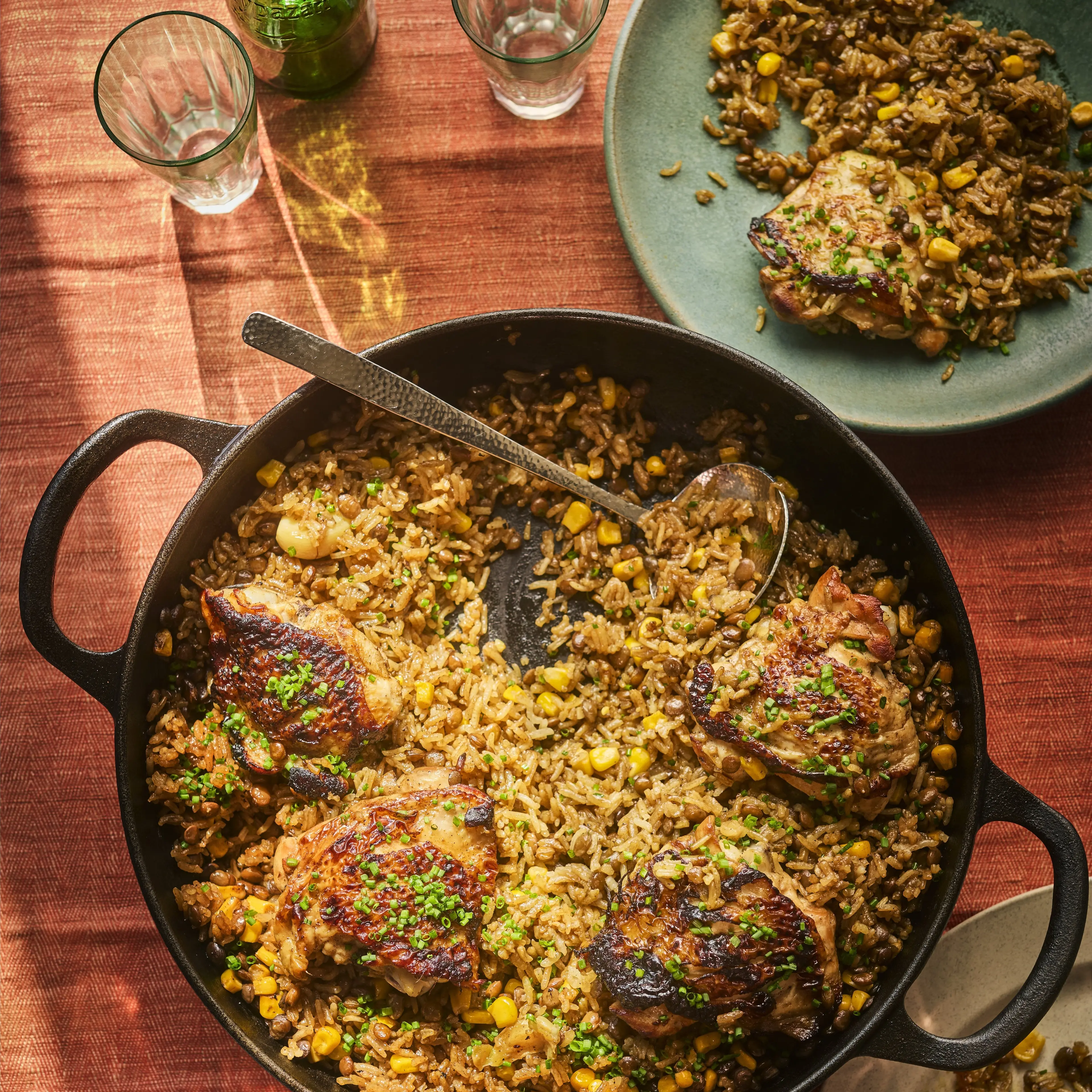
Baked honey and soy chicken rice
Welcome to your new favourite one-pot rice dish! I have been looking at ways to add more fibre into my rice dishes to make them more balanced.
What I ended up with is a dish that has flavour, texture and fibre from the lentils and sweetcorn.
Serves 4
Ingredients
5 skin-on, bone-in chicken thighs
1 tsp vegetable oil
2 Tbsp butter
2 garlic cloves, crushed
300g jasmine or basmati rice
1 Tbsp chicken stock powder
380ml water
160g canned sweetcorn
340g canned green lentils
20g chives, chopped, to garnish
For the marinade
3 Tbsp pineapple juice
1 Tbsp honey
1 Tbsp light soy sauce
1½ tsp dark soy sauce
½ tsp sesame oil
½ tsp five spice powder
½ tsp ground ginger
¼ tsp salt
Method
Score the top of the chicken thighs a couple of times so that the marinade penetrates deeper into the chicken and place in a bowl. Add all the marinade ingredients and marinate for at least 30 minutes at room temperature or in the refrigerator overnight.
Preheat the oven to 180°C.
In a large oven-proof pan, heat the oil over a medium heat. Add the chicken thighs to the pan, skin-side down, and fry for 5 minutes to brown the skin. Flip the chicken over and pour over the marinade in the bowl. Cook for 2-3 minutes to reduce the marinade a little, then remove the chicken to a plate.
Add the butter, garlic and rice to the pan and give it a good stir, then add the chicken stock powder, water, sweetcorn and lentils. Stir again to distribute the ingredients evenly in one layer. Nestle the chicken thighs into the rice mixture, cover with a lid and bake in the oven for 35 minutes.
Remove from the oven and let it stand for 5 minutes before serving.
Sprinkle some chives on top, fluff up the rice and serve.
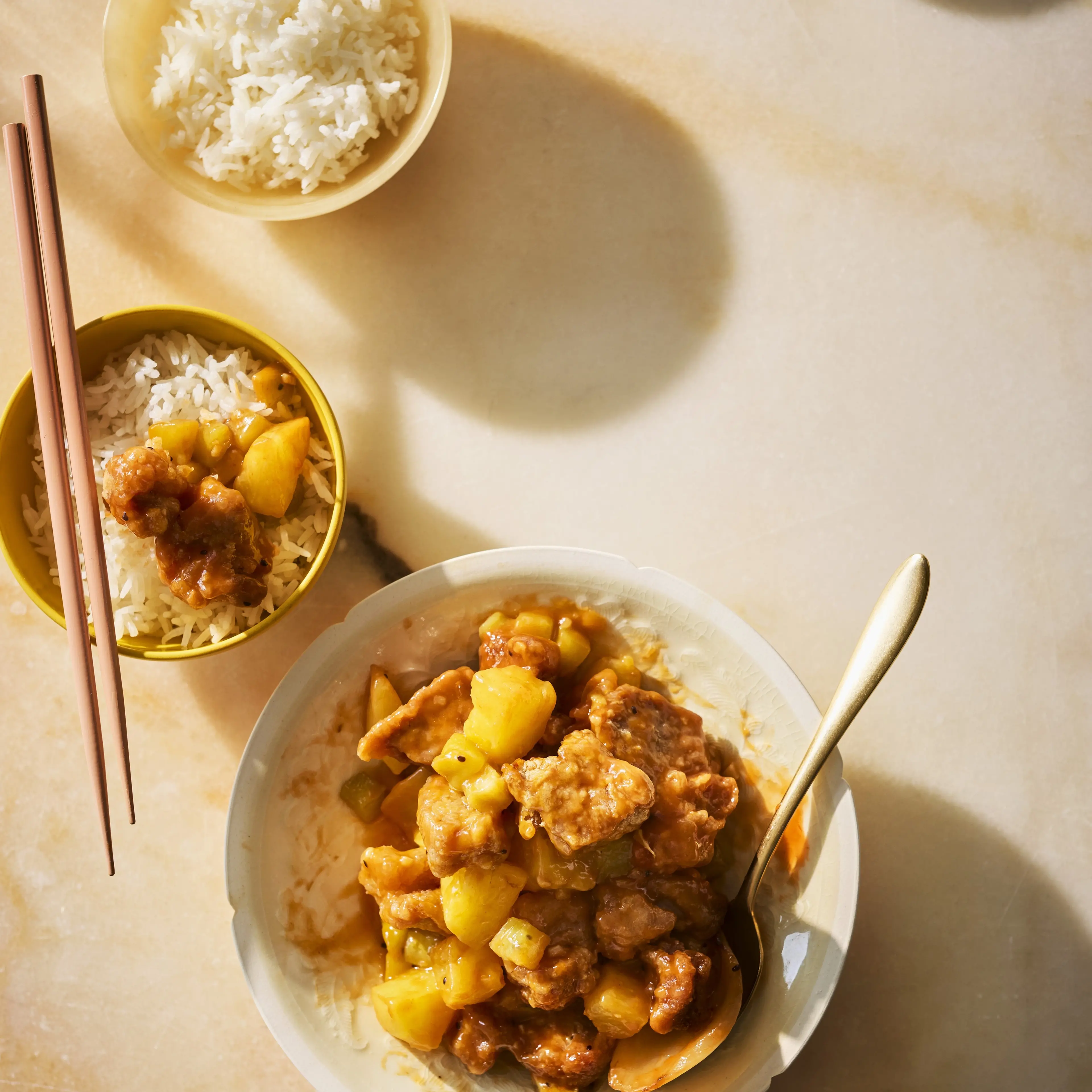
Sweet-and-sour pork with pineapples and kiwifruit
I always sneered at people ordering sweet-and-sour pork in a Chinese restaurant or takeaway. I would think they were being boring, going for the most obvious choice.
I now realise that, done right, it is a killer combo with rice! with rice!
Serves 4
Ingredients
400g whole pork shoulder, cut into 2-cm cubes
400ml vegetable oil
120g cornflour (cornstarch)
1 small onion, quartered and separated into individual pieces
1 garlic clove, chopped
1 kiwifruit, peeled and cut into 1-cm dice
100g pineapple, cut into 2-cm dice
For the marinade
1½ tsp light soy sauce
1 tsp granulated (white) sugar
1 egg white
½ tsp salt
½ tsp bicarbonate of soda (baking soda)
For the sauce
120ml water
3 Tbsp ketchup
3 Tbsp orange juice
1½ tsp granulated (white) sugar
1 tsp oyster sauce
1 tsp cornflour (cornstarch)
¼ tsp rice wine vinegar
Method
Mix together the marinade ingredient in a medium bowl and add the pork pieces, turning to coat. Cover and marinate the pork for at least 2 hours, or overnight in the refrigerator.
Mix all the ingredients for the sauce together and set aside.
Heat the oil in a wok or deep saucepan over a medium-high heat. To test whether the oil is hot enough, drop a little cornflour into the oil — it should sizzle and float immediately.
Place the cornflour on a shallow plate and add the marinated pork pieces. Turn to make sure all sides are covered, then give the pieces a shake to remove the excess flour. Set aside on a separate plate.
Fry the pork in the hot oil in batches for 2-3 minutes until crisp and golden brown. Flip the pork from time to time to ensure even cooking.
Remove the pork to a wire rack set over a tray lined with paper towels to crisp up further. Repeat until all the pork is fried.
In a separate wok or large frying pan, add 1 tablespoon of the frying oil used for the pork and heat over a high heat. Fry the onion and garlic for 30 seconds, then add the kiwi and pineapple along with the sauce and bring to the boil. Reduce the sauce to a thicker consistency. It should only take about 3-4 minutes.
Add the crispy pork pieces to the sauce and coat well. Cook for a further minute.
Serve immediately with plenty of rice.
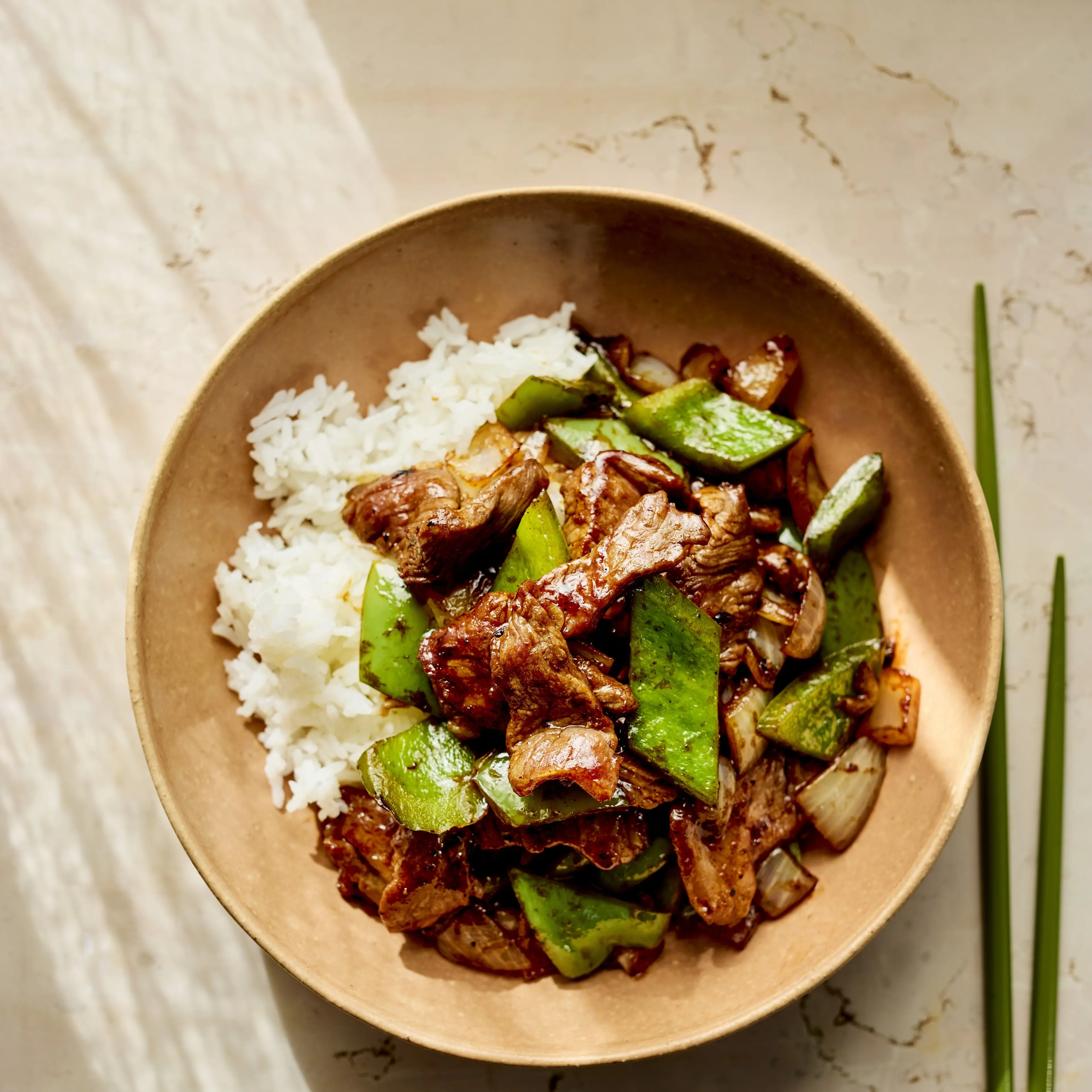
Stir-fried black pepper beef with green peppers
This is quite a classic dish. Traditionally, in a Chinese restaurant, a cheaper cut of meat will be used and tenderised with bicarbonate of soda before stir-frying.
The meat is tender but loses whatever it is that makes it beef. If you are going to make this, ensure you use good-quality beef, as the black pepper goes so well with it, making you reach for that second bowl of rice!
Serves 2-4
Ingredients
250g rib-eye or sirloin steak
1½ tsp cornflour (cornstarch)
2 tsp light soy sauce
2 tsp whole black peppercorns
3 Tbsp vegetable oil
2 garlic cloves, roughly chopped
1 large green pepper (capsicum), cut into 2-cm dice
1 medium onion, cut into 2-cm dice
For the sauce
2 Tbsp oyster sauce
1 Tbsp Shaoxing rice wine
1 tsp light soy sauce
1 tsp dark soy sauce
1 tsp granulated (white) sugar
1 tsp sesame oil
Method
To make it easier to cut the beef, place it in the freezer for 15 minutes, then remove and slice into 5mm strips. Coat the beef with the cornflour and light soy sauce and set aside to marinate while you prepare the vegetables and sauce.
Coarsely crush the whole peppercorns in a pestle and mortar. If you don’t have one, place them in a freezer bag and crush them with a rolling pin.
Mix all the ingredients for the sauce in a bowl and set aside.
In a wok or frying pan, heat 1 tablespoon of the vegetable oil over a high heat until it is smoking. Add the marinated beef and move it around the pan quickly, so that all the pieces are broken up and in one layer. You want to move them around the wok so the high heat sears the beef.
Remove the beef after 30-40 seconds. You might still have some rare beef, which is what we are aiming for.
Turn the heat under the pan down to medium and add the remaining 2 tablespoons of oil. Add the crushed black pepper and garlic. Stir-fry for about 30 seconds until fragrant. Be careful not to burn them.
Throw in the green pepper and onion. At this point, you can increase the heat a bit and fry for a couple of minutes so the vegetables soften a little but still remain crunchy.
Add the beef back in along with the sauce and mix to incorporate well. Continue to cook for a minute until the beef is evenly coated with the sauce. I like mine still a little rare so that it will be tender and soft. You can cook it a little more if you like it well done, but be careful not to overcook.
Dish up and serve with the rice of your choice.