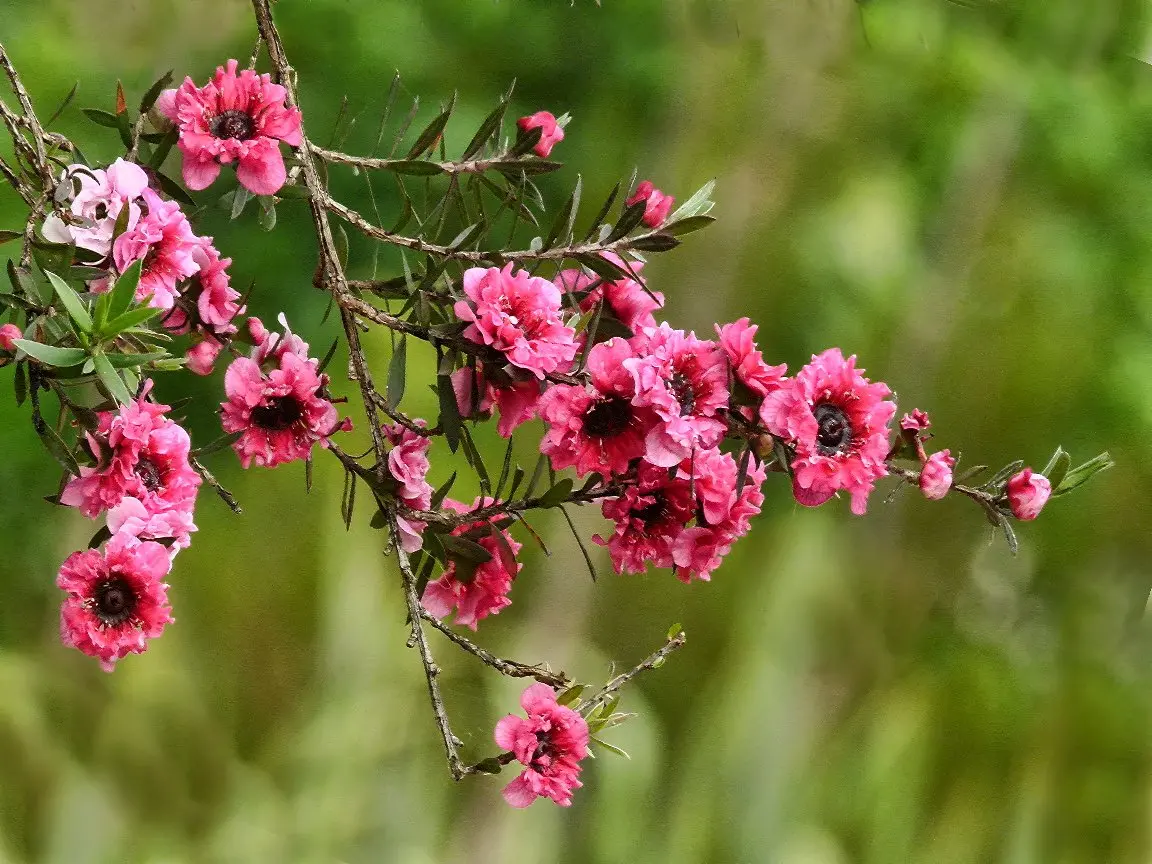
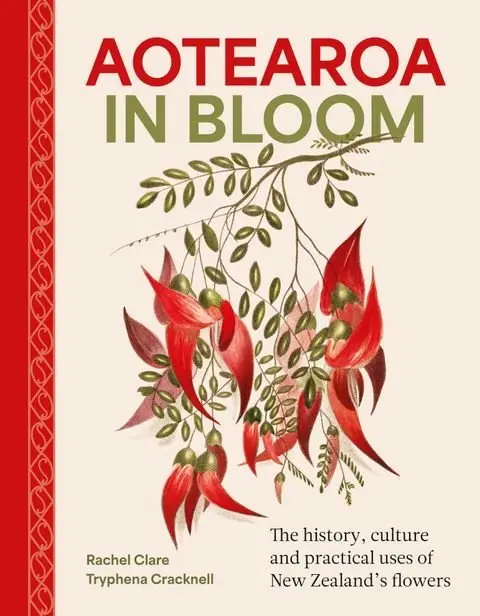
There are many pink and red hybrids of mānuka growing in gardens and parks such as ‘‘Red Damask’’. PHOTO: WIKIMEDIA COMMONSLushly illustrated new book Aotearoa in Bloom, by Rachel Clare and Tryphena Cracknell, looks at the history and uses of many of New Zealand’s native flowering plants and trees, including their significance in te ao Māori. In this extract, they zero in on mānuka.
If there was a school prize-giving for our native plant species, mānuka would be that kid that wins everything, smiling humbly while it gets loaded up with trophies and ribbons, certificates and lolly leis.
Mānuka is one of Aotearoa’s most prolific plant species and one of the toughest. It will grow in wet, boggy conditions, and on windswept cliff tops and coastlines, where it surrenders any chance of an upright growth habit to god of the wind Tāwhirimātea.
Mānuka isn’t bothered about having a permanently swept-back hairdo. It’s one of the first plants to grow on disturbed or burnt land, its hard seed pods being activated by fire. It will quickly populate an exposed area of land, forming a dense canopy and acting as a nurse plant for more tender native species that will eventually shade the sun lover out.
And then there are the flowers — thousands of them at one time. It blooms and blooms and blooms for months on end, providing food for native bees, moths, flies and geckos. At the same time, mānuka provides habitat for riroriro/grey warbler and pīwakawaka/fantails that build nests in its branches, from where they can easily catch the resident insects mānuka attracts.
For Māori, the strong wood of this multi-purpose taonga species has been used to make paddles, house beams, fences, spade blades, roofs for storage pits, shelter belts for gardens, eel pots, kites, fish hooks, bird spears, combs and needles for piercing children’s ears. The shaggy bark was also used to make water containers and rain capes. Crushed leaves soaked in tītoki oil were rubbed into the skin for perfume.
The inner bark can be boiled with water then used as a mouthwash and gargle or to treat sore eyes. It’s also been used to treat diarrhoea and dysentery, while ash made from the bark can treat skin complaints.
In Native Medicinal Herbs, Edward Frost described how ‘‘a poultice of pounded titree berries applied to a flesh wound, being strongly astringent, would dry it up quickly, and greatly assist in healing’’.
Mānuka shares its sweets too! Pia mānuka, a type of honeydew caused by the boring of certain insects, such as the longhorn beetle, causes the tree to excrete a gum that looks and tastes like damp icing sugar. Botanist William Colenso referred to it as a ‘‘sugary, manna-like exudation’’. This was eaten to ease coughs and also given to infants.
Birds also take advantage of the healing properties of mānuka. In 1989, scientist Terry Greene described observing kākāriki chewing up mānuka leaves while preening, potentially to manage external and internal parasites.
Tea time
James Cook famously had the crew of the Endeavour brew up mānuka leaves as you would tea, leading to the nickname tea tree.
This name was also used for kānuka (which at the time was considered to belong to the same genus as mānuka) and the Australian tree Melaleuca alternifolia, all of which belong to the myrtle family.
Early settlers also drank mānuka tea when black tea was scarce. In Station Life in New Zealand, a collection of reminiscences of her time living in Canterbury in the 1860s, Lady Mary Anne Barker describes shepherds making an infusion, noting that ‘‘it must be like drinking a decoction of cloves’’.
Cook also famously brewed a rimu and mānuka beer, which he described as ‘‘exceedingly palatable and esteemed by everyone on board’’.
Honey, I’m famous
Mānuka honey, often described as the world’s healthiest, stands out for its methylglyoxal (MGO), which retains its potency over time. Its antiviral, anti-inflammatory and antioxidant benefits and the buzz created by the Unique Mānuka Factor (a certification system for MGO) saw overseas exports worth $500million in 2020.
While farmers once viewed mānuka as a problem plant like gorse, that needed to be cleared, new farming generations are planting mānuka and kānuka and either taking up beekeeping themselves or leasing land to apiarists.
While we don’t mean to be a buzz-kill, it’s time for some myth-busting. Because of mānuka honey’s reputation, you’ll often see it recommended as a plant for bees. In fact, given the choice, they’ll ignore mānuka in favour of other blooms. Honeybees (Apis mellifera) are an introduced species. Unlike our native bees, which live solitary lives and don’t make honey, honeybees haven’t evolved alongside mānuka, and they actually find it difficult to suck up the viscous nectar through their proboscis. It’s only by placing hives in areas where there is little else flowering that they’ll forage for mānuka.
Redefining kānuka - a case of mistaken identity
Although they’re similar in appearance and name, mānuka and kānuka (Kunzea ericoides) are actually unrelated plant species. However, they were both classed as members of the Leptospermum genus until 1983. Kānuka is actually endemic, growing nowhere else in the world, whereas mānuka is also native to Australia; and seed likely blew over or was dispersed by birds to Aotearoa millions of years ago.
There are a couple of ways to tell the two plants apart. For starters, kānuka is the taller of the two, growing to 15m compared to mānuka’s 10m. If you compare the foliage on the two plants, mānuka has prickly leaves whereas kānuka’s are soft, giving rise to the handy mnemonic ‘‘mānuka is mean, kānuka is kind’’. Kānuka makes a softer mattress too. In Ellen Blackwell and Robert Laing’s 1906 book Plants of New Zealand, they describe how L. ericoides, which they refer to as tree mānuka, ‘‘provides fragrant bedding, easily collected, and not readily surpassed for comfort’’.
Mānuka holds on to its hard seed pods for a long time, whereas kānuka seed heads are soft and fall off the tree. The tree bark is slightly different as well, with mānuka bark being flaky and kānuka bark coming off in leathery strips. They also fare better in different growing conditions. Kānuka can cope with drier areas, whereas mānuka can hack it in boggy, wet soils.
Pink ladies
In the wild, mānuka generally has white flowers, but there are hundreds of colourful pink and red hybrids growing in gardens and parks today. These have been bred from rare mutant plants that produced pink or red flowers. Their discoveries were a great source of excitement and often reported in the newspaper.
L. scoparium‘‘Keatleyi’’ was one of the first pink-flowering plants to be propagated. The parent plant (now recognised taxonomically as a different form) was collected between Pārengarenga Harbour and Otou North Cape by Captain Keatley in 1917. Today popular varieties like ‘‘Ruby Glow’’ and ‘‘Tui’’ all whakapapa back to the original ‘‘Keatleyi’’.
Even more unusual in nature are red-flowering mānuka. One was found on Sandilands Station, north of Canterbury, in 1898. When Canterbury resident William Nicholls wore a sprig of this red-flowering mānuka in his buttonhole while visiting Christchurch nursery Nairn & Sons around 1905, the nursery owner begged for a cutting. These failed, but seeds from the cuttings germinated.
Double-flowering plants, along with dwarf and prostrate species, have also been propagated from plants collected in the wild.
THE BOOK
Aotearoa in Bloom: The history, culture and practical uses of New Zealand’s flowers, by Rachel Clare and Tryphena Cracknell. Harper Collins. RRP: $60
WHAT’S IN A NAME?
Leptospermum means slender seed and scoparium means ‘‘like a broom’’, which is fitting as the botanist William Colenso described mānuka being used to make brooms for use in domestic settings and on ships. The name mānuka may relate to the Tongan plant nukanuka (Decaspermum fruticosum), which, like mānuka, belongs to the myrtle family.
Mānuka is also called kahikātoa.
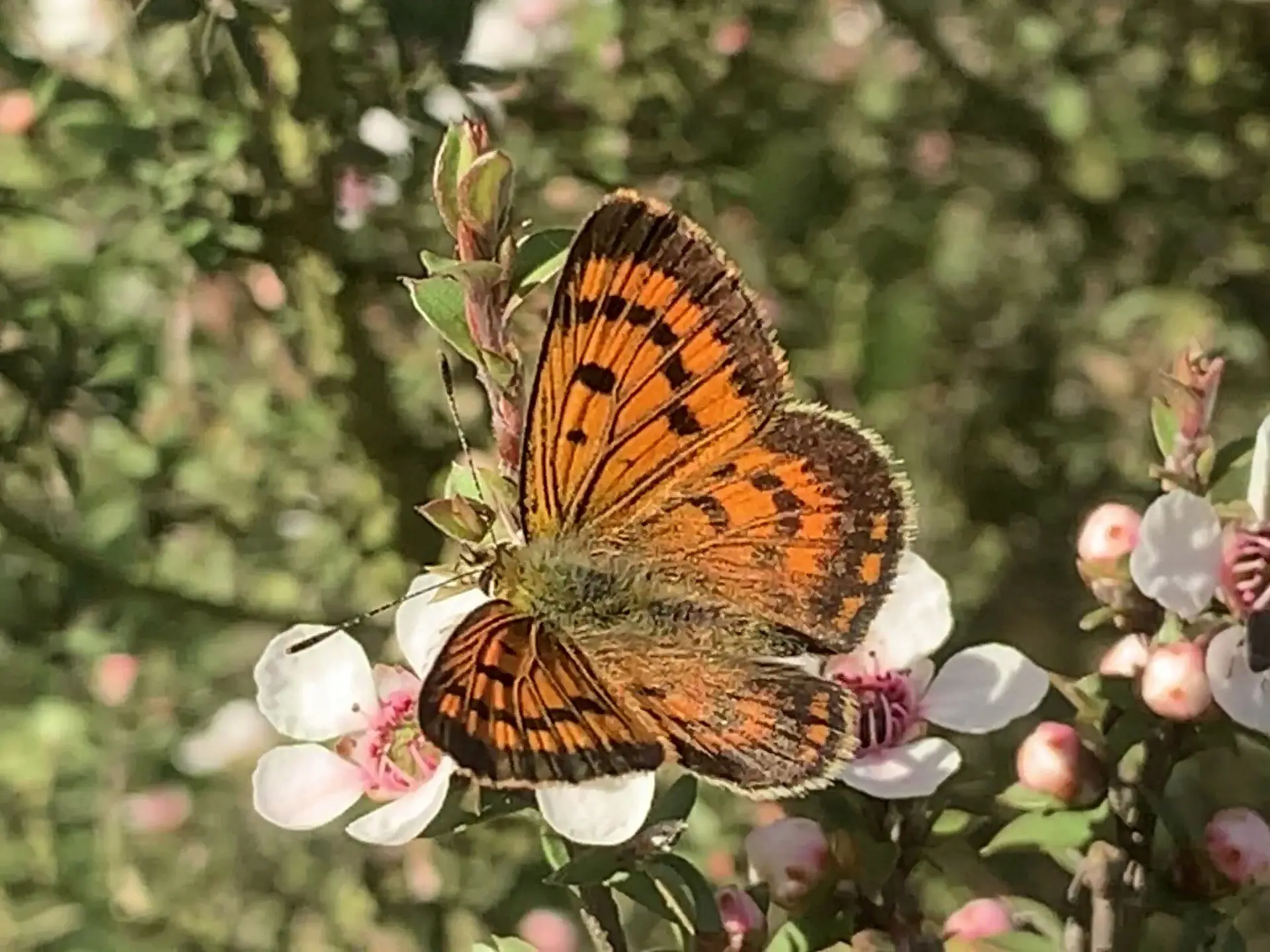
Pepe para riki common copper butterfly (Lycaena salustius complex) on a mānuka flower. PHOTO: BRAD HOWLETT
IN THE GARDEN
With so many hybrids available, there’s a mānuka to suit every garden. Hybrids generally flower in winter then less prolifically throughout the rest of the year.
L. scoparium plants grow up to 2.5m. If you’re after a compact plant, go for the nanum cultivars (nanum means dwarf in Latin), which were propagated by iconic Taranaki nursery Duncan & Davies and named after native birds, such as pink and white Nanum ‘Kea’ or red Nanum ‘Ruru’.
Prostrate varieties look wonderful grown as ground covers on banks or cascading over stones. ‘Wairere’, which means waterfall, is a pale pink variety that was collected in Northland in the 1940s, while ‘Karekare’ is a white variety grown from a plant that the late native-plant nurseryman Graeme Platt found growing on Lone Kauri Rd, Auckland, in the 1970s.
It’s important that plants grown on conservation land are the original white-flowering species rather than hybrids to avoid cross-pollination and loss of this taonga.
Branches of mānuka are a favourite wood for smoking fish.
Providing it is planted in a sunny spot, mānuka will grow in pretty much any soil but is excellent for clay soils, particularly planted on banks to help control erosion. Clip it once a year to make a pretty flowering hedge. If you fancy yourself a dab hand with shears, you can even turn it into a topiary ball or a standard.
Mānuka can develop a black, sooty mould caused by the scale insect Eriococcus orariensis secreting a honeydew which then grows mould. This insect now seems to have been superseded by the scale insect E. leptospermi.
Also, sooty mould is less of an issue in suburban gardens.
Gardeners can, however, use spraying oil to control it.