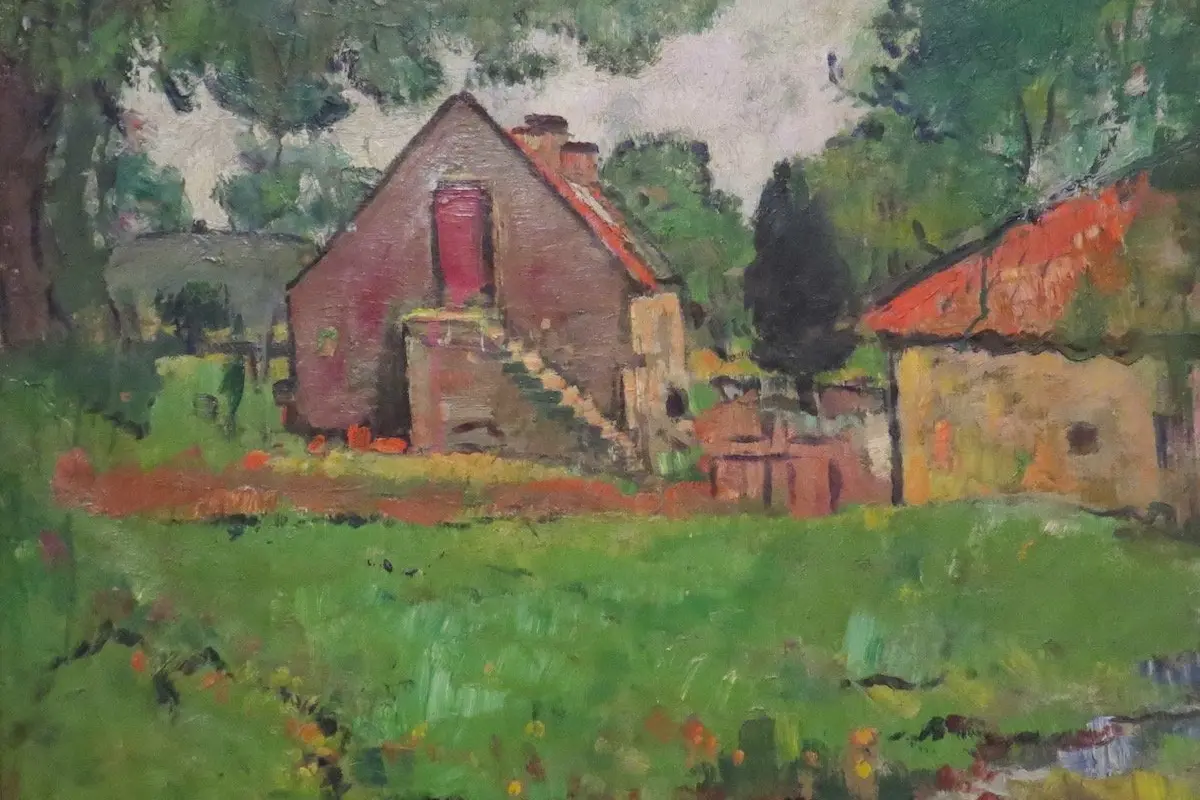
“Panorama: An Extended View of Frances Hodgkins (Dunedin Public Art Gallery) “Panorama” is an engrossing show featuring works by New Zealand’s first internationally regarded artist, Frances Hodgkins, and her contemporaries, mostly featuring works from the British art scene of the first years of the twentieth century. While the artists did not necessarily know each other’s art practice, they were all working within the cultural milieu of the age, a fact reflected by the occasional cross-over between art and literature, with several of the works on display by people associated with the Bloomsbury Group. As such, the display gives feeling for the contemporary background within which all the artists were working. Alongside pieces by Hodgkins herself, the exhibition includes art by John Piper, Vanessa Bell, Maurice Sochachewsky and others, each of them forming pictorial conversations with Hodgkins’ own work. The earliest works are coupled with late impressionist pieces by Paul Signac. The works are grouped roughly by both age and subject, allowing themes to become apparent across multiple canvases and showing the gradual development of styles across time. As always with the Dunedin gallery, the exhibition is excellently annotated, allowing visitors chance for a more in-depth understanding of the works. By showing Hodgkins’ work and contemporaneous art, we gain a more thorough view of the artist’s work and her influences within the culture of her time. see capSimon Ingram's "Farm and Industry (045)". Photo: James Dignan “Pictorial Fictions: Painting from Frances Hodgkins’ Latent Space”, Simon Ingram (Dunedin Public Art Gallery) Alongside “Panorama” sits a directly related exhibition by Simon Ingram. In this exhibition, statistical data drawn from several of Hodgkins’ works has been used as the basis of newly created art. Ingram has taken information from several of Hodgkins’ works via machine-learning software to isolate and interpret colour fragments of the original paintings. From these, the artist hand-paints new works, the resulting pieces being a symbiosis of human and machine art. While the intention is clear and the concept ties in with other historical advances in the use of technology in arts, the resulting works seem relatively cold and dispassionate when viewed alongside their nearby source material. This is not to say that the exhibition is without merit. There is strength in the textures with which the solid blocks of colour have been applied to the masonite to create heavy, at their best heady, abstractions with a nod to Informalism or Tachism. In some cases, especially those where the palette is reduced, there is power — perhaps most notably in the deep churning blues of “Harbour (021)” and the strong greens of “Farm and Industry (001)” . This is also the case in those pieces where pictorialism emerges from the abstraction, such as “Harbour (043)”. see capSimon Attwooll's "Sometimes All You Need is 2.52 Million Dollars". Photo: James Dignan “Season’s Greetings, But in July”, Simon Attwooll (Hutch) Simon Attwooll examines the clash of tradition with cultural reality in a series of works at Hutch. The exhibition is composed of a series of acrylic works surrounding a central Christmas tree. All of the acrylic pieces are based on found photographs showing domestic Christmas scenes, but painted entirely in subtle shades of those most seasonal colours, green and red. The works draw your eye, and the low contrast forces the viewer to examine the scenes in close detail. There is an uneasy feeling of voyeurism with looking at a long-gone Christmas in someone else’s house, the absence of people in the scenes adding to this feeling of a stolen view. Some of the pieces are presented ostensibly upside-down, in order to emphasise that these are traditions from another hemisphere and another season, imported to a place and time which does not necessarily suit them. At a second remove, this also asks questions of reality and falsehood, especially when seen through the staged unrealities of art. The central figure of the exhibition is Christmas tree, underneath which are identical present boxes each wrapped in screen-printed paper bearing the simple slogan “Season’s Greetings”. Each box contains piece of coal, traditionally Santa’s gift for naughty girls and boys.