
PHOTO
Rhododendron Dell collection curator
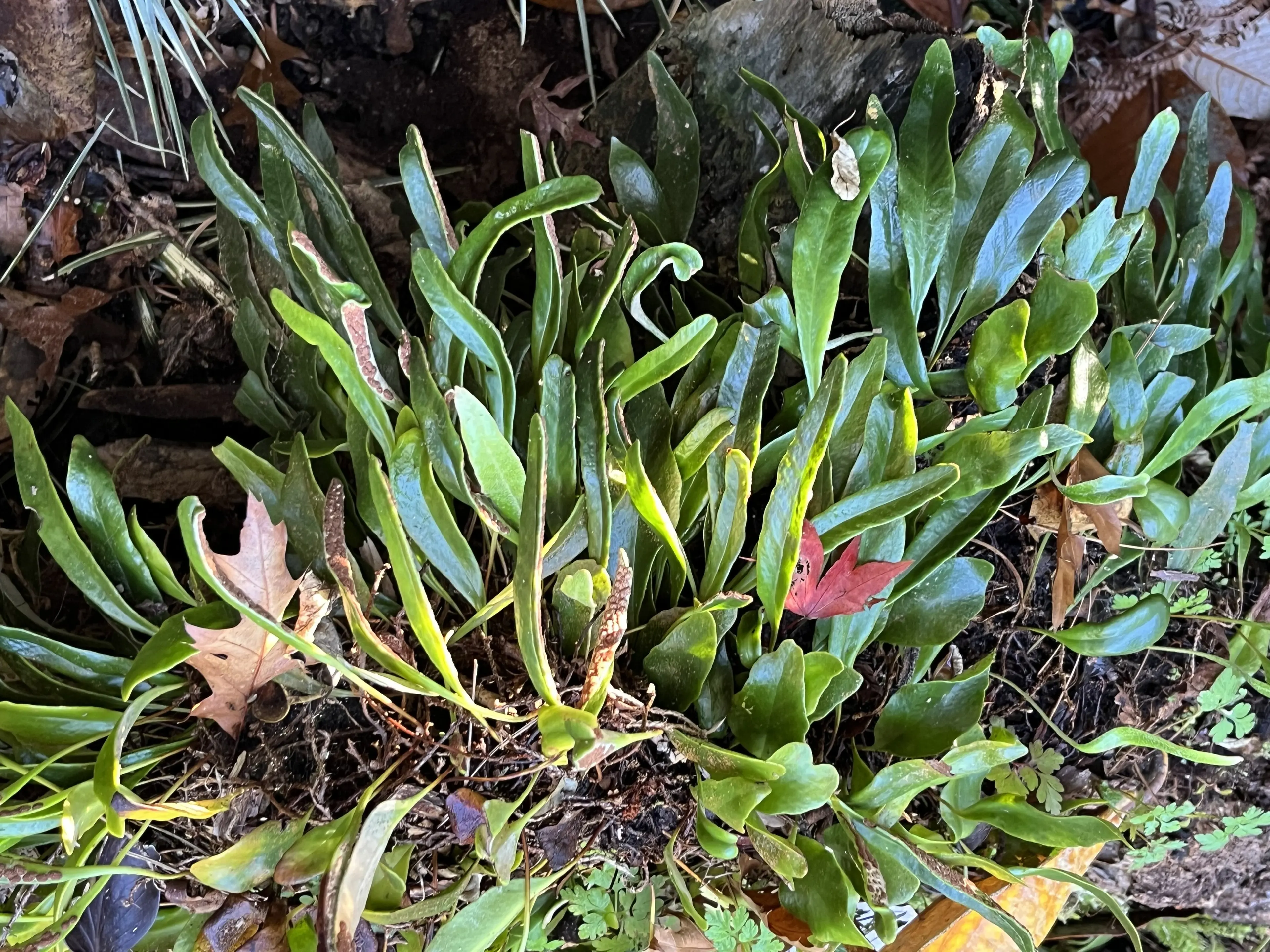
Pyrrosia eleagnifolia, commonly known as leather-leaf fern, is a distinctive climbing fern native to New Zealand.
This rhizomatous epiphyte is frequently found growing along rocks, on banks, or ascending tree trunks, using them purely for structural support rather than nourishment.
Unlike parasitic plants, it absorbs moisture and nutrients from rainfall, decomposing organic debris, and the surrounding air, making it well adapted to a variety of environments.
Some striking displays of Pyrrosia eleagnifolia can be seen throughout the Rhododendron Dell, where it climbs up large Griselinia littoralis trees or spreads across fallen trunks near the gazebo.

Leather-leaf fern forms an attractive evergreen presence year-round, creating valuable habitat for a range of small organisms, including insects and mites.
Notably, it supports native moth species such as Scoparia molifera and Calicotis crucifera, both of which construct delicate silk-lined tunnels on the undersides of the fronds to lay their young.
The life cycle of Calicotis crucifera is particularly interesting: its larvae feed exclusively on the spores of the leather-leaf fern, while the adults adopt a more varied diet consisting of nectar, tree sap, and moisture such as dew found on leaves.
This plant species is highly resilient and adaptable, capable of withstanding extended periods of drought. Its fronds are undivided and vary considerably in shape and size, ranging from small and rounded to longer, more lance-like forms.
Typically, the sterile fronds are broader and shorter, while the fertile fronds are narrower and longer.
The easiest way to propagate this plant is by division during spring or early summer, using a well-draining potting mix.
Found throughout New Zealand, this species ranges from the Manawatāwhi/Three Kings Islands to the Kermadec and Chatham Islands, as well as across the North, South and Stewart Island-Rakiura.