
PHOTO
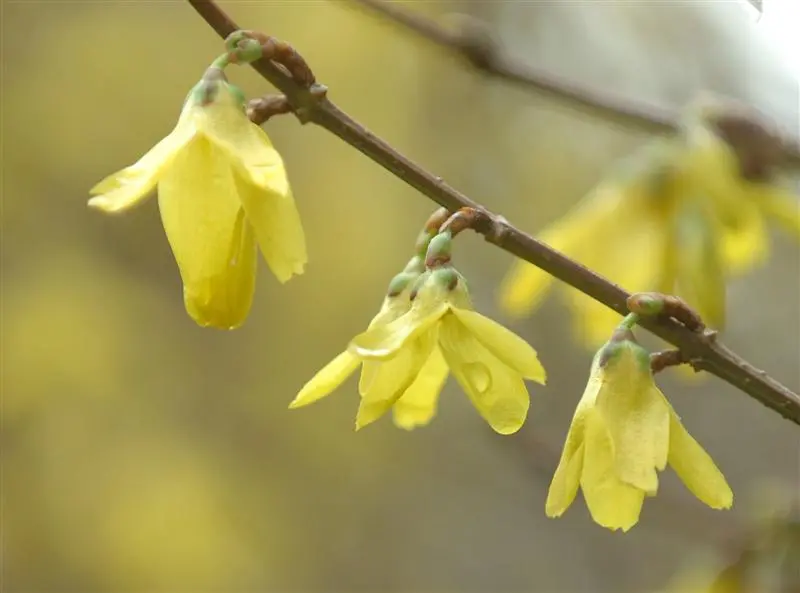
One shrub that always reminds me that spring has arrived would have to be Forsythia, with its early display of masses of yellow flowers, followed by the soft new green leaves.
A somewhat unruly looking shrub at the best of times, its flowers more than make up for it. These are tough, reliable garden plants and are popular as an early spring-flowering shrub.
Uses
Forsythia is a great plant to add colour to the garden at the beginning of the season.
An easy-care shrub suitable for most situations, it can be used on banks for erosion control, or planted as a hedge.
Forsythia is wonderful in flower arrangements, especially with daffodils.
Habit and cultivation
They are fast-growing shrubs with an upright and arching habit.
Some people find that if Forsythia is left to its own devices it can take on a rampant and wild look, but with a little bit of judicious pruning it can be kept in shape well.
For best blooms, and to avoid your plant becoming a monster, prune immediately after flowering, to encourage new growth.
Cut the branches back to a pair of strong buds, or thin out old shoots down to the base, if required.
The decision to prune or leave natural is a matter of personal taste.
Propagate by hardwood cuttings in spring before flowering, or by softwood cuttings in summer.
Availability
This is a good time of year to select Forsythia for your garden while they are in flower.
Most garden centres will have them on display.
Forsythia intermedia is most commonly grown and there are many named cultivars available.
One of the best is Forsythia intermedia "Beatrix Farrand" which has a vigorous form with an arching habit and a profusion of flowers in spring before the mid-green leaves emerge.
For smaller gardens, Forsythia viridissima "Bronxensis" is a very good small, compact shrub, suitable as a ground cover, with a mass of twiggy branches, yellow flowers, and attractive foliage.
Both these cultivars can be seen in the lower garden, at the northernmost end of the thematic borders.
Linda Hellyer is rose and herbaceous collection curator at Dunedin Botanic Garden.
- By Linda Hellyer