


We need not regard our landscape as fixed, Phoebe Thompson writes.
The Otago Peninsula has been the subject of landscape painting in the Western tradition since permanent Pākehā settlement in the region. Among the many examples held at Hocken Collections Uare Taoka o Hākena are George O’Brien’s Mount Charles, Otago Peninsula, from the Camp, 1867, Colin McCahon’s Otago Harbour, 1941, and Doris Lusk’s Otago Peninsula, 1962.

In the company of these artists is Anna Caselberg (1942-2004) who lived with her poet husband John at Whakaohorahi (Broad Bay) for many years. For her, landscape painting was a means of communing with the environment that she loved and over the years her relationship with Otago Peninsula grew into a deep-rooted belonging.
From the peninsula’s shores Kāpukataumāhaka (Mt Cargill), Mihiwaka, Mopanui and Aramoana can be viewed across the harbour, inviting one to experience two landscapes from a single place. Hocken Collections hold three preparatory studies and two final works by Caselberg from 1980 which focus on Mihiwaka, a peak north of Koputai (Port Chalmers).
Rather than topographical precision or a static representation of a place, they capture the constant transformation of the land. The preparatory sketches, studies and final works show the landscape emerging over time, not as a fixed image, but as a series of encounters. They are the result of a lived experience.
![Anna Caselberg (née Woollaston, 1942-2004), Mihiwhaka [sic] Hills, 3a, 1980, oil on board:...](https://www.odt.co.nz/sites/default/files/story/2026/06/hocken_image_3.jpg)
In Preliminary Painting for Mihiwaka, there is a sense of layering and translucency, like shifting clouds or the flicker of light over water. Marks have been scratched, scraped away, and reapplied. The notations, scribbled and partially erased, offer fragments of thoughts and observations, some read: ‘‘MOPANUI’’, ‘‘MIHIWHAKA’’, ‘‘SEE THEN’’, ‘‘ROTTEN STINK. EARTH. WATER’’, ‘‘SEE THE CLEAREST COLOURED SAND AND WATER WHERE ALL SORTS OF FISH COULD BREED’’, ‘‘I COULD’’, ‘‘EVERYONE’’, ‘‘RUSHING’’.
These field notes capture the raw, fragmented process of the artist recording her experience.
In another example, Preliminary Painting for Mihiwaka. 2, the approach shifts. Verging on abstraction, the brushstrokes are quick, and the perspective ambiguous. Perhaps Caselberg is working out how best to capture the body of water, the texture of the sand, and the movement of the air.
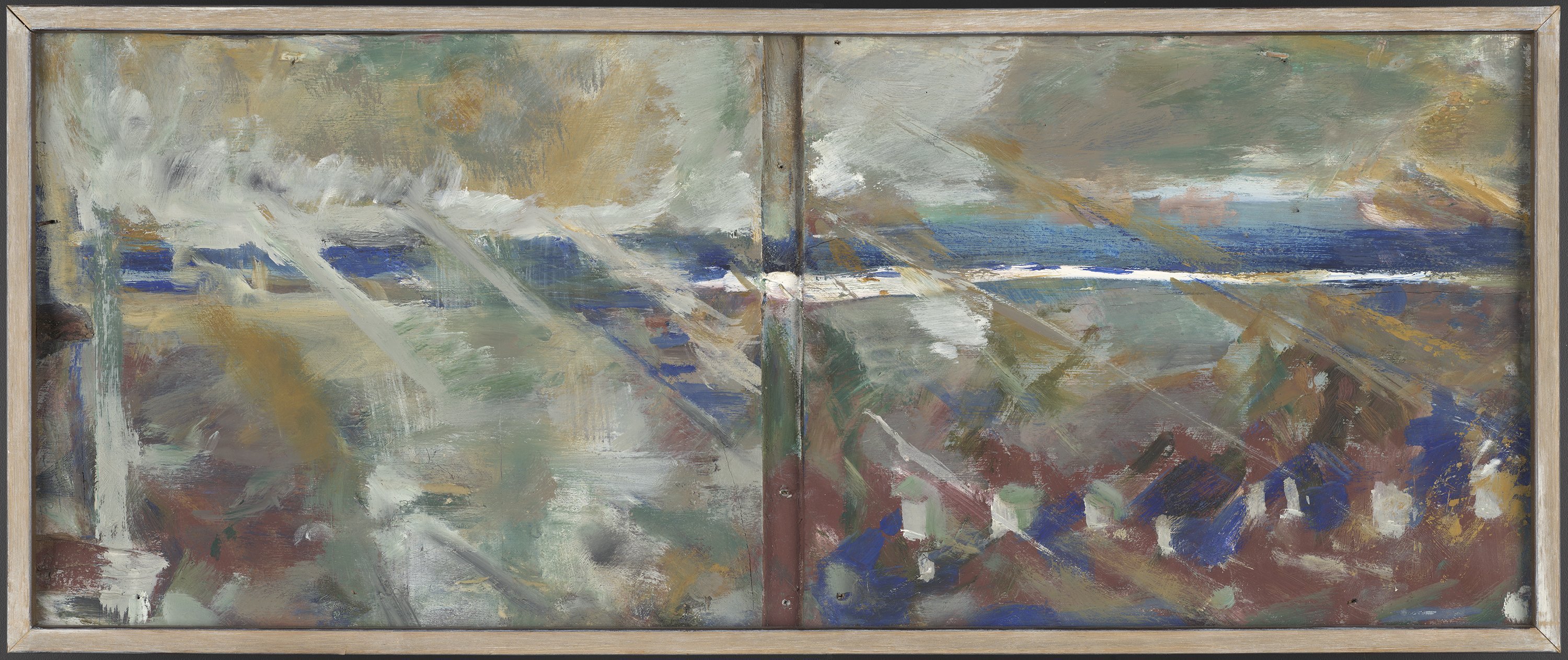
In Mihiwhaka [sic] Hills, 3a, the broad and gestural marks give a sense of movement, of change. Stylistically expressionist, this is a felt response to the landscape and invites the viewer to share the experience.
Caselberg’s series of Mihiwaka works reflect her understanding of place as a dynamic relationship between the artist and the environment. It is a landscape that cannot be fixed in one moment but is constantly shifting, changing and evolving through repeated visits and observation. Caselberg invites viewers to experience the landscape not as something external, but as something felt, lived and understood.
To arrange a viewing of these artworks, please get in touch with the Hocken art and photography team at pictures.hocken@otago.ac.nz.
• Phoebe Thompson is a collections assistant at Hocken Collections.


