
PHOTO
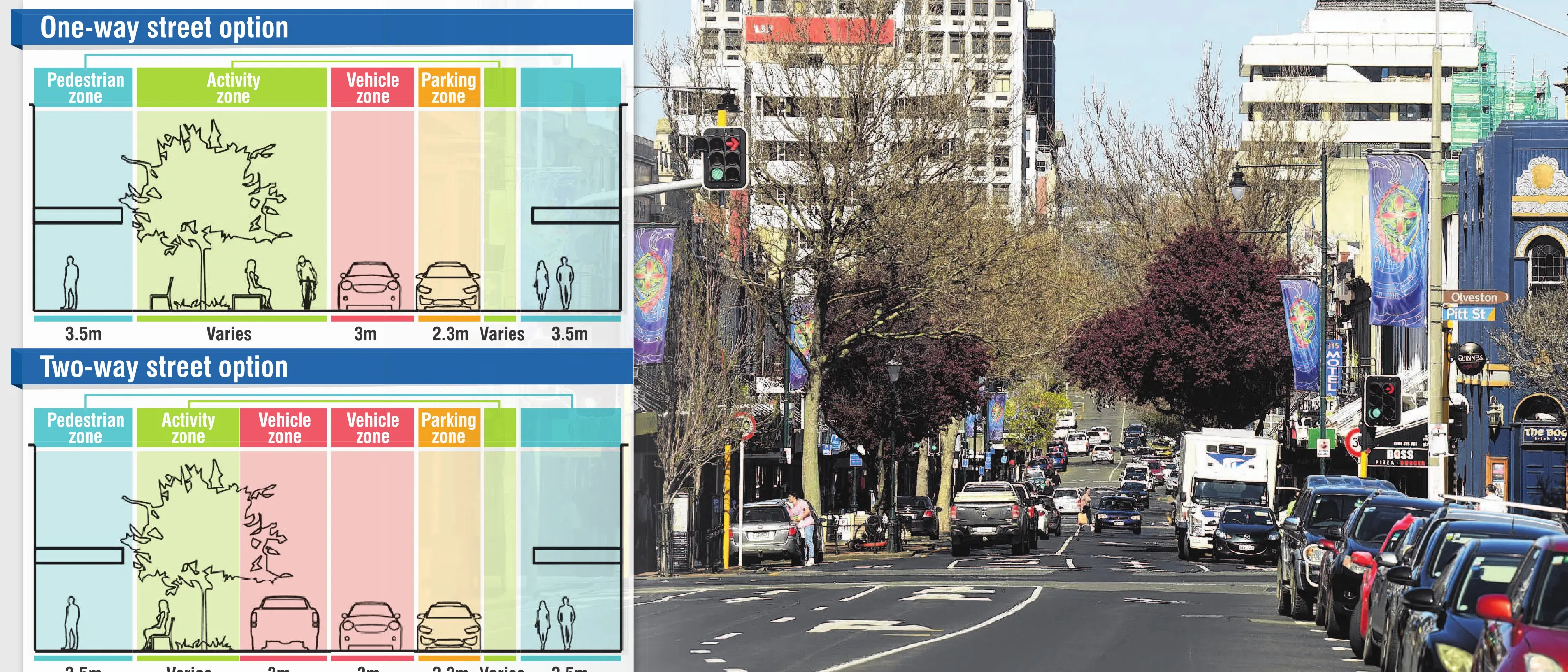
More space for pedestrians, play equipment, street furniture and bike parks could be favoured in a new-look George St, Dunedin.
Car movement will no longer be the primary function of the city’s main shopping street, unless city councillors make a surprise call to back a "do-minimum" approach.
Whether councillors retain two-way traffic or opt for a one-way design, motorists can expect "an intentional level of ambiguity so that drivers proceed with caution and at slow speeds".
If they keep faith with their previous instinct for a one-way design, the change will not easily be reversed.
The flexibility promoted by urban consultant Kobus Mentz — two-way traffic but with the flexibility to change to one-way, or vice versa — looks headed for the dustbin.
Dunedin city councillors are to debate on Tuesday a detailed business case for the redevelopment of George St and weigh up the merits of four options.
Three of them would limit traffic to a speed limit of 10kmh — one-way north, one-way south and a two-way design that would promote pedestrian activity.
A 30kmh speed limit would apply for the alternative do-minimum approach, in which underground pipe work would go ahead, but the street would look much the same as now.
The do-minimum option would amount to an abandonment of a George St revamp.
"The last major upgrade in the central city was more than 30 years ago, meaning the paving, lighting and other furniture is now dated and deteriorating quickly," the detailed business case states in its executive summary.
"The overall look and feel is tired ... [and the area] has not kept pace with changes in how people move around and want to use the city today."
"Activity zones" are promoted in the upgrade options.
"The activity zone contributes to enhancing the public realm, as it allows space for street furniture, planting, performance spaces and play equipment."
More detail would be supplied in the next stage of design.
A council staff report says all options are technically feasible.
Two-way traffic was strongly supported by commercial advocacy groups, Grey Power, the Automobile Association and Urban Access Dunedin, council staff noted.
One-way traffic was strongly supported by students and young people, Plunket and disability groups.
The business case assessed the capital cost of a George St upgrade as $19million for the one-way options and $18million for an upgraded two-way street.
A minimalist approach would come with a capital cost of $9million.
None of the options was found to be a resoundingly better investment prospect than the others.
Funding from the NZ Transport Agency is expected to be "restricted to a percentage contribution of walking and cycling benefits and any identified safety improvements".
Council staff said the one-way north option would have marginally faster travel times than the alternative direction, but the one-way south option would result in a safer intersection at the five-way George, London, Pitt and Frederick Sts intersection.
A one-way street with the flexibility to shift to a two-way design is no longer considered viable because substantial changes would be needed at intersections, traffic lights, crossing points for pedestrians, signage and access to parking.
"Attempting to incorporate the flexibility between one-way and two-way would compromise the quality of the design," the staff report says.