
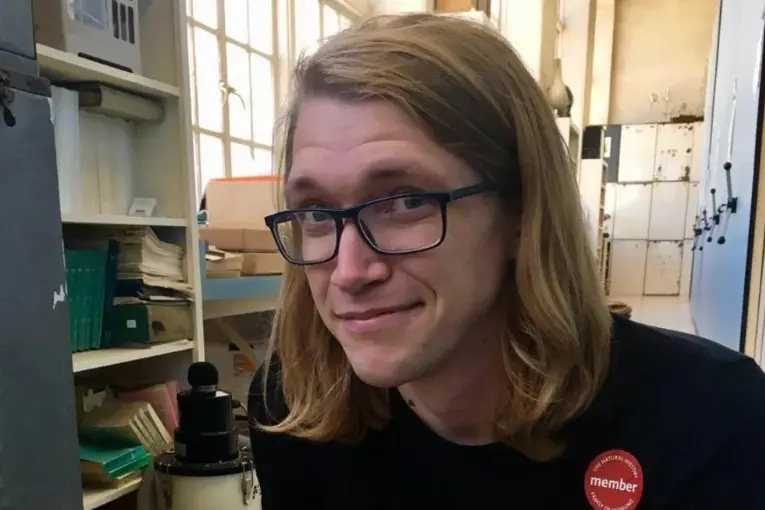
PHOTO
Kyle Whorrall had just made a routine night-time visit to the supermarket and was walking home when he sat down at a bus stop in the Auckland suburb of Meadowbank.
While he was at the bus stop, the Crown says the 33-year-old American PhD student was brutally murdered in an unprovoked attack in April 2025.
Four teens pleaded not guilty to his murder and aggravated robbery in the High Court at Auckland on Monday.
Jurors heard a fifth teenager had earlier pleaded guilty to both charges.
None of the young people can be named.
In his opening address, Crown prosecutor Taniela-Afu Veikune laid out the case and said Whorrall was making his way home from the shops, when the four teens drove past in a car.
"[The car] and its occupants drove past him again, and again, and again, five times, four U-turns going back and forth past Mr Whorall..."
Veikune said two people got out of the car, armed with a machete.
They robbed Whorrall and struck him in the head with the machete, splitting his skull.
"The defendants then left the scene with Mr. Whorrall's wallet, driving away in [the car], leaving him crumpled on the bench in the bus stop, dying from a catastrophic and ultimately fatal injury," Veikune said.
The trial was less about the murder, and more about the extent of the actions of those involved, Veikune said.
He said the Crown did not have to prove who struck the fatal blow, only that those in the car knew what could have happened.
"The Crown says that the defendants agreed to target Mr Whorrall to rob him, and it would have been known to each of the four defendants, as it would be to any reasonable person, that the robbery could well result in the use of the machete."
Lawyers for the teenagers also gave opening remarks.
Paul Borich KC told the court with all the evidence, and with 18 months of detective work, the Crown still could not say who wielded the machete.
"You might think: 'Well, if the case is going to be proved beyond a reasonable doubt, and the Crown don't know, how can we as jurors know?'," he said.
Borich said it was the person who had already pleaded guilty who was the murderer.
"He used the machete, he is your murderer, the evidence will show that he is the person who did that."
Defence lawyer Harvena Cherrington said there were three questions the jury would need to answer for her client: Was he there, who got out of the car, and what knowledge did he have?
She said the jury should focus on the matters in front of them at trial and not other incidents the Crown referenced.
Veikune had earlier told jurors two of the defendants - Cherrington and Borich's clients - had previously been involved in robberies with a machete.
Another lawyer - Oscar Hintze - acknowledged the Whorrall family.
"We recognise the grief of the Whorrall family," he said.
"Their loss is real and permanent, nobody on this side of the courtroom disputes that Kyle died a terrible and senseless death, or whoever caused it did a grave wrong."
Hintze said feeling sympathy for Kyle and his family was natural, but reminded jurors those feelings had to be put to one side.
"When a young man is killed in a public place, there is an understandable urge for someone to pay, that urge is instinct for revenge," he said.
"You're not here to satisfy that, you're here to do justice, that is something much different and much harder."
Meanwhile, defence lawyer Marie Taylor-Ciphers said there was no evidence her client got out of the car that night.
She cautioned jurors that what they had heard earlier was just the Crown's version of events.
"That's what the prosecution say happened," she said.
"You must make your mind up once you've heard all of the evidence.
The four appeared before Justice Simon Mount, who reminded jurors it was up to the Crown to prove the charges against the group.
The trial continues on Tuesday.
