
PHOTO
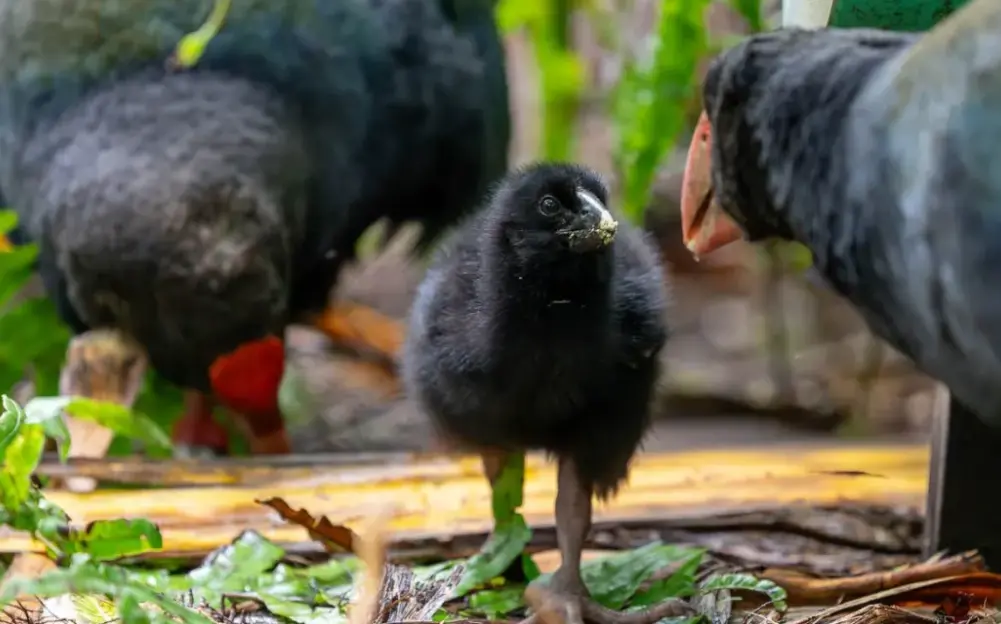
A pair of takahē believed to be infertile have thrilled staff at Zealandia wildlife sanctuary by unexpectedly hatching a chick.
Bendigo, a male, and Waitaa, a female, came to the Wellington sanctuary two years ago as a non-breeding pair.
Staff thought Bendigo had fertility issues, as he was not productive with two previous partners, so they let them live their lives not expecting chicks.
But last month, Waitaa had not been turning up for food, and as the team went to investigate her nest, they heard Bendigo and Waitaa making soft calls, noticing a high-pitch cheep in response.
Trail-cam footage confirmed Bendigo and Waitaa with their new chick.
"It's a lovely Christmas miracle I think... we thought the birds weren't able to have chicks at all," general manager of conservation and restoration at Zealandia Jo Ledington said.
Takahē are a threatened, nationally vulnerable bird, with an estimated population of about 500.
Ledington said any new addition to the population was really significant.
"Having the unexpected happening is a little bit of a glimmer of hope. I think conservation takes many hands, and I think it's fantastic that Zealandia as an advocacy site has been able to introduce about 140,000 people a year to takahē - some of those people would never ever have the opportunity to see them otherwise."
She said the chick, whose sex is still unknown, was doing well. Though known for keeping to themselves and for their "roaming" natures, Bendigo and Waitaa have become "attentive and doting" first-time parents, and the chick was living in an area of the sanctuary that is closed off.
That will open up more to the public as the chick grows and gets more resilient.
Ledington said the chick hatched in November, but this was kept secret until now due to a period of perilous weather that month.
"Takahē chicks in particular are quite vulnerable to cold, wet weather - they don't have their feathers, so they just have down and it's not waterproof, so if get wet they can get chilled.
"We just wanted to be a little bit certain that it was doing well, and just give it the best start in life."
The chick will be banded and vaccinated in March, and in time named and moved to a new home, as part of the Department of Conservation's Takahē Recovery Programme, Ledington said.
She said Bendigo, who hatched in 2017, and Waitaa, who hatched in 2020 are still a young pair.
Takahē generally live to anywhere between 16-22 and are known to breed from the age of two into their mid-late teens.
As to why the unexpected occurred for Bendigo, Ledington said that was an enigma that continued to confound staff.
"These are the mysteries of nature aren't they... it's not unheard of in takahē world that when birds change partners they can have more breeding success. I don't know maybe... right girl, right place, right time."
