
PHOTO
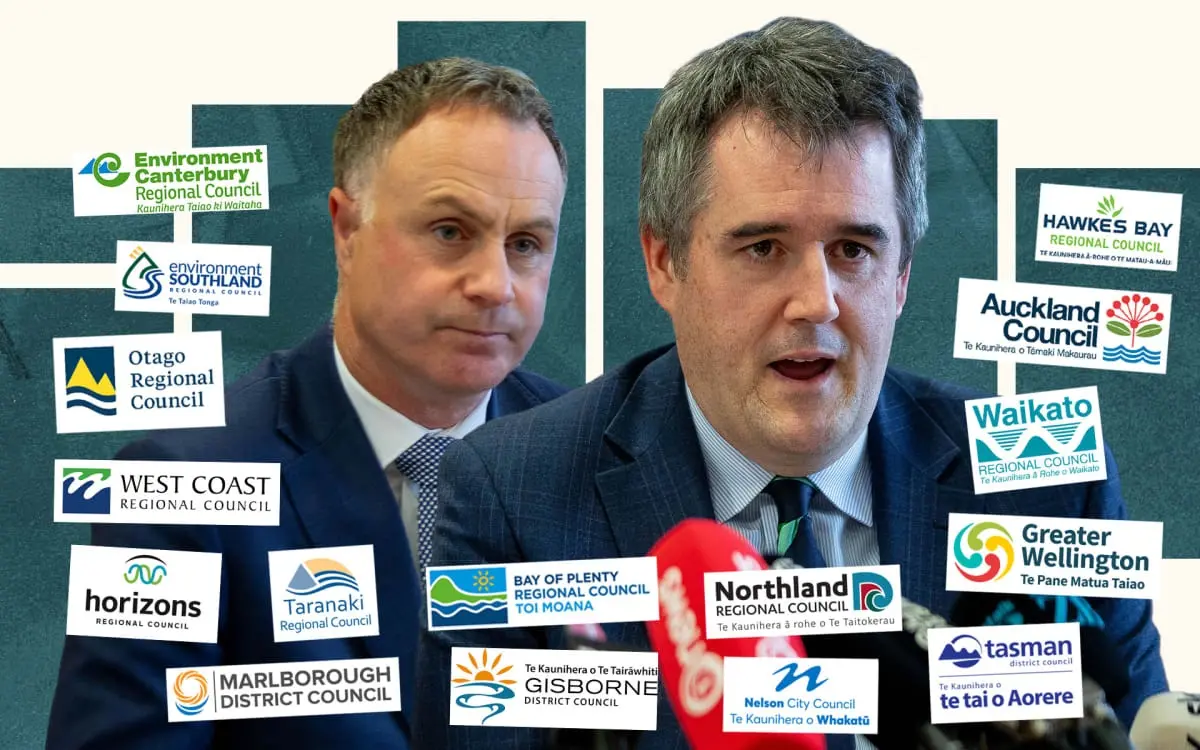
Big changes to New Zealand's council boundaries are in the government's hands now that the deadline has passed for councils to state their preferences.
Ten different reorganisation models have been proposed by 27 South Island councils, including a vast new unitary authority spanning the central and eastern parts of the Mainland and two conflicting models for Southland.
In May, councils were given three months to come up with proposals to create larger and more efficient unitary councils or have the government do it for them.
Government officials will assess the Head Start proposals and decide by the end of September if they are realistic and deliver better value to ratepayers.
Local Government Minister Simon Watts told Morning Report on Tuesday that he was impressed by the number of proposals put forward.
"This is going to form a more efficient local government system that's more fit for purpose. We know the current model is too complex and [has] too much duplication," he said.
Approved plans will be signed off in 2027, with changes expected to take effect from the 2028 local elections.
Nelson and Tasman: No proposal
As unitary councils, Nelson City Council and Tasman District Council were not explicitly included in the Head Start process.
Nelson was still exploring a merger but Tasman was not interested.
Nelson mayor Nick Smith wrote on Facebook he was disappointed the councils had not grasped an opportunity for change.
"Nelson and Tasman are one interdependent economy - we sink or swim together. The duplicate bureaucracy of having two councils adds extra costs for ratepayers," he said.
Tasman mayor Tim King told RNZ the councils already collectively owned a significant amount of infrastructure and assets.
"We work very closely and there's heaps of scope to do more of that. My perspective is that the last thing you give up in any democratic system is your vote or your representation," he said.
You exhaust every other opportunity to make the efficiencies or cost savings before you give up your vote and your representation."
Marlborough and Kaikōura: Merger
In one of the simpler amalgamation proposals, Marlborough District Council and Kaikōura District Council agreed to form a partnership and create an extended unitary authority from 2028.
Their joint Head Start proposal sets out plans to maintain a "strong local voice for Kaikōura" by establishing a Kaikōura ward with three dedicated Kaikōura-based councillors.
The councils said they had a shared tourism economy, transport corridors and coastal and marine interests.
The partnership would allow both districts to diversify their economies, attract investment and reduce their reliance on any single sector, they said.
"The merger is not without risk. While Marlborough District Council is experienced in managing regional council functions, it does not have the same scale or number of ratepayers as the Canterbury region has to address the impacts of storm events," the councils said.
West Coast: Merger
Grey and Westland district councils submitted a proposal for a joint unitary authority encompassing all of the West Coast, despite a split vote from Buller District Council which did not endorse the plan.
"The proposal nevertheless remains eligible for submission under the government's Head Start criteria, which require support from a majority of the directly affected territorial authorities," the councils said.
They said the proposal was not a decision to establish a new council, rather examining whether the model would work.
Westland mayor Helen Lash said any changes should be informed by independent evidence, meaningful community input and a clear understanding of the long-term benefits and challenges.
North Canterbury: Merger
Waimakariri and Hurunui district councils have teamed up on a proposal to create a new North Canterbury council.
They said the model would let the districts build on long-standing collaboration, rather than creating entirely new governance arrangements.
Hurunui mayor Marie Black said the move would keep North Canterbury's future in the region's hands.
"North Canterbury already functions as a connected community. Our residents work together, support one another through challenges, share services and infrastructure and increasingly see themselves as part of a wider North Canterbury story," she said.
Selwyn: Standalone council
Selwyn District Council was seeking to establish a standalone Selwyn Unitary Authority, absorbing regional council functions within its existing boundaries.
Selwyn mayor Lydia Gliddon said it was the preferred option among a survey of ratepayers.
"Our community has told us they value strong local representation, local decision-making and a future that keeps Selwyn's priorities at the forefront," she said.
Christchurch: Standalone council
Similarly, Christchurch City Council agreed to keep its current city boundaries and absorb regional council functions to create a new unitary authority.
Mayor Phil Mauger wanted a greater Christchurch metropolitan option that included Rangiora, Rolleston and other towns but failed to gain majority support.
He said he would not lose sleep over the "missed opportunity".
"The council made the decision and we're head down and get on with it," he said.
Mid Canterbury, South Canterbury, North Otago: Merger
Timaru, Mackenzie, Waimate and Waitaki district councils jointly lodged what they described as a bold and ambitious proposal for a vast new unitary authority spanning the central and eastern South Island.
Their proposal also assumed the inclusion of Ashburton District, despite Ashburton councillors equally split between four reform options and deciding not to submit a proposal.
The councils said their 26,900 square kilometre patch from the Rakaia River in the north to the Waitaki River in the south was one of the country's most productive and strategically important regions.
"Local government remains divided across multiple councils and two regional jurisdictions. This proposal is about correcting that mismatch and better leveraging its resources and talents to drive success locally, regionally and nationally," they said.
Central Otago & Clutha: Merger
Central Otago and Clutha district councils were earlier working with Queenstown Lakes on a proposal for a single, provincial council capturing their "mountains to the sea" region.
Queenstown Lakes then decided to walk away in pursuit of a partnership with Dunedin City Council.
Central Otago and Clutha district councils said they were disappointed but the proposal would still go to government.
Clutha mayor Jock Martin said the proposal was well thought out and had merit.
Inland and Coastal Otago: Twin model
Queenstown Lakes District Council agreed to work with Dunedin City Council on a twin model for Otago, consisting of an Inland Otago Unitary Authority and a Coastal Otago Unitary Authority.
Queenstown mayor John Glover said the proposal would give the district a seat at the table and time for more detailed exploration of a potential governance model.
"It does not represent a final decision on any future council structure. It simply allows us to positively contribute to the conversation," he said.
Southland: Merger or twin model
Southland councils have submitted two conflicting proposals that include Gore.
The first submitted by Invercargill City Council would see all four existing local authorities - Invercargill, Southland, Gore and Southland Regional Council - replaced with a single, region-wide unitary council.
Mayor Tom Campbell said the proposal was about creating "a governance model that reflects how Southland already works" while ensuring a strong voice for rural and urban communities.
The second submitted by Southland District Council would see it team up with Gore District Council to form a new rural unitary authority, while Invercargill city would remain a separate unitary authority.
Southland mayor Rob Scott said the twin model reflected community feedback and had the backing of Federated Farmers Southland.
"Our focus is on ensuring Southland communities are represented in shaping their own future," he said.
"The Head Start process has been rushed and we would have liked to have more time to talk to our people and the other councils in Southland but we believe it is important to be part of this to ensure the best outcome for our region."
Gore District Council has given its support to both proposals.
Mayor Ben Bell said he wanted to keep the district at the table, rather than committing to any particular model.
"This decision keeps Gore at the table. If we don't participate in these discussions, we risk having decisions made for us rather than with us," he said.
