

PHOTO
National has plunged below 26 percent in a new RNZ-Reid Research poll, while the Greens have surged about a month out from voting day.
The poll - published on Tuesday - puts the Opportunity Party once again in the kingmaker position.
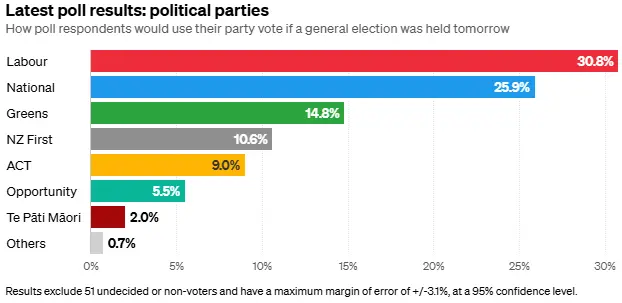
Christopher Luxon's National Party has fallen 3.2 percentage points since August, registering just 25.9 percent, its weakest result since the 2020 election.
Labour has also lost ground, falling 1.4 points to 30.8 percent in its third consecutive decline.
The poll was conducted as both National and Labour launched their election campaigns and Treasury delivered a brighter forecast for the government's finances.
Together, the two major parties now attract just 56.7 percent support, down from 61.3 percent in August and 64.9 percent at the 2023 election.
The Green Party has made the biggest gain, jumping 4.6 points to 14.8 percent, its strongest showing this term.
Opportunity has edged up 0.2 points to 5.5 percent, clearing the 5 percent party-vote threshold for a second RNZ-Reid Research poll in a row.
New Zealand First has fallen 1.3 points to 10.6 percent, while ACT has climbed 1.3 points to 9 percent. Te Pāti Māori has dropped one point to 2 percent.
If the results were replicated at the election, neither the existing coalition nor a Labour-Greens-Te Pāti Māori combination would have a majority in a 120-seat Parliament.
Opportunity's seven projected MPs could give either bloc the numbers to govern, although Luxon has previously ruled out working with the party in any capacity.
The basic seat projection assumes Te Pāti Māori would win at least one electorate, but that no party creates an overhang by winning more electorates than it would otherwise be allocated according to its party vote.
Under that scenario, National would return 32 MPs, New Zealand First 13 and ACT 11. Their combined 56 seats would leave the coalition five short of the 61 needed for a majority.
Labour would have 37 MPs, the Greens 18 and Te Pāti Māori two, giving them 57 seats.
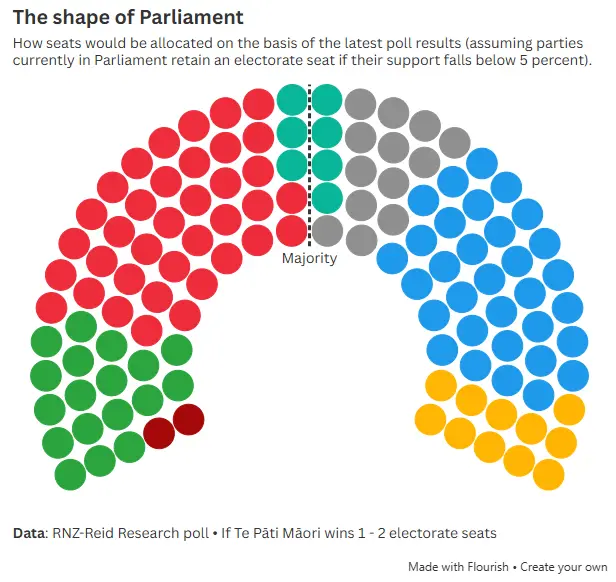
Opportunity's support would lift the existing coalition to 63 seats or the Labour-Greens-Te Pāti Māori bloc to 64.
Labour and the Greens could also reach a majority with Opportunity alone, holding 62 seats between them.
Opportunity, however, remains just half a percentage point above the threshold. Falling below 5 percent would leave it outside Parliament unless it won an electorate, significantly changing the calculations.
An overhang could also upset the calculations. On these figures, Parliament would expand beyond 120 MPs if National won more than 32 electorates, or Te Pāti Māori won more than two.
Te Pāti Māori has openly promoted split-voting to engineer such an outcome, as have prominent figures on the right, including Don Brash and Harry Mowbray.
National has resisted the push, warning it could shut senior list MPs out of Parliament. Luxon has called the idea "insanely stupid", while former leader Sir John Key said it was "the opposite of clever".
The poll also delivers another poor result for Luxon personally.
His preferred prime minister rating has fallen 2.8 points to 17.1 percent, while Labour leader Chris Hipkins has edged up 0.6 points to 21.9 percent.
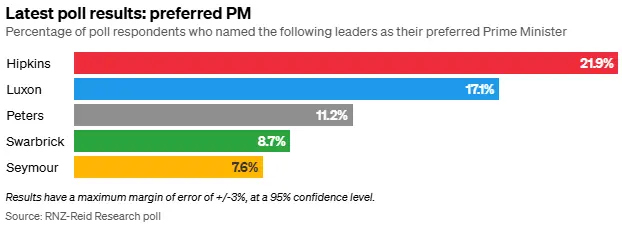
Winston Peters remains third on 11.2 percent. Green co-leader Chlöe Swarbrick has risen 1.3 points to 8.7 percent, her highest result in the series.
Another 14.4 percent of respondents selected no preferred prime minister or said they did not know.
More than half, 53.3 percent, rate Luxon's personal performance as prime minister poorly, against 29.6 percent who say he is performing well.
His net performance rating of negative 23.7 is his worst under his leadership, though only 0.8 points below August's result.
Hipkins also remains in negative territory, with 38.7 percent rating his performance as opposition leader poorly and 35.1 percent well. His net rating is negative 3.6.
The wider mood remains sour. Some 53.1 percent say New Zealand is heading in the wrong direction under the current government, compared with 31.6 percent who say it is heading in the right direction.
Another 13.5 percent say neither right nor wrong, while 1.8 percent do not know.
Reid Research surveyed 1000 eligible voters online between 24 September and 1 October 2026, using quota sampling and weighting by age, gender and geography. The poll had a reported maximum margin of error of +/- 3.1 percentage points at a 95 percent confidence level. Party-vote figures excluded the 3 percent who were undecided or did not know and the 2.6 percent who said they would not vote.
