
PHOTO
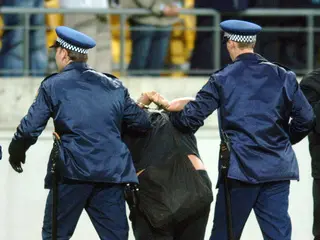
Police rules for handcuffing prisoners will be updated to end the practice of cuffing offenders to officers, police say.
Police operations support manager Superintendent Tony McLeod told The Dominion Post officers in some areas were handcuffing prisoners to police escorts, which was "not an approved practice".
Former police officer Stu Dever wrote to the Police News magazine warning someone would be hurt.
"The majority of the prisoners we see on TV handcuffed to police officers are seriously unstable, and I presume, unpredictable," Mr Dever, who served for 23 years, said.
Mr McLeod said handcuff guidelines were being updated to specify prisoners should be cuffed behind their backs or to another prisoner.
However, in what was an "atrocious" double standard, prison guards were still expected to be cuffed to prisoners, Corrections Association president Beven Hanlon said.
They did so without any of the police precautions, such as stab-proof vests, pepper spray and batons.
A prison guard had his nose broken by double murderer Graeme Burton, despite being in a wheelchair and cuffed to a large prison guard on each arm.
New policies were agreed after that requiring that a prisoner be cuffed and four guards present before being handcuffed to a guard, Mr Hanlon told the newspaper.
"But it's not happening. The managers won't do it because it costs too much."
The Corrections Department said introducing waist restraints had reduced the need for handcuffs.
"However, high-risk prisoners are still handcuffed to corrections officers in less secure situations (such as escorts to hospital).
"This is done to further minimise the risk of a prisoner escaping."