
PHOTO
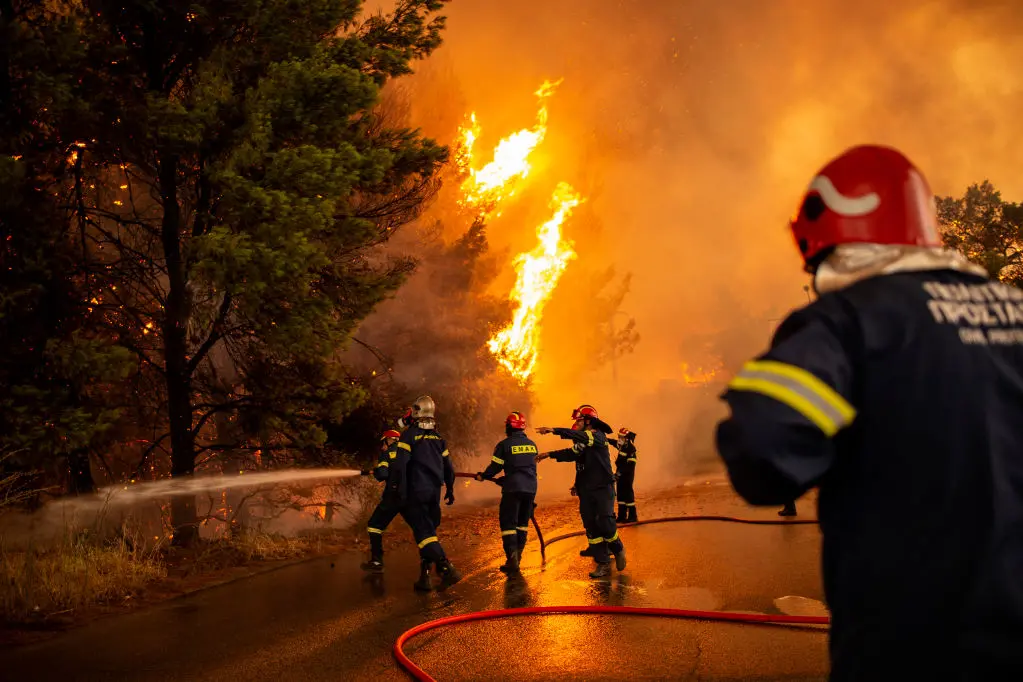
Large areas of France, Greece and Spain are burning, resulting in the displacement if not tens but hundreds of thousands of people, and the destruction of their homes and way of life as well as untold material damage and cost.
Likewise in Canada, raising objection from below the border to air pollution of Northeast USA. An almost daily replay of natural disasters of ever-increasing proportion.
A glimmer of hope can be drawn from the acknowledgement of the BBC in its reporting of these catastrophic events that their cause is rooted firmly in climate change, (not so in the report of Reuters in World Focus (27.7.26).
For those of us that have enjoyed as many decades on this fragile planet as myself, this should come as no surprise. From the 1980’s, climate science has been warning of these events, making it clear that growing levels of carbon pollution will inevitably have serious negative impact on the natural order.
At first these warnings were treated with scepticism and not a little derision. Such scepticism is no longer the case, as there is international acceptance that increasing levels of carbon pollution are inarguably linked to climate change (formally called ``global warming’’), with one or two notable exceptions, who will be recognised by readers for their attributes of clear, logical thinking, speech and action.
We know, or most of us know, that burning fossil fuels pollute the atmosphere, compounding the problem, but as a nation, we resile from taking meaningful steps to change course.
An often-repeated mantra is that, as a very small nation, the combined carbon contribution of Aotearoa New Zealand to global warming is so small as to be insignificant.
There was a time when Aotearoa New Zealand took pride in its ability to take a lead in matters of national and international importance. Take for example the enfranchisement of women, where this country became the first in the world to recognition of the right of women to register a vote, or when we led the world in recognising the obligations of the State to shoulder the burden of welfare, health and education.
In more recent times we witnessed our then Prime Minister champion the dangers of nuclear weaponry in the famed Oxford Debate, leading a government that had the temerity to ban nuclear powered or armed ships from our waters.
Such leadership that brought about these events, and others are sorely needed in times such as we now face.
There is a window of opportunity in the here and now for Aotearoa New Zealand to show leadership with a resolute drive to eschew fossil fuels with a commitment to developing the alternative and abundant energy sources which would meaningfully diminish reliance on carbon polluting fuels.
Not try to hide behind the false premise of a ‘carbon credit’ scheme that accepts the pollution but claims to minimise its effect.
Instead, we see the spectre of the current Minister of Resources proposing the opening of exploration permits in the Southern Ocean, the same Minister that reportedly (RNZ 2.2.26) shut down the possibility of this country being party to entering into a road map from reliance on fossil fuels in 2025. A declaration signed by Australia, and several Pacific countries.
Mr Jones, on his own admission, sees no future for this country if it is denied access to fossil fuels and holds out the example of Norway that benefits greatly From the exploration of oil reserves in its waters.
From my understanding, Norway’s sovereign fund, the repository of fiscal benefits from oil extraction is not applied to domestic funding requirements. Norway as well as other Scandinavian neighbours operate highly supported social welfare democracies, funded
by a robust taxation regime Which is largely supported by their well provided for populations in terms of education, health and welfare.
Norway is not fazed by having one or two disgruntled billionaires up stakes and locate in some tax haven locus.
Accent on the common good would appear to have majority support in Scandinavia. Something can be learned from that.
Noel O'Malley is a Balclutha lawyer, past-president of the Otago District Law Society and holds a master's degree in peace and conflict studies.