

PHOTO
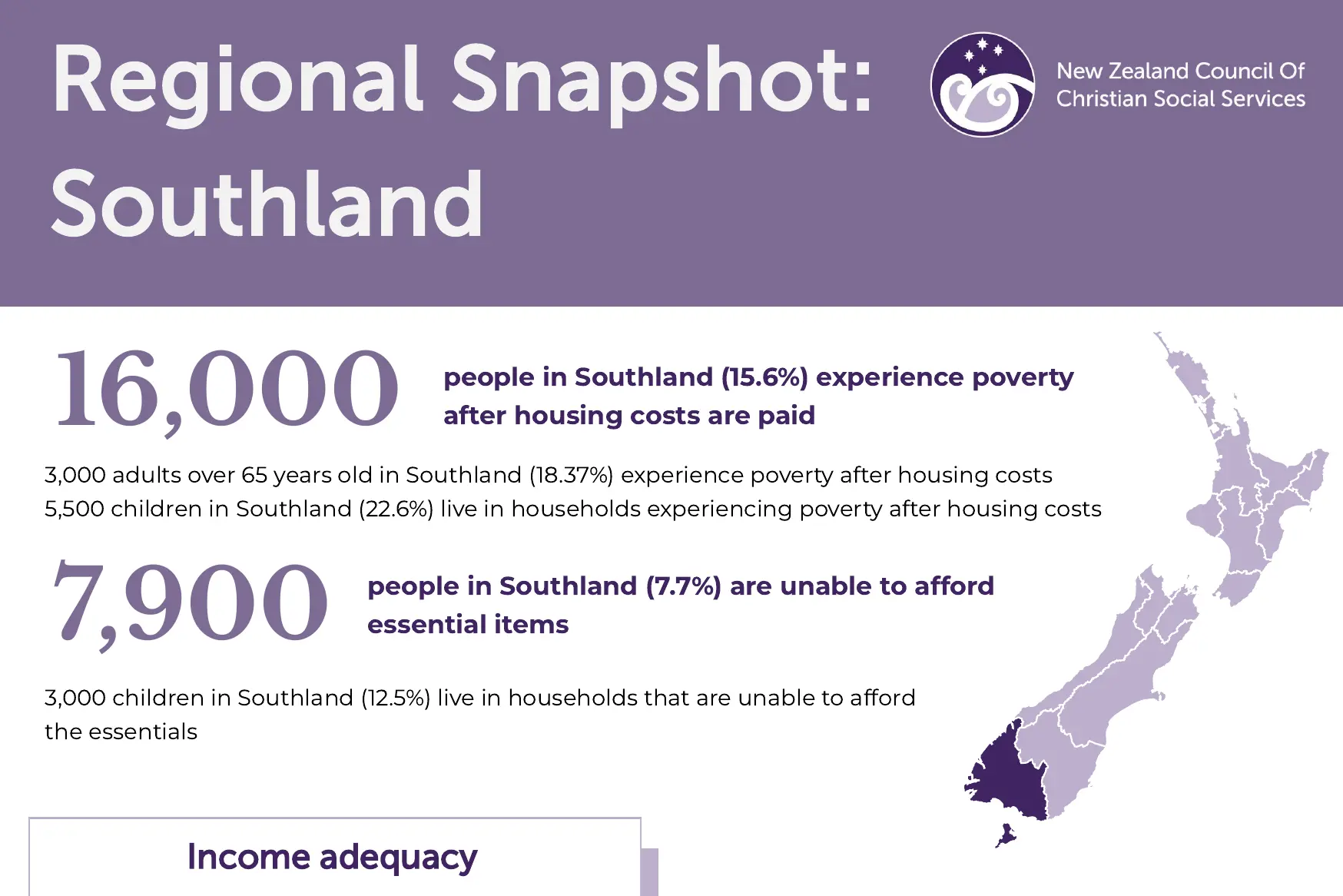
A regional snapshot from the New Zealand Council of Christian Social Services has revealed 16,000 people across Southland are experiencing poverty.
Also outlined in the report, a population bigger than Te Anau, Winton, and Bluff combined cannot afford essential items.
New Zealand Council of Christian Social Services chief executive Alicia Sudden said although cost of living and poverty was a nationwide issue, they thought it would prove useful to see what unique factors might be effecting each region.
“In general what we’ve found is that our current systems are failing to support people and failing to lift them out of hardship.
“Specific to the Southland region, the cost of renting has more than doubled in a 10 year period, income has only gone up 42%.”
She said accessing basic medical care like dentists and doctors have become increasingly difficult due to the cost of living.
“Power bills are going up, insurance is going up, so all of those are culminating into really significant and tight budgets.”
Food insecurity is also a major issue for many Southlanders with 35% of people in the region feeling uncertain if they would have access to adequate nutrition.
She also highlighted fuel costs, especially for those who live rurally who have to “travel further to get essential services”.
The New Zealand Council of Christian Social Services is an organisation which oversees just over 100 charitable organisations like the Salvation Army and local churches.
“The reason we decided to dig into these stats is because of what we were hearing from frontline services directly … social services are seeing a lot more people in need and they’re often coming in with multiple different needs that are really complex.”
She had spoken with the Salvation Army in Invercargill who told her they were seeing an increase in families who would have previously been considered middle class, coming to them for support.
This is putting pressure on local charities who are feeling “stretched,” amid the cost of living crisis, she said.
“A lot of impact is on the staff who are dealing with some really complicated issues.
“It’s a real stretch of services to try and cover the high level of need that they’re seeing.”
She said the charities were working with everyone including children, families and the unemployed, working through a variety of issues.
“It’s people who are dealing with food insecurity, budgeting, right through to aged care providers.”
Her organisation had submitted a list of policy asks for the upcoming election which received submissions from every significant political party except ACT.
“We think these would be effective and we’ve put them to all the political parties and made a scorecard which is on our website.
“We think that improvements in the welfare system are really critical … improving access to special needs grants and more access to the accommodation supplement.”
She also wanted to see a “Poverty Reduction Act,” implemented so statistics can be measured more effectively nationwide, aiming to “track positive progress to reduce poverty in the future”.
“We do think a big part of it is the fact our systems are currently failing to help people when they’re experiencing hardship.
“Once people find themselves having experienced something unexpected, that can catch them off guard instead of having welfare systems and other supports in place to help people bounce back.”
She said a lot of people end up in “really difficult cycles of hardship” and improved systems could help alleviate that.
“Making sure people can move back into work easily if they’re able, making sure they’ve got enough money to feed them and their families so that children can grow up better.
“These are all very achievable things if we put our minds and money to it as a country.”
tayler.mutton@alliedmedia.co.nz