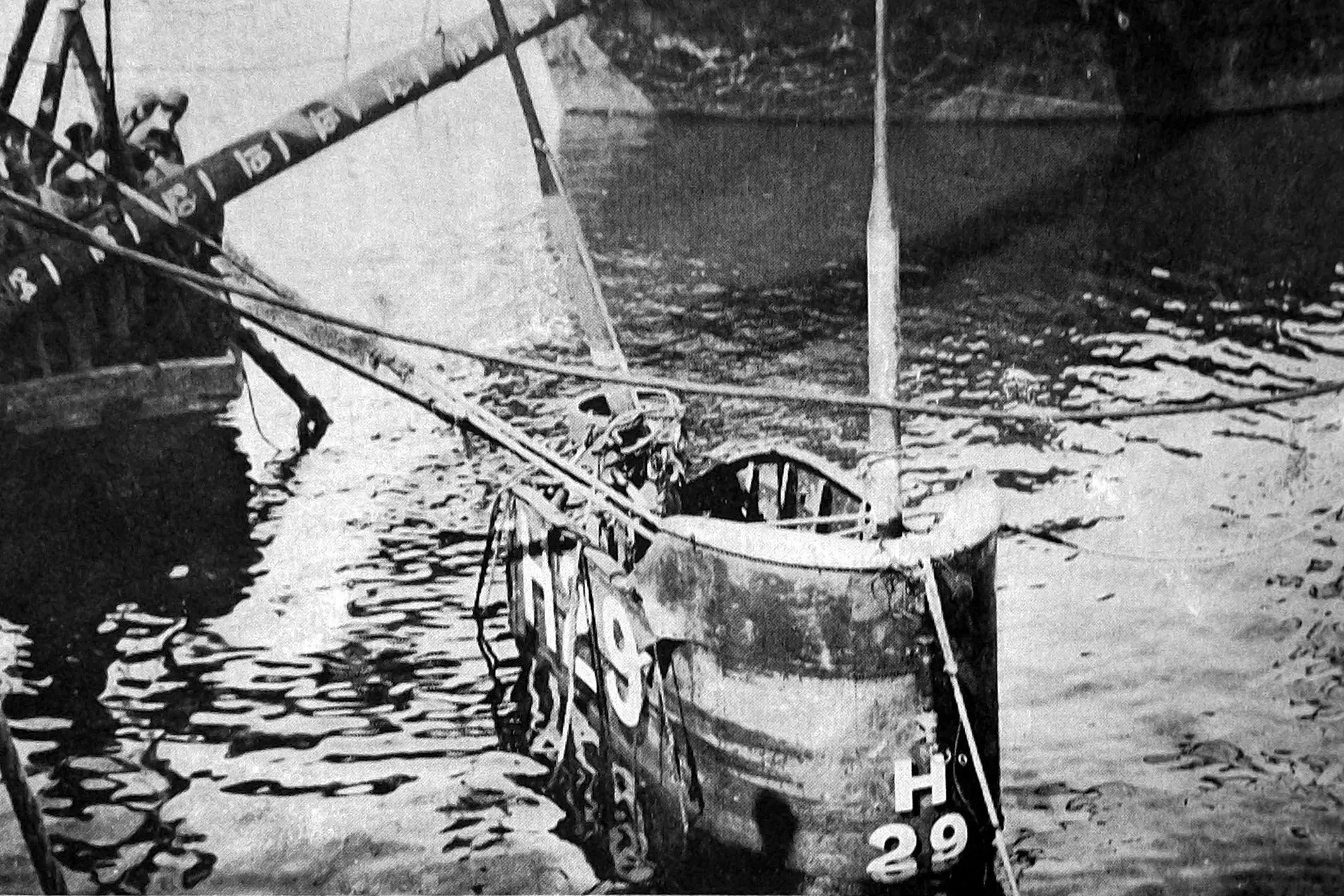
LONDON, August 9 (Received August 10, at 5.5pm): While undergoing repairs at Deyonport, submarine H29 sank. One artificier and four dockyard workmen were drowned. The submarine was undergoing tilting tests when it suddenly heeled and sank. An eye-witness states that the man in the conning tower was blown into the water and six others were swept off the deck. The last man to leave the vessel alive was seen struggling through the hatch under water. Five of his shipmates who had just been rescued jumped into the sea and helped him ashore. Divers instantly descended and the fire brigade made fruitless attempts to raise the ship by pumping. The submarine sank in 25ft of water. The first warning was given when an officer in the room aft shouted to the men forward, “For God's sake clear off the boat. There's something wrong, but we don’t know what it is." Another officer dashed below in order to close the watertight doors but he was too late, and the inrush of water blew him through the conning tower. Half the normal crew were on leave. The H boats have the reputation of being the fastest divers and the safest boats in the service. ‘Hot-house of New Zealand’ Speaking on the supply of fruit from Rarotonga, Sir Maui Pomare stated that in addition to bananas they were now growing a very fine kind of grape fruit there and also tomatoes. The tomatoes were grown in the winter so that New Zealand could be supplied in the off-season. Some people, however, wanted to shut them out from New Zealand because they were produced by coloured labour. “I cannot understand," added Sir Maui Pomare, “why they want to shut this beautiful fruit out when they cannot themselves grow it in the winter.” Mr Parry: "They’ll have a North v. South Island tariff soon.’’ Sir Maui: "Yes, our aim is to supply the people of this country with cheap fruit. Rarotonga is the hot-house of New Zealand.” Like clockwork When one climbs that tower where the watchful Dunedin Town Hall clock reposes in its giddy heights, perspective changes entirely — the perspective of vision and the perspective of sound. The way leads up several flights of steps until we come to a ladder. There is a rope suspended from the top to aid the explorer and halfway up this flight is an ante-room where the mechanism is housed. It is a marvellous machine, but its intricacies would take more than the layman to describe. Suffice is to say that it is from this part of the clock that the tick comes — a slow loud, deliberate tick that tells of the relentless march of time. Here, too, is the weighted end of the pendulum which swings a distance of only a foot — the father of all pendulums, with a weight on the end that would sink a foot or so into the pavement if it fell from its height. The loud tick follows us as we pursue our climb inside the four great faces of frosted glass. Here the shadows of the hands can be seen as they creep round in their pursuit of minutes. On the next floor the great bells hang from the roof, and it is these that announce the progress of the hours. They are green with the weight of the years, but their voice is unimpaired. The final flight opens on to a small platform that surrounds the summit of the tower. Here the wind blows freely and freshly. It is a wonderful view, embracing the whole city. The downward journey began. The reporter was half-way down one of the ladders, level with a huge bell, when suddenly there came the most appalling and ear-splitting crash it had ever been his lot to hear. One frantic clutch at the ladder prevented him from breaking his neck, and then pandemonium broke loose. The clock was chiming. It chimed, and then it struck 12 times, and each blow of the hammer was a mighty crash that clamoured at the ear drums and the angles and pillars as though seeking to knock them down. — ODT, 11.8.1926