
PHOTO
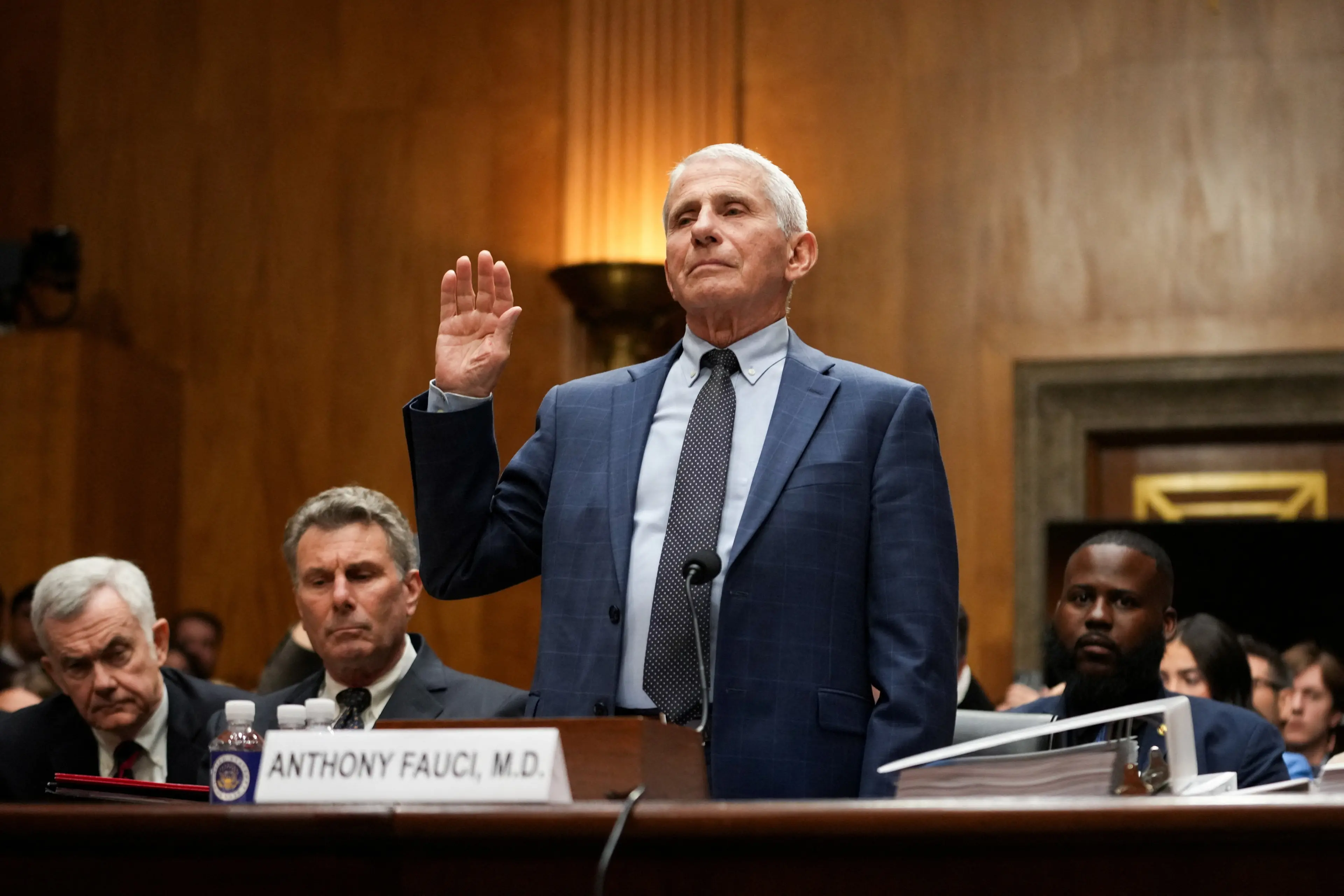
Anthony Fauci, the former top US infectious disease expert, declined to answer questions at a Senate hearing on Wednesday, invoking his constitutional right against self-incrimination and accusing Republican Senator Rand Paul of an "unhinged" campaign to see him imprisoned.
Fauci, who is 85 and retired in 2022, was subpoenaed by Paul of Kentucky, the chair of the Senate Homeland Security and Governmental Affairs Committee and a longtime adversary. Fauci accused Paul of an "unhinged" campaign to see him imprisoned, and refused to answer more than 100 questions.
Paul said Fauci was not allowed to plead the Fifth Amendment right to refrain from answering senators' questions, that a pardon from former president Joe Biden would not protect him, and that there would be consequences for refusing to answer. He said the committee had scheduled a vote for next week to hold Fauci in contempt.
Fauci, who led the National Institute of Allergy and Infectious Diseases for 38 years, serving under multiple Republican and Democratic presidents, and became the face of the US pandemic response, has long been criticised by President Donald Trump and many American conservatives. Trump before the hearing wrote of Fauci on social media: "His ideas were CRAZY!"
More than 1.1 million people died of Covid-19 in the United States, and the pandemic touched off a long-running effort by conservatives to assign blame for the toll of actions taken to stem the global health crisis.
Fauci became the primary target of that anger, criticised for lockdown directives, guidance on mask-wearing and social distancing, and his promotion of vaccines, which became heavily politicised during the pandemic, despite being shown to be safe and effective.
He and many public health officials globally recommended such measures based on scientific evidence available at the time of best practices to slow the spread of a novel and deadly virus for which there was no immunity, until a vaccine became available.
Biden preemptively pardoned Fauci on January 19, 2025, to guard against "unjustified and politically motivated prosecutions" for allegations related to Covid or his role in the response. The pardon does not cover subsequent conduct.
LEGAL POSSIBILITIES
Federal law makes it a crime to knowingly and wilfully make a "materially false, fictitious, or fraudulent statement or representation" to Congress, potentially exposing Fauci to prison if prosecutors decided he lied after being pardoned.
Republicans criticised Fauci for refusing to answer and claimed federal law and a 19th-century US Supreme Court decision required him to testify.
The 1896 decision lets Congress compel testimony from witnesses by immunizing them from criminal prosecution for what they say, without violating the witnesses' Fifth Amendment right against self-incrimination.
Fauci even invoked the Fifth when Senator Josh Hawley, a Republican from Missouri, asked him what day it was and what colour his tie and the carpet were. Ohio Republican Senator Bernie Moreno repeatedly asked if Fauci would apologise to various groups Moreno claimed were harmed by pandemic-era policies for which he blamed Fauci.
Paul had David Schertler, one of Fauci's lawyers, removed from the hearing after refusing to recognise his attempts to speak.
In a statement, Schertler called Paul's pursuit "an obsessive vendetta" and said the accusations "are false and disgraceful, and we will examine all options to hold him accountable."
Paul has for years called for Fauci's indictment and accused him of lying to Congress about whether the National Institutes of Health funded virus research in Wuhan, China, and of helping cover up Covid's origins.
'SLANDEROUS COMMENTS'
Fauci denies both claims and says he has testified truthfully multiple times before Congress on these issues, with Paul often his chief antagonist.
Fauci said Paul's "obsession" with prosecuting him, his "slanderous comments" and his release of Fauci's unredacted personal diary showed the hearing's sole reason was to make him "say something that could vindicate" Paul's public pledges to see him behind bars.
Michigan US Senator Gary Peters, the committee's top Democrat, called the hearing biased and one-sided, describing it as an effort "to legitimise a predetermined conclusion that was reached years ago."
Claims of so-called gain-of-function research in China have been behind much Covid origin conspiracy theory accusations. It broadly means modifying a pathogen in ways that could make it more transmissible or dangerous.
Paul had long suggested that the US National Institutes of Health funded such work in Wuhan and that Fauci lied when he denied it, while Fauci says the research did not meet the government's formal regulatory definition.
COVID ORIGINS
Covid's origins remain unresolved. The FBI said in 2023 that a leak from a Wuhan laboratory likely caused the pandemic, a claim China said had "no credibility whatsoever."
The CIA said in January 2025 a lab leak was likely, but with "low confidence," while four other US intelligence agencies and the National Intelligence Council believe the virus most likely emerged via natural transmission from some animal.
Paul this week published a 1141-page tranche of Fauci's pandemic-era diary entries, from December 2019 through December 2022, saying they "completely undermine the official narrative that Fauci and other public health officials espoused."
A review provided by a representative of Fauci said the entries matched what he said publicly at the time. Fauci has maintained since 2021 that he kept an "open mind" that Covid could have leaked from a lab, and spoke publicly in early 2020 about asymptomatic transmission and China's lack of transparency, the very matters Paul says the diary reveals.
The entries largely chronicle Fauci's media appearances and rising fame.
The Trump administration issued a policy on Tuesday barring federal funding for "dangerous gain-of-function" research.