
PHOTO
A man has been arrested in Russia on accusations of spying for New Zealand.
In a statement, the Russia's Federal Security Service (FSB) said the Russian Federation had "identified and stopped the illegal activity of a citizen of the Russian Federation suspected of committing treason".
The FSB said it had established a Khabarovsk resident, born in 1971, "proactively established" contact with the New Zealand Security Intelligence Service.
New Zealand's intelligence services are part of the Five Eyes intelligence-sharing alliance which includes Australia, Canada, Britain and the United States.
The FSB said the contact was done for "for selfish motives, on instructions from a foreign intelligence service, using foreign email services and instant messengers, transmitted information to the foreign intelligence service that could be used against the security of the Russian Federation".
The FSB said it had opened a criminal case against the man and he was being investigated under Article 275 (treason) of the Russian Criminal Code.
The man has been remanded in custody.
"The Russian Federal Security Service (FSB) once again draws the attention of citizens to the fact that treason is punishable by criminal penalties under Russian law, including life imprisonment."
The Moscow Times reported the man was arrested in the south-east city of Khabarovsk.
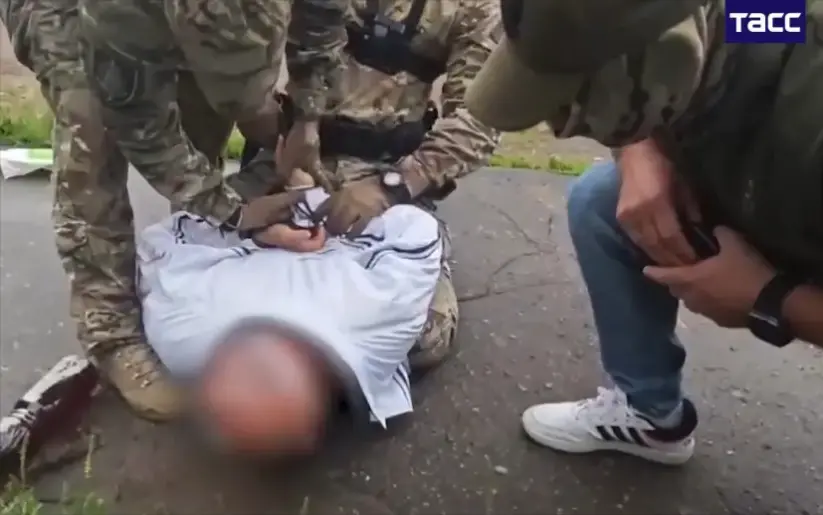
Video footage by FSB shown by Russian media showed authorities rushing over to the man on a street pavement and pinning him to the ground before locking him in handcuffs.
The video showed the man being taken into custody and his home searched.
The information hasn't been independently verified.
Both Foreign Minister Winston Peters and the minister with responsibility for the spy agencies Chris Penk referred comment to the NZSIS.
Speaking to reporters at Parliament, Penk stuck to the usual policy of neither confirming, nor denying details about the case.
"I've seen the reports overnight in the Russian media. These matters, if true, that would be operational in nature. So we make a practice, and it's been a long-standing practice of not commenting on those," he said.
"We don't comment on matters alleged, including and especially in overseas media that may or may not have taken place."
He would not say whether the Russians had been in contact, and would not say whether or not New Zealand had ever spied on other countries.
"I would love to give reassurance, but to breach the long-standing practice around not commenting on operational matters wouldn't be the right thing for me to do. I don't think it would be in the public interest, and perhaps New Zealanders who are weighing the nature of the claims might consider its source and draw any conclusions in terms of the likelihood of that being accurate or not," he said.
Prime Minister Christopher Luxon was similarly tight-lipped.
"I've seen the reports. As previous governments have done, I don't comment on security intelligence issues and I'd encourage you to talk directly to the NZSIS," he said.
A spokesperson for the NZSIS told RNZ it had a long-standing practice of not commenting on what "may or may not be operational matters".
"It should also be noted that Russian state media are often not the most reliable source of accurate reporting," the spokesperson said.
'Multiple audiences' for arrest video
Otago University associate professor James Headley, an expert on Russian foreign policy and international relations, said it was interesting a spokesperson for NZSIS had said no comment would be made but to basically take it "with a grain of salt".
The video of the arrest was also interesting, he said, and had been publicised for multiple audiences.
Headley said part of the message was to domestic citizens as a warning to show what would happen to them if they spy - as the man is accused of doing.
He said it was also trying to present a picture of Russia protecting its security against what they consider "unfriendly states".
"I think that's the other interesting aspect of how they presented it. They specifically referred to Five Eyes which is the intelligence sharing cooperation between Australia, Canada, the US and the UK, so they've framed it in terms of that and that's the way they position New Zealand a lot, is in alliance with states they actually deliberately frame as unfriendly or part of the collective West which is against Russia."
Specifically calling out New Zealand was also interesting, Headley said - and it was the first time he was aware of it happening.
The New Zealand government has placed sanctions against those supporting Russia's war against Ukraine.
Earlier this year, Peters announced more sanctions against cyber actors and online platforms supporting Russia's war on Ukraine.
More than 2000 groups, individuals and vessels had been sanctioned since the war began.
Peters has consistently said New Zealand will hold Russia and its enablers accountable.
The Russian Embassy has been approached for comment.
