PHOTO
Over the past few months, we, the Fernhill and Sunshine Bay Community Association, have been collecting feedback from the Fernhill and wider community.
Like many communities facing a fast-track development, we share concerns about the proposed project itself, associated necessary infrastructure, the potential cost to ratepayers, the overriding of the area’s district plan and accountability for delivering what is promised and for when things go wrong.
However, our concerns go considerably beyond these issues.
We are also facing a combination of safety, environmental and community wellbeing risks that we believe are particularly significant because of the scale and location of the proposed Powerhouse Queenstown development by Bowen Peak Ltd.
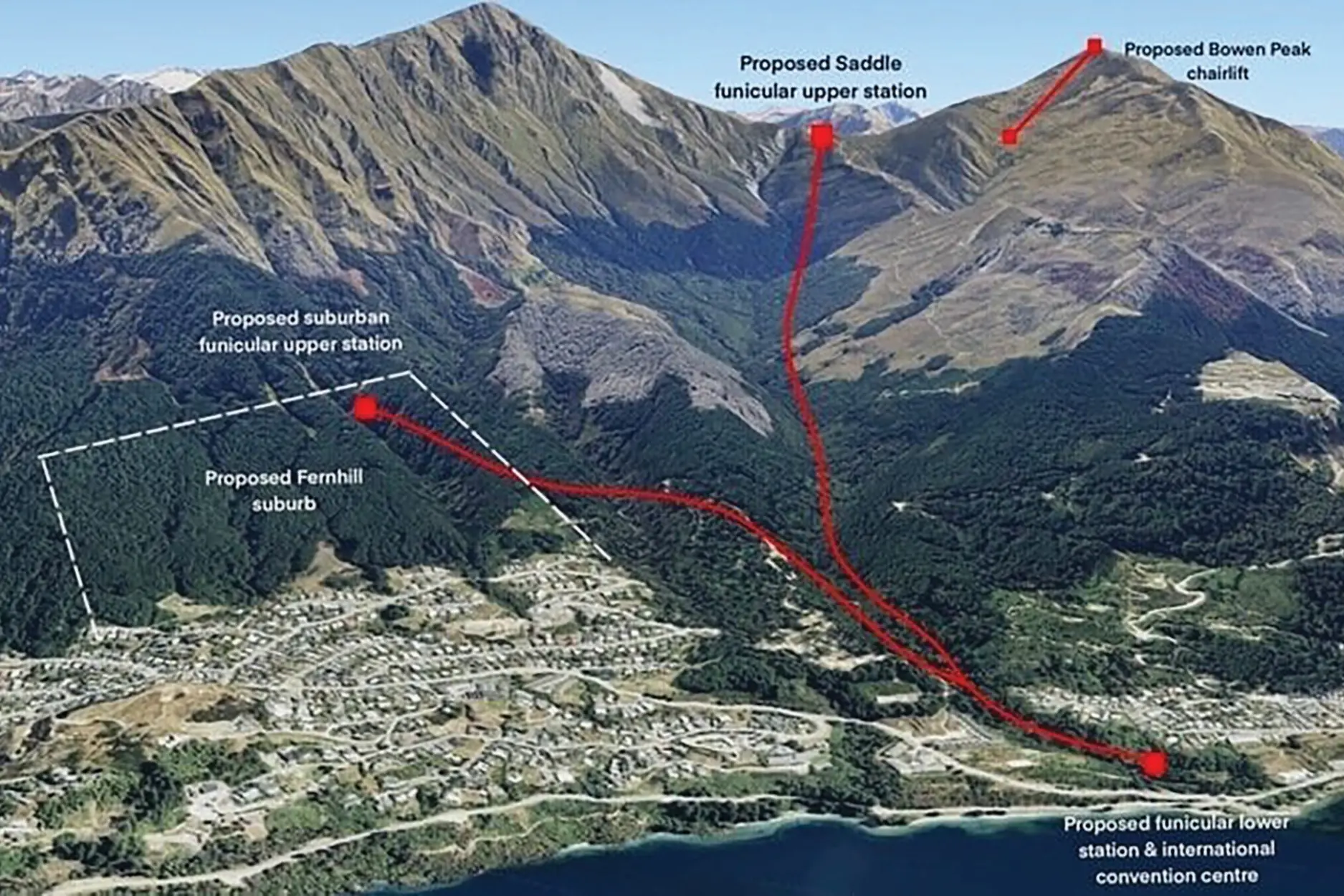
One of the main concerns that has been repeatedly raised by residents is the geotechnical and natural hazard risk associated with the construction of the 175, six-storey, high-density apartment blocks proposed to be built on the mountain face above the existing Fernhill suburb.
These are not chalets, as Bowen Peak Ltd is trying to market them as.
Instead, each proposed block is comparable in size to some of the large apartment buildings and hotels in the Frankton Flats area.
The proposed development is located on steep terrain above the existing residential area.
The community is seriously concerned about geotechnical stability, including the potential for landslide, rockfall, debris flow and slope instability.
These are not simply concerns about inconvenience or amenity.
They are fundamental questions about the construction phase itself and then also about the safety and long-term security of the existing homes and residents below the proposed new apartment blocks.
At our June meeting, an emergency management expert also raised concerns about evacuation capacity.
Fernhill already has constraints around evacuating the existing population.
The community is concerned about how this could be managed with an additional 1333 residential units, visitors, a proposed gondola and skifield.
As Fernhill residents, we have always been conscious that we live in an area with natural hazard risks.
Intensifying development in an area already subject to these constraints raises serious questions about whether the risks are being increased rather than reduced, as Bowen Peak has claimed.
The other major issue is the extraordinary length of the proposed development, which has been timelined to take 20-plus years to complete.
This would expose residents to decades of construction disruption, including extensive land works, a major logging operation, heavy construction, vibration, dust, traffic and disruption.
Notably, a lot of the claimed amenity and benefits are only proposed to be delivered in the mid and later stages of the project timeline.
This means massive disruption and risk is guaranteed, but with the claimed positives only arriving years later as per the developer’s own plans.
This is assuming the developer has sufficient finances to continue to the end.
As there are no guarantees to protect the community and rate payers if the developer becomes insolvent after causing all the stress and disruption but before delivering any supposed benefits.
As residents, we already know what it is like to have continuous large-scale construction with extensive earthwork in a residential area as we have already experienced the failed Jade Lake development, which sits smack bang in the middle of Wynyard Cres.
You only need to drive to the top of the suburb to see how utterly terrifying the construction of Fernhill Heights will be for those residents whose homes run along the bottom of the proposed development area.
The surrounding area will also be severely impacted, as the main roads to the site run right through the heart of the existing suburb.
One resident wrote to Bowen Peak Ltd in their feedback that they had “genuinely lost sleep over what you are trying to do”.
Alongside the safety and wellbeing concerns, the majority of feedback also raised concerns over the proposed use and development of public reserve and conservation land.
There are so many groups and individuals that use and protect this area that to see it being thrown into the mix for nothing but private gain is heartbreaking.
The petition set up by the group Forward Whakatipu has gained over 4200 signatures.
We believe this is an issue that should be taken up by everyone that calls New Zealand home, as not only is this selling our protected areas for private gain, but it is being sold to us as having regional and national significance.
These concerns are not being raised by residents alone.
Even Queenstown Lakes District Council (QLDC) has identified significant uncertainty.
At the referral stage, QLDC stated that it was unable to confirm that the development would provide regionally or nationally-significant benefits and identified significant uncertainty around natural hazard risk, infrastructure servicing, transport, three waters, landscape capacity, economic benefit realisation and long-term implementation.
“QLDC is unable to confirm that this development would have regionally (or nationally) significant benefits (in terms of the FTAA referral criteria) and this is of concern.
“Many of the claimed benefits are not to be realised until the end of the multi-decade staged implementation period (approximately 26 years).
“Further, the application is likely to generate significant adverse effects upon the environment, and the current level of information does not provide sufficient certainty regarding natural hazard risk, infrastructure servicing feasibility (transport and three waters), landscape capacity, economic benefit realisation, and long-term implementation sequencing to confidently confirm that the statutory threshold of significant regional or national benefit has been met.”
There are so many other issues that the community has with the proposal: the damage that would occur to the historic One Mile Powerhouse, the permanent change to existing natural habitat in the reserve and wildlife impacts, the destruction of land identified as outstanding natural landscape, and the effects on the already established bike trails and other recreational values.
It is difficult to address them all due to the myriad of issues this proposal raises.
The development of the reserve is just one disingenuous claim that Bowen Peak Ltd consistently states they are doing this for the community, whereas we are yet to see one positive response to the project.
Indeed, if protection of flora and fauna were truly the objective, there are far simpler and far more effective means of achieving it, not proposing what appears to be a vanity project at the expense of the community and the environment.
Workers’ accommodation is another claim that falls into this category.
Bowen Peak Ltd has provided limited information on what it actually considers to be “workers’ accommodation” and how it proposes to manage that 50% of the units remain as worker accommodation. They persist in citing a ‘’statistic’’, that 10% of residents had to sleep at least one night outside secure accommodation.
In fact, proper research shows that the origin of this figure was an RNZ article published in March this year, which was derived from the Quality of Life Survey, of which there were 1767 responses from residents and a further 330 from non-resident ratepayers.
So, at a stretch, around 200 residents experienced this, not 3000-plus, as Bowen Peak Ltd would have us believe.
Again, this appears to be window dressing to push through with a private residential development which in no way supports the existing need or community.
This exemplifies the prevailing community sentiment to date, namely that the proposed gondola, sustainable public transport, skifield, sanctuary, workers’ accommodation and arterial route are simply a ruse to secure approval for the residential development.
Like other communities facing fast-track developments, we have very limited ability to influence what happens.
A small community association made up of volunteers is now trying to navigate a highly-complex process.
It appears that the only way we are able to have input to the process is if we produce our own independent expert reports.
We are now in a position where funds we have raised for community projects, such as a community pontoon, may instead be redirected towards trying to protect the community from the potential impacts of an unwanted and ludicrous development we have little ability to influence.
For Fernhill and the wider Queenstown residents, this is no longer simply a debate about development.
It is about the safety, wellbeing, environment and future of an existing community, and whether the fast-track process provides adequate protection when the potential consequences are this significant and this long-lasting.
— The Fernhill and Sunshine Bay Community Association