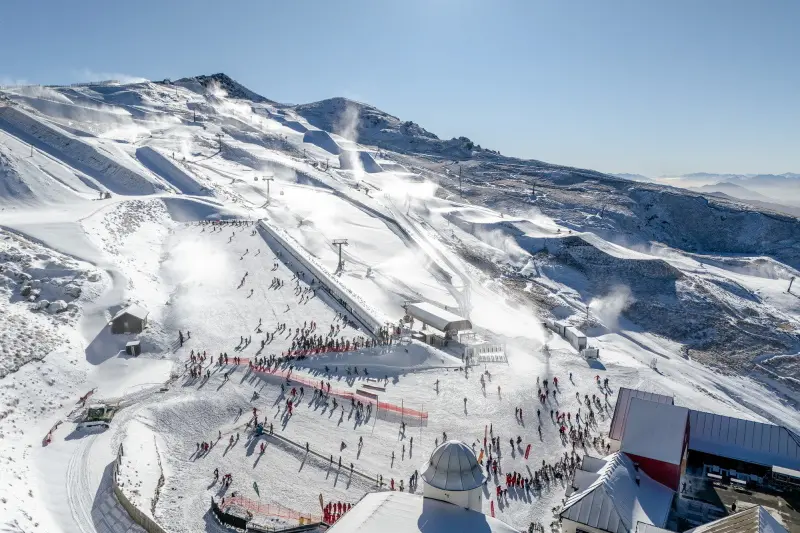
PHOTO
The South Island's ski season began with a stutter this year, with warm weather and limited snowfall forcing several fields to push back their opening days.
But for inbound groups of young Chinese skiers, some as young as 8 years old, the late start offered something that was difficult to find at home: a chance to train outdoors on alpine slopes.
Some of the young athletes jokingly call themselves "fridge children", a reference to the indoor ski centers in which they usually practice.
In southern China, where winters are mild and natural snow is scarce, indoor slopes have become training grounds for a new generation of skiers inspired in part by the 2022 Beijing Winter Olympics.
New Zealand's winter overlaps with China's summer school holidays, which generally run from early July through the end of August.
The timing allows the young athletes to continue training while many outdoor ski areas in China are closed.
Among those making the trip this year was a group of nine young skiers from the Bao An Ski Club in the southern Chinese city of Shenzhen, most of them primary school students.
The group spent six days training at Treble Cone and Cardrona from July 16-23.
Yuyi Lin, the group's leader, said it was the first time some of the children had skied outdoors in alpine conditions.
The opposite seasons in the Northern and Southern Hemispheres, she said, allowed them to train year-round.
"They were first introduced to skiing and completed their beginner training at indoor ski centres in Shenzhen," Lin said.
"They then took advantage of the summer school holidays to travel to New Zealand for further training."
Lin said the group chose New Zealand because of its varied mountain terrain and its reputation as a safe and welcoming destination.
"The mountainous terrain is diverse, and the public safety, social environment and local culture are all excellent," she said.
"We feel completely at ease bringing the children here."
Winter sports had become increasingly popular in China, Lin said, aided by local government initiatives and growing interest among families.
Although the club is only a year old, about 300 children aged 6 to 8 have enrolled in its ski programs.
Lin said she expected enrolment to continue rising.
But ski training can be expensive, she added, leaving the sport most accessible to middle-income families.
Evan Lee, founder of Aether Racing Club, is also the father of a young skier who has trained in China for more than three years.
Lee has accompanied seven young skiers, aged 11 to 16, to New Zealand from July 24 for a month of intensive alpine training at Roundhill and Mount Dobson, two ski areas in the Mackenzie region.
Lee said the 2022 Beijing Winter Olympics had helped popularize snow sports across China, expecting the surge in interest to prove more enduring than a passing trend.
Training in skiing and snowboarding represented a substantial financial commitment for many Chinese families, he said.
Families typically spent between 150,000 and 200,000 yuan (about $40,000 to $50,000) a year on training in China.
For children who trained overseas, the annual cost could rise to about 400,000 yuan (roughly $100,000).
Nevertheless, Lee said, many families were willing to make the investment, and children were increasingly beginning to train at younger ages.
"Chinese parents' attitudes towards education are changing," Lee said.
"They are no longer focused solely on academic achievement. Increasingly, they also value their children's physical development, resilience and strength of character."
The 2022 Beijing Winter Olympics helped fuel a boom in winter sports across China.
Domestic ski resorts recorded about 26.05 million skier visits during the 2024-25 season, according to the China Ski Industry White Paper, an increase of 12.9% from 23.08 million a year earlier.
China had 748 ski resorts in operation during the 2024/25 season, including 66 indoor facilities, the report said.
The indoor resorts attracted a combined 5.63 million skier visits during the season, accounting for 21.6% of the national total, it said.
The expansion has included a wave of vast indoor facilities near major cities.
China is now home to seven of the world's 10 largest indoor ski areas, including the five largest. Two, in Shanghai and Harbin, each have 65,000sq m of snow-covered terrain.
The boom has also caught the attention of tourism operators in the South Island, who see China's growing appetite for winter sports as a potential source of visitors during New Zealand's quieter tourism season.
NZSki, which operates Coronet Peak, Mt Hutt and The Remarkables, announced a partnership late last year with Chinese snow resort operator Sunac-BonSki.
NZSki said the agreement could give New Zealand direct access to 13.5 million active skiers in China.
Alison Wang, NZSki's sales manager for Eastern markets, said Australia remained the company's largest international market, while China was among its fastest growing.
Visitor numbers from China had risen sharply over the previous two years, Wang said.
Visits by Chinese skiers across NZSki's three ski areas increased 52% from 2024 to 2025, while sales through Chinese travel trade partners rose 200% over the same period.
China's ski market had also become increasingly diverse, she said.
"We see families, independent ski enthusiasts and organised training groups, as well as general tour groups that include skiing as a distinctive New Zealand experience rather than the sole purpose of their trip," Wang said.
Coronet Peak and The Remarkables were NZSki's most popular fields among Chinese visitors, Wang said, largely because of their location in Queenstown, one of New Zealand's leading ski destinations.
She said China's ski boom offered an opportunity to attract more travellers during New Zealand's winter.
"Skiing gives Chinese travellers an additional reason to visit New Zealand during this period, particularly when it can be combined with a wider holiday," Wang said.
Other South Island ski operators have reported similar growth.
Cardrona Alpine Resort and Treble Cone, both operated by RealNZ, said visitor numbers from China had risen steadily since 2022.
Laura Hedley, chief mountains officer for Cardrona and Treble Cone, said the resorts had received more inquiries from Chinese freestyle and alpine ski groups made up of school-age athletes, particularly those seeking high-performance training.
Hedley said the 2022 Beijing Winter Olympics had helped drive a sharp increase in skiing and snowboarding participation in China.
The success of Eileen Gu, a Chinese American freestyle skier who trained at Cardrona for several years, had also drawn more Chinese skiers to New Zealand, she said.
Cardrona and Treble Cone have partnered with ski associations and resort operators in China to better understand the expanding market, Hedley said.
She added that the growth could bring more Chinese visitors to New Zealand, particularly in late spring, when the weather is more stable and conditions for lessons and training are at their best.
Tourism New Zealand's China Visitor and Market Insights reported in July that 297,000 visitors from China arrived in New Zealand in the year ending March 2026. Nearly three-quarters, or 74%, travelled for holidays.
Eighteen percent of Chinese visitors arrived during the winter months, a share broadly in line with prepandemic levels.
By comparison, 22% of Australian visitors arrived during winter. Japan and Singapore recorded slightly higher proportions, but neither market matched China in visitor volume.
Tourism New Zealand estimated that 73 million Chinese travellers qualified as "active considerers," a group the agency defined as people who viewed New Zealand as an appealing holiday destination, would consider visiting within the next three years and met its minimum spending threshold for the market.
Of those travellers, 66% ranked New Zealand as their preferred destination, according to Tourism New Zealand.
Their interest also extended beyond the summer peak, with 85% saying they would consider travelling during autumn, winter or spring.