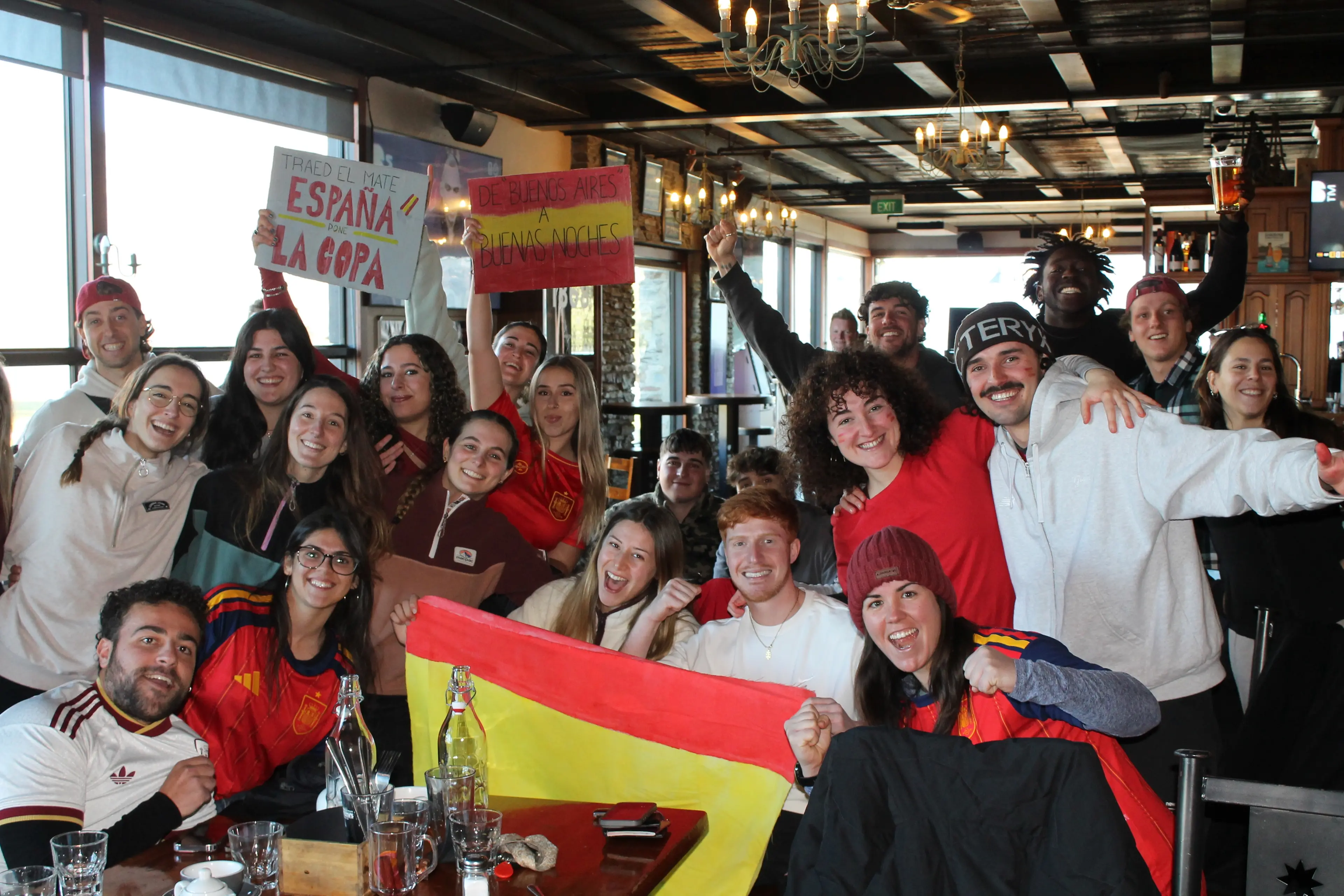
In football’s heartlands, the Fifa World Cup is a uniquely unifying experience, bringing together friends, family and strangers like no other event on earth. Watching the event from New Zealand — let alone the south of the South Island — can be an alienating experience. Everyone back home is together, celebrating victory on the streets of major cities, or commiserating in defeat in pubs and living rooms. And while its no match for being in London, Spain, Paris or Buenos Aires, as the World Cup reached its crescendo, Wanaka’s diasporic communities offered a home away from home. In the first of last week’s semifinals the tournament’s two favourites — France and Spain — played in Dallas for a place in the final at 7am on Wednesday. The assembled crowd in Wānaka’s Lake Bar were unanimous in support of the French team, and in a sense of homesickness not to be part of the party in Paris. Asked if being in New Zealand while France unified around the football team made him homesick, Gayle Core, a crepe-maker from Besançon near the Swiss border, said, “a little bit”. "The atmosphere in France is completely different, and with it being Bastille Day yesterday and the game today, I’ve been seeing a lot of videos of France,” Mr Core said. [Missing Credit]Dejected French fans watch on as France succumb to a 2-0 defeat vs. Spain in the World Cup semi-final. Photo: Ruairi O'Shea Spain’s style of play suffocated France, and sucked the air out of the French crowd gathered in Wānaka. With 10 minutes remaining, Miriam Delgado, an aerospace engineer from Cadiz entered the premises, resplendent in the red jersey of Spain. [Missing Credit]Miriam Delgado, the sole Spanish supporter at Wanaka's Lake Bar for the World Cup semi-final victory vs. France. Photo: Ruairi O'Shea “I went for a run this morning, and then I came back and I followed the match from home. "I avoided some suffering, and now here I am,” Ms Delgado said. On Thursday, England and Argentina revisited a rivalry fought at sea and on the football pitch. In what has become a tradition, Argentina’s fans gathered in the Wānaka District Club on Plantation Rd. For the event’s organiser, Lucas Castillo, bringing people together for the game was a way of replicating the party atmosphere of Argentina in Wānaka. "After every match, in every single part of Argentina, you’re going to find a bunch of people shouting and jumping and everything. “It doesn’t matter where you are, if you are with Argentina, you’re going to have a big party, of course, if we win. For Mr Castillo, maintaining the new District Club tradition plays in a suspicion that requires maintaining the conditions of watching a game that have resulted in success. “Quite a lot of people have their own rules,” Mr Castillo said. “We call it cabala...it means that if you are watching the first game and you win using a shirt, you don't change your shirt. “If someone scores a goal and I was outside, I have to stay outside for the whole game,” Mr Castillo said. England’s fans gathered in Wānaka’s lakefront bars, Lake Bar and Paddle and Pint, and while there was a buzz in both venues, the atmosphere was no match for home, Tom Polledri said. “Being away from home is very strange. "In England you wouldn’t be able to move...It would be like shoulder to shoulder, and if England score, you’d be drenched in beer. “There’s quite a lot of English people in Wānaka, so it’s a little bit like home, but in England when the World Cup is on, the whole country shuts down,” Mr Polledri said. [Missing Credit]Tom Polledri felt conflicted in the event of an England win. He needn't have worried. Photo: Ruairi O'Shea Spain, France and Argentina have each experienced significant international success in the last decade, but England’s men’s team have not won an international tournament since the 1966 World Cup. And this might explain the sense of fear of missing out on the party back home held by Mr Polledri (and the author of this article). “I almost feel like I want them to be out so I don't miss out on what's going on back home,” Mr Polledri said. He needn’t have worried, with England establishing its own tradition of throwing away leads in important football matches in a 2-1 defeat by Argentina. [Missing Credit]Argentina's fans gathered in Wanaka's District Club for the final against Spain. Photo: Ruairi O'Shea The finalists set, arrangements were quickly made by the remaining sets of supporters in Wānaka; Argentina’s fans would be back in their traditional home of the District Club, with Spain’s fans gathering in Lake Bar. At 7am on Monday morning, over 100 Argentinian fans packed into the District Club, launching into a thundering rendition of the national anthem before the game started. Flavia Bustos, an educational psychologist from Buenos Aires, has watched Argentina play in the World Cup final in New Zealand in 2014 and 2022, and was preparing to watch her team take on Spain for the 2026 title. [Missing Credit]For Flavia Bustos, the Wanaka District Club was a "piece of Argentina" for Monday morning's World Cup Final vs. Spain. Photo: Ruairi O'Shea “I feel homesick,” Ms Bustos said. “Home would be a get-together, and united feeling. "That’s obviously not what its like in Wānaka, necessarily, but in this room...this is a piece of Argentina,” Ms Bustos said. After 90 minutes of deadlock and a surreal half-time show, an extra-time goal by Spanish forward Ferran Torres was enough to settle the tie. As the final whistle blew, and the World Cup ended, the Spanish fans at Lake Bar erupted into song. ruairi.oshea@alliedmedia.co.nz