
PHOTO
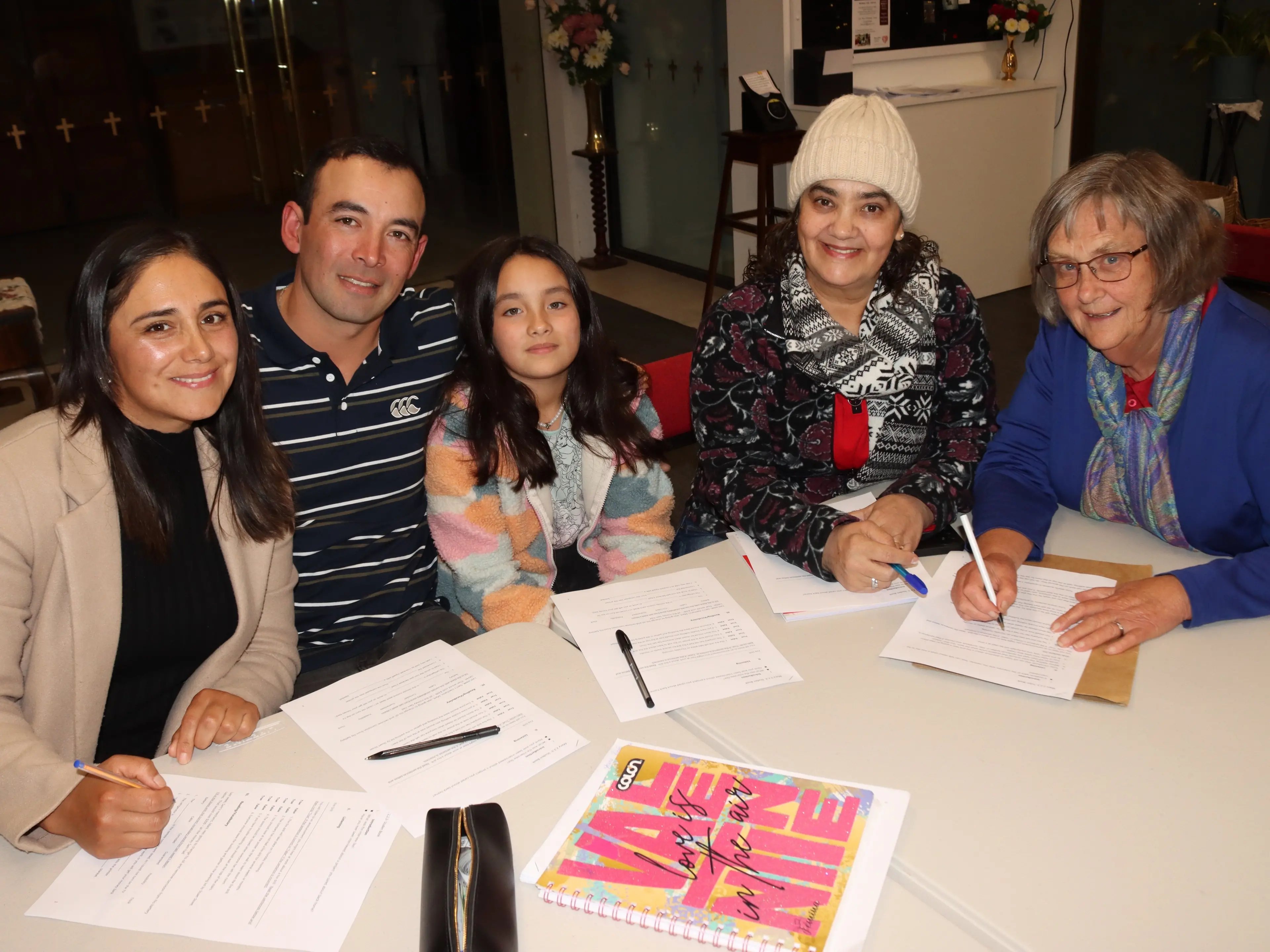
A volunteer-led English programme at South Dunedin’s Mercy Parish is helping visa holders overcome crucial language barriers.
Co-ordinated by Jess and Ross Reitz, the free, year-long initiative uses small-group tutoring to prepare migrants for residency-extending language tests.
The community project based at St Patrick's Basilica aims to help migrants pass the Pearson Test for English or IELTS General test to extend their immigration status.
Henley farm worker Christian Gutierrez arrived from Chile about 11 months ago with his partner Yoana Purran and daughter Maylen Gutierrez, 9.
The classes are ‘‘really good’’, Mr Gutierrez said.
‘‘The teacher is perfect, all people is very good.’’
His partner Yoana Purran agreed.
‘‘I feel good in this class, I feel comfortable here,’’ Ms Purran said.
Mr Gutierrez said his employer communicated in English, making the lessons vital for his daily work on the farm.
‘‘It is very important learning this.’’
Mr Gutierrez had a five-year work visa but needed to learn English so that he would be able to take the proficiency language test for permanent residency.
‘‘This is the long term project, but the first important is learning English for the test for residency.’’
Fellow student Dora Santos, of Brazil, was experiencing life in New Zealand for the second time.
She spent roughly four years living in Queenstown about 20 years ago but then returned to South America.
Her son moved to Dunedin about three years ago, and Ms Santos followed him a year later.
‘‘I met my partner here about one month after I arrived here.’’
Ms Santos was employed as a nurse in Brazil and she gained a job at Marne Street Hospital as a caregiver.
‘‘But it was very difficult because I don’t have good English.’’
Her employer helped her transition to cleaning and laundry duties at the hospital.
As her comprehension has developed she has begun working shifts in the kitchen.
Her reading skills were improving, but speaking was more of a challenge.
‘‘I still don’t have a good English.
‘‘I understand more, I listen more and I speak a little bit more, but sometimes my translation is very different.’’
Being able to understand the language was valuable not only for her career but also in her personal life.
Her partner spoke only four words of Portuguese.
‘‘Kiwi people are speaking in English with me, but I don’t understand.
‘‘My partner translates for me but in English.’’
The lessons were very good, helping her both in her personal and work environments, she said.
Volunteer tutor Mary Roche, a former teacher, said she used a light-hearted approach to help beginners build confidence.
Her own diverse family, which included a Cambodian son-in-law and Canadian-Chinese and German daughters-in-law, motivated her to contribute to the programme.
‘‘That sort of whetted my interest, you would say, in doing it because I realised what a difficult thing it would be for them,’’ she said.
‘‘I want everybody to also be brave enough to try to say the words.’’
Co-ordinator Jess Reitz said the weekly lessons take place on Mondays from 6.30pm to 8.30pm.
The classes are free and people can register any time of the year.
There is free parking and childcare during the lessons.
For further information email jess.reitz@yahoo.com or text or call 021 823-9545.